
Transitioning from a visual-centric role to user experience requires a strategic shift in how you present your career history. A Graphic Designer Shifting To UX Design Cover Letter is a specialized document designed to translate your aesthetic expertise into user-centered problem solving. While you already master visual hierarchy, this letter emphasizes your ability to interpret user data and conduct meaningful research. By highlighting how your previous design choices improved user engagement metrics, you prove that your transition is backed by logical evidence rather than just style. This approach bridges the gap between static art and interactive architecture. To help you articulate your journey from pixels to personas, below are some ready to use templates tailored for your career pivot.
Cover Letter Template and Sample List
Table of Content
- Transitioning Graphic Designer To UX Design
- Graphic Design Specialist Moving To UX Designer
- Senior Graphic Designer Career Pivot To UX
- Visual Communications Background To UX Design
- Print Designer Shifting To Digital UX Design
- Graphic Design To Junior UX Designer Role
- Freelance Graphic Designer Transitioning To UX
- Branding Designer To User Experience Designer
- Creative Graphic Designer To UX Product Designer
- Graphic Design Portfolio Pivot To UX Design
- Professional Graphic Designer Transition To UX
- Mid Level Graphic Designer Moving To UX
- Digital Designer Shifting From Graphic To UX
- Traditional Graphic Designer To Modern UX Design
- Graphic Designer Expertise Applied To UX Design
Transitioning Graphic Designer To UX Design Cover Letter Template
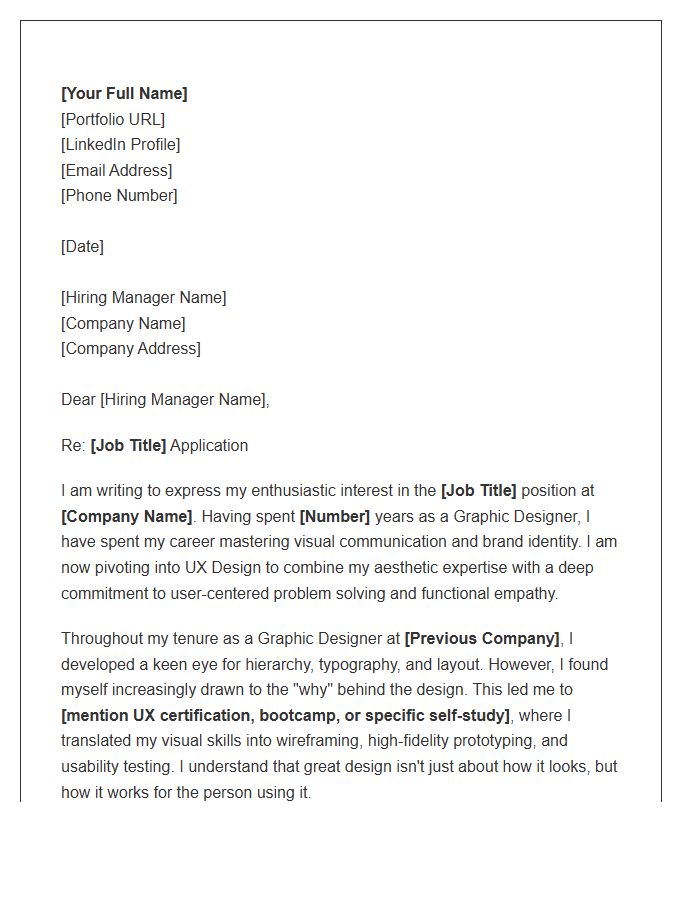
Transitioning from a graphic background to UX Design requires a strategic shift from pure aesthetics to User-Centered Design. This template works by emphasizing your existing mastery of visual hierarchy and typography-skills that account for roughly 90% of a high-quality UI-while explicitly highlighting your new proficiency in UX Research and Wireframing. Instead of hiding your past, this cover letter uses it as a foundation for functional empathy, which is the ability to understand a user's emotional and practical journey through a digital product. It effectively bridges the gap between creating "pretty" layouts and developing data-driven Iterative Designs that solve real business problems. By focusing on Cross-functional Collaboration, you prove to hiring managers that you already understand how to handle professional feedback and stakeholder requirements. Note: Always link your portfolio early, as recruiters often spend less than 10 seconds deciding if your visual style aligns with their product's design system.
Graphic Design Specialist Moving To UX Designer Cover Letter Template
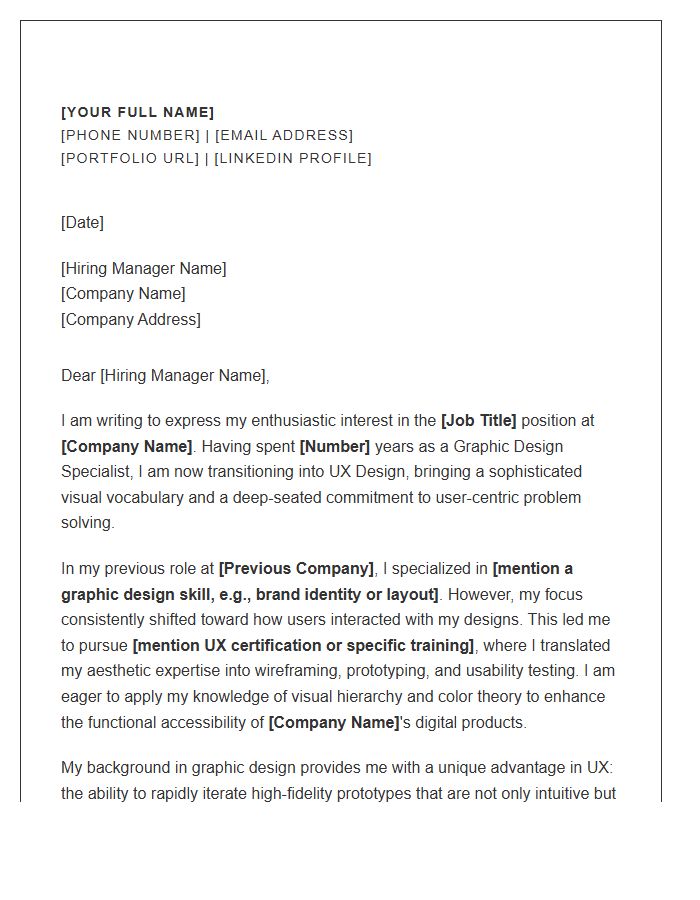
Transitioning from a graphic background to a UX Designer role requires a strategic narrative. This template works by framing your visual hierarchy skills-the arrangement of elements to imply importance-as a foundation for Information Architecture. Instead of just listing tools, it highlights data-driven results, such as how your layouts improved user flow. It bridges the gap between aesthetics and User-Centric Design, ensuring hiring managers see your High-Fidelity Prototypes as functional solutions rather than just "pretty pictures." By using this structure, you demonstrate Iterative Design, proving you can refine work based on feedback and Usability Testing. This approach is effective because it treats your career change as a professional evolution rather than a total restart, making your Graphic Design history a competitive asset. Wireframing and branding knowledge are presented as integrated strengths that speed up the development lifecycle. Note: Always link your portfolio early, as UX recruiters prioritize seeing your User Journey case studies over text-heavy descriptions.
Senior Graphic Designer Career Pivot To UX Cover Letter Template
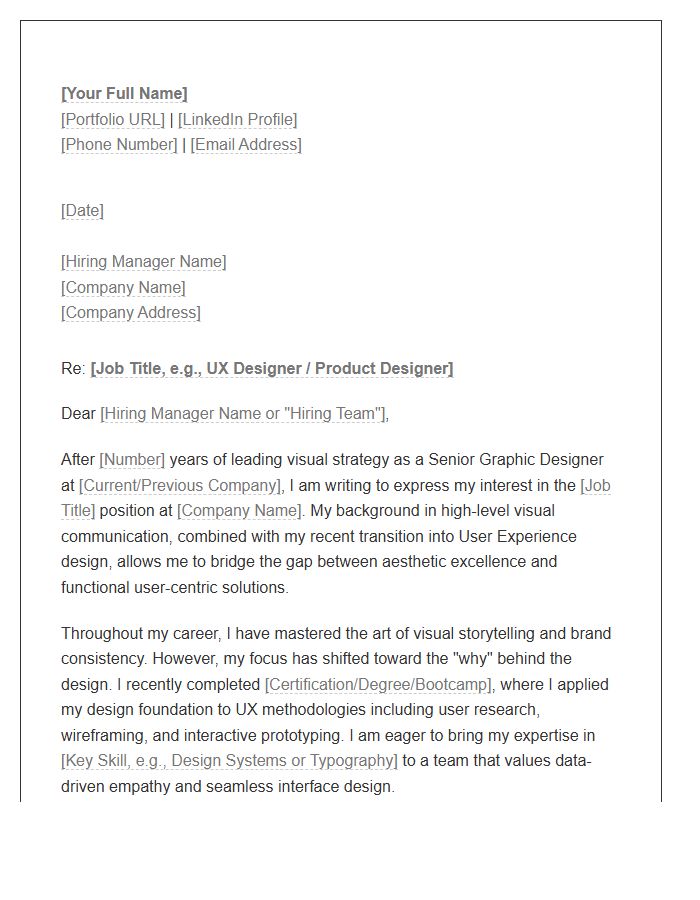
Transitioning from a senior creative role requires a Strategic Career Pivot that reframes your existing expertise. This template works because it emphasizes Transferable Skills, showing hiring managers that your years of visual mastery aren't lost, but evolved. By focusing on the shift from "how it looks" to "how it works," you demonstrate a high UX Maturity-the ability to balance business goals with user needs. The structure highlights key data, such as your years of experience and specific KPIs (Key Performance Indicators) from past redesigns, proving you can deliver measurable impact. This approach bridges the gap between Interface Design (UI) and deep User Research methodologies. It shifts the narrative from being a "new" designer to being a "senior" professional with a fresh, specialized lens. Note: Always link your portfolio early, as recruiters spend an average of only six seconds scanning your initial profile for visual proof of your claims.
Visual Communications Background To UX Design Cover Letter Template
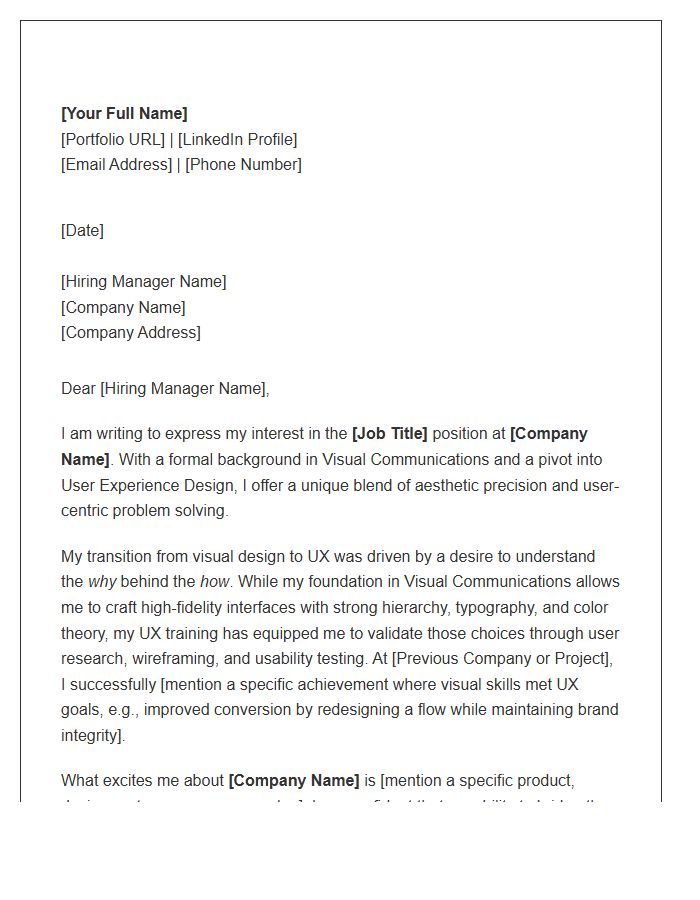
Transitioning from a creative arts role to tech requires a strategy that bridges the gap between aesthetics and functionality. This Visual Communications Background to UX Design Cover Letter Template works because it frames your artistic expertise as a functional asset. Instead of just "making things look good," this template uses semantic storytelling to prove how visual hierarchy and typography directly influence user behavior. It focuses on the pivot-the moment your design intent met data-driven decision-making. By highlighting technical terms like Information Architecture (the structural design of shared information environments) and Usability Testing (evaluating a product by testing it with representative users), you demonstrate professional maturity. Data shows that hiring managers value designers who can articulate the "why" behind their visual choices. Use this layout to showcase your ability to transform complex brand identities into intuitive digital interfaces. Note: Always link your portfolio early, as your visual evidence is the strongest proof of your UX claims.
Print Designer Shifting To Digital UX Design Cover Letter Template
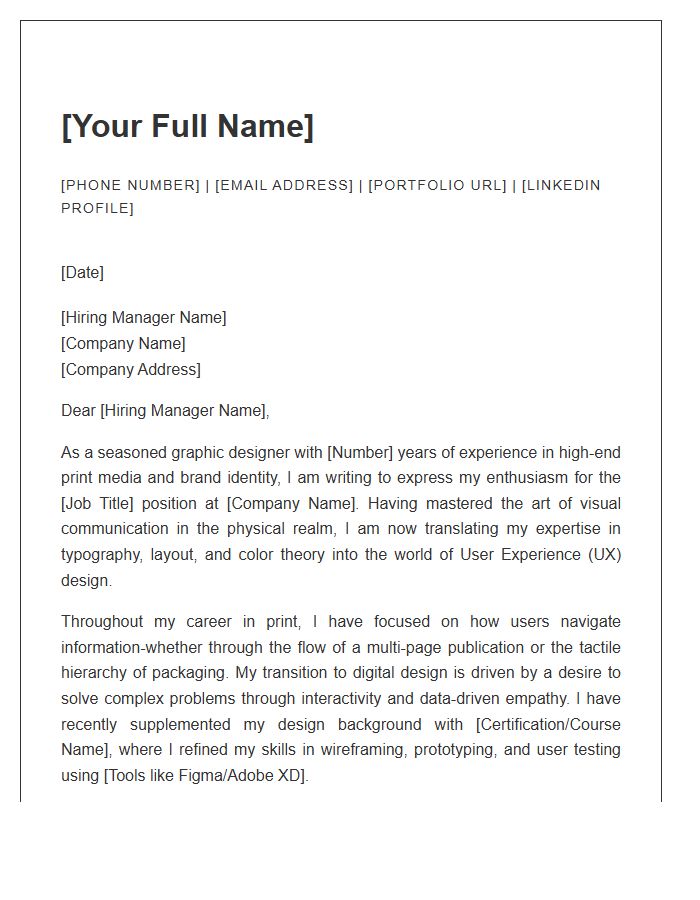
Transitioning from print to digital requires a strategic narrative, and this UX Design Cover Letter Template is built to bridge that gap. It works by reframing your tactile expertise-like visual hierarchy and typography-into digital-first terminology. Instead of just listing software, it highlights user-centricity, showing how you translate static layouts into interactive wireframes and prototypes. Data shows that hiring managers value "T-shaped" designers who possess deep foundational skills alongside new technical proficiency. This template emphasizes your transferable skills, ensuring your years of experience aren't seen as "old school" but as a solid foundation for User Interface (UI) precision and Information Architecture. By using this structure, you demonstrate data-driven empathy, proving you understand how users navigate digital spaces just as they do physical media. Note: Always link your portfolio early, as recruiters spend an average of only six seconds scanning your initial profile layout.
Graphic Design To Junior UX Designer Role Cover Letter Template
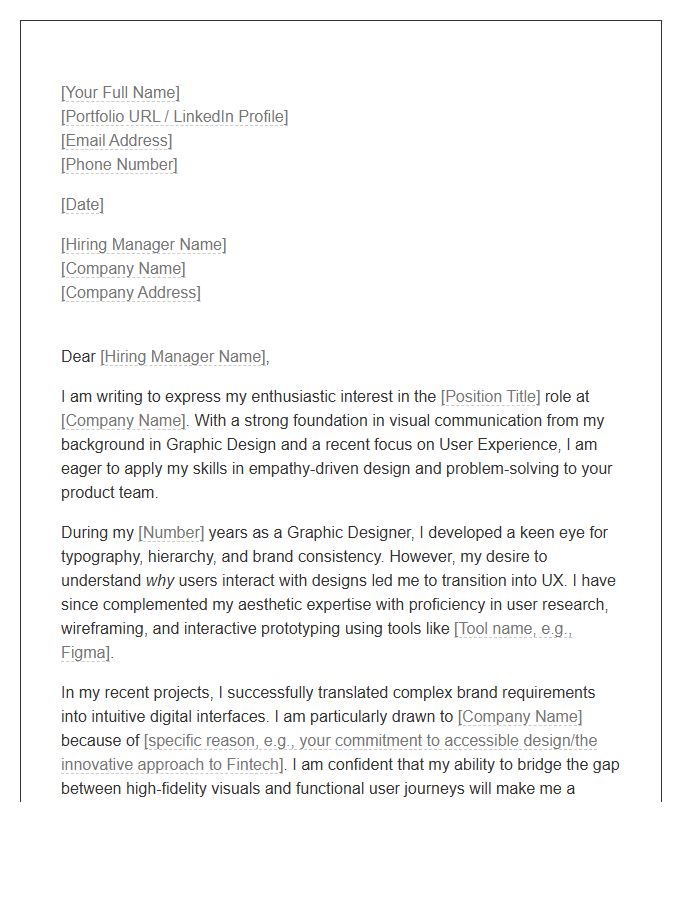
This Graphic Design to Junior UX Designer Cover Letter Template is specifically designed to help visual creatives pivot their careers by highlighting transferable skills. Transitioning into UX isn't just about a new title; it's about shifting from aesthetics to User-Centricity. This template works because it validates your professional history while proving you have mastered UX fundamentals like wireframing (creating skeletal blueprints of a website) and high-fidelity prototyping (making interactive, realistic digital simulations). By using this structure, you bridge the gap between "making things look good" and "making things work well." Data shows that hiring managers value designers who understand brand hierarchy but can also conduct user research to solve pain points. It focuses on the ROI (Return on Investment) of your dual-expertise, making you a versatile asset. Note to remember: Always customize the "specific reason" section to show you have researched the company's unique product challenges.
Freelance Graphic Designer Transitioning To UX Cover Letter Template
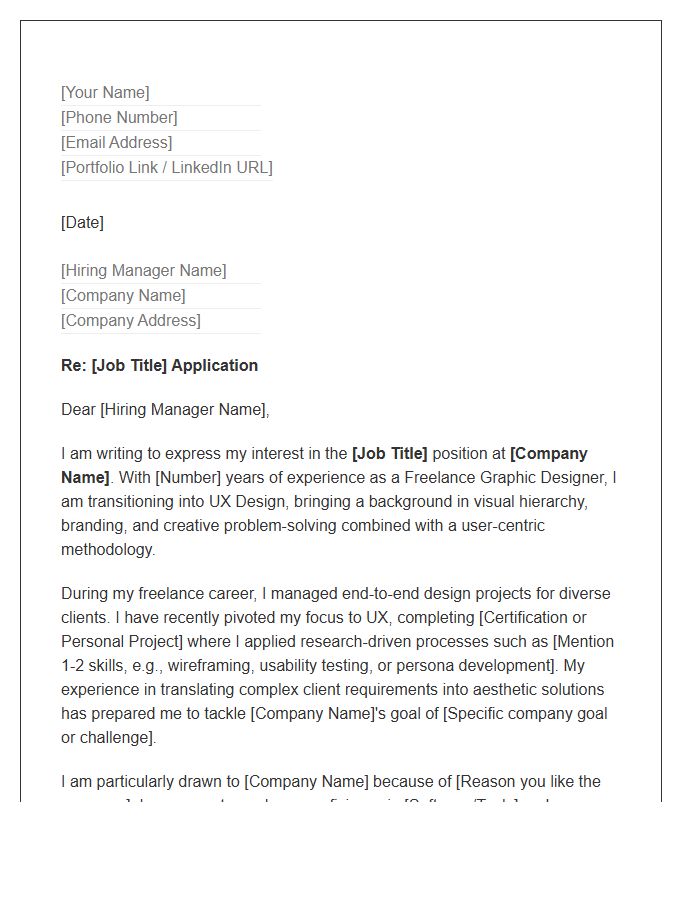
Transitioning from a creative freelance role to a structured tech environment requires a Strategic UX Cover Letter. This template works by reframing your artistic background into a User-Centric narrative, proving that your visual skills translate directly into solving complex digital problems. Instead of just listing software, it highlights your Transferable Skills-like turning client feedback into functional designs. Statistics show that recruiters spend less than 10 seconds scanning documents, so this layout uses a clear hierarchy to emphasize your User Research capabilities and Wireframing proficiency immediately. Key terms include Information Architecture (the structural design of shared information environments) and Usability Testing (evaluating a product by testing it with representative users). By bridging the gap between aesthetics and functionality, you demonstrate that your design decisions are backed by data, not just intuition. Note: Always link your portfolio to prove your transition is supported by a solid Case Study rather than just concepts.
Branding Designer To User Experience Designer Cover Letter Template
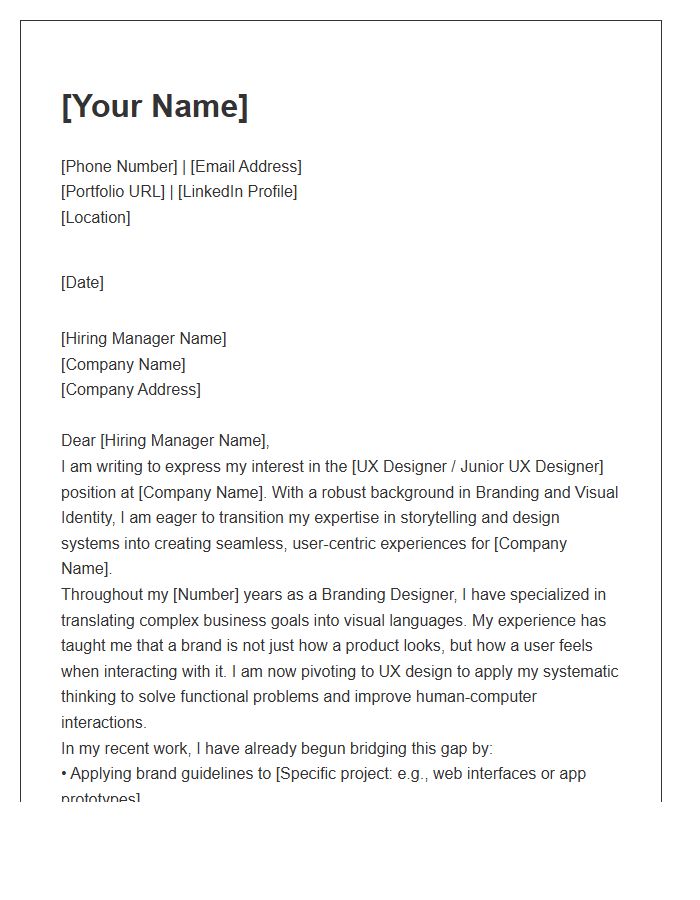
Transitioning from Branding Design to User Experience (UX) Design requires a strategic narrative that bridges visual storytelling with functional problem-solving. This template works by framing your existing expertise in design systems-the collection of rules and components that ensure brand consistency-as a foundation for Information Architecture, which organizes content for usability. Data shows that 70% of UX success relies on empathy and systematic thinking, both of which are core to branding. By highlighting your proficiency in User Flows and Wireframes, you demonstrate that you can translate aesthetic vision into interactive logic. This approach shifts the focus from how a product looks to how it functions, making your pivot feel like a natural evolution rather than a career reset. Note: Always include a link to a Case Study that specifically showcases your research process, as recruiters prioritize your "why" over your "how."
Creative Graphic Designer To UX Product Designer Cover Letter Template
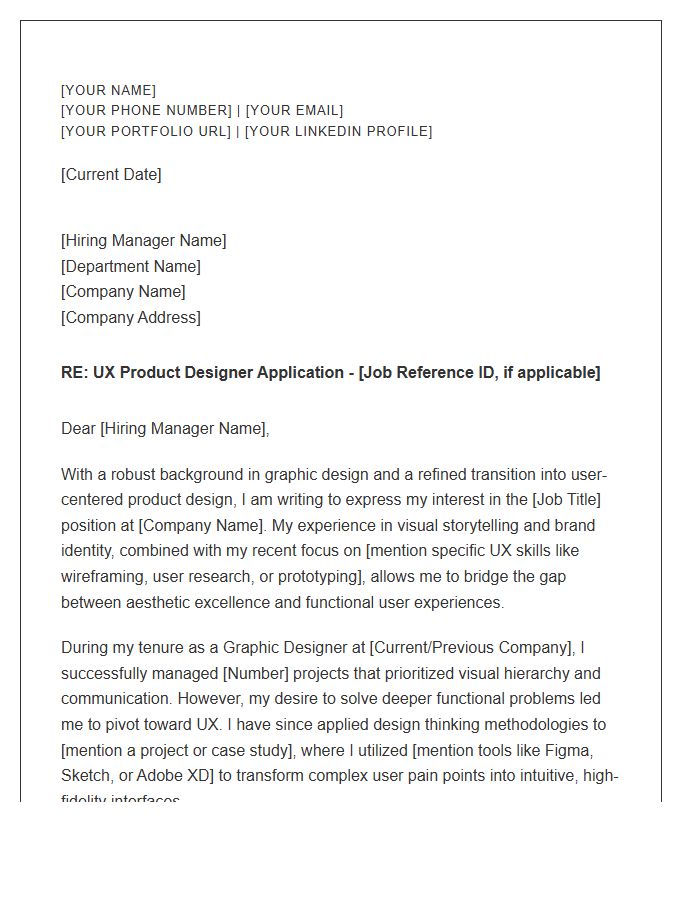
Transitioning from a creative background to a technical role requires a strategic narrative. This UX Product Designer Cover Letter Template is designed to help graphic designers pivot by framing their aesthetic skills as functional assets. Instead of focusing solely on visuals, this template emphasizes design thinking-a problem-solving methodology that prioritizes the user's needs over mere decoration. It works because it bridges the gap between "making things look good" and "making things work well." By highlighting your proficiency in high-fidelity interfaces (detailed, interactive prototypes) and user research, you provide the data-backed evidence hiring managers crave. Data shows that 70% of hiring managers look for candidates who can articulate the "why" behind their design choices. This layout ensures you translate your visual hierarchy expertise into product-driven results, making your career shift look like a natural evolution. Note: Always link your portfolio early, as UX recruiters often spend less than 60 seconds scanning your initial application materials.
Graphic Design Portfolio Pivot To UX Design Cover Letter Template
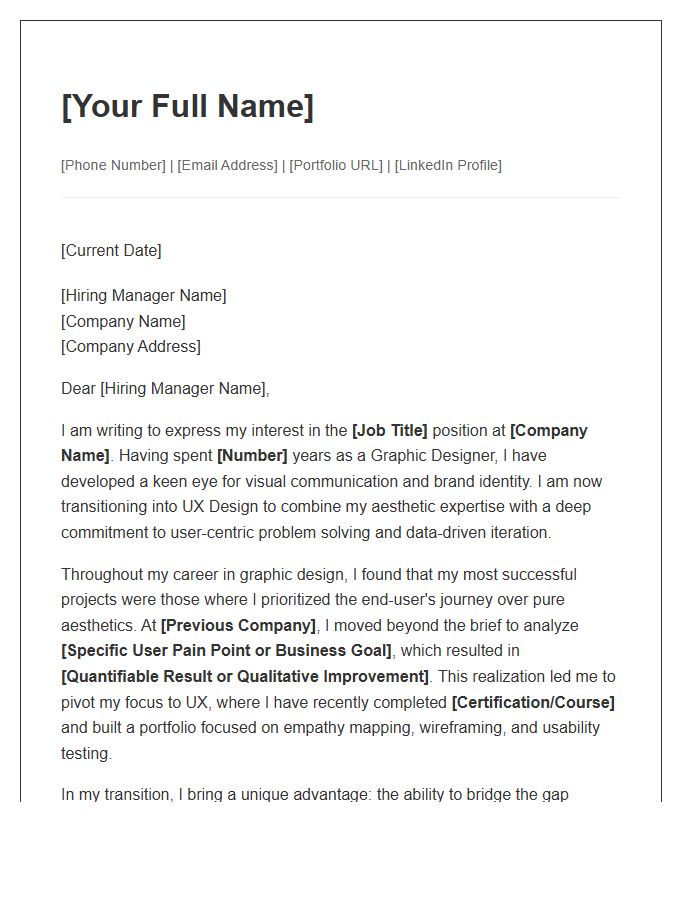
If you are transitioning from visual arts to digital interfaces, this Graphic Design Portfolio Pivot to UX Design template is your bridge. It works by reframing your existing visual communication skills as a foundation for user-centric problem solving. Instead of just listing software, it emphasizes your ability to handle data-driven iteration, turning abstract colors and layouts into functional user journeys. This template is semantically designed to highlight your transferable skills-the "why" behind your design choices-which is exactly what recruiters look for in a UX Pivot. By using this structure, you explain how your eye for detail translates into usability testing and wireframing, ensuring your past experience feels like an asset rather than a distraction. This approach helps bridge the gap for hiring managers who need to see both high-fidelity polish and deep empathy mapping. Note: Always quantify your impact by mentioning how your design decisions improved specific conversion rates or user engagement metrics.
Professional Graphic Designer Transition To UX Cover Letter Template
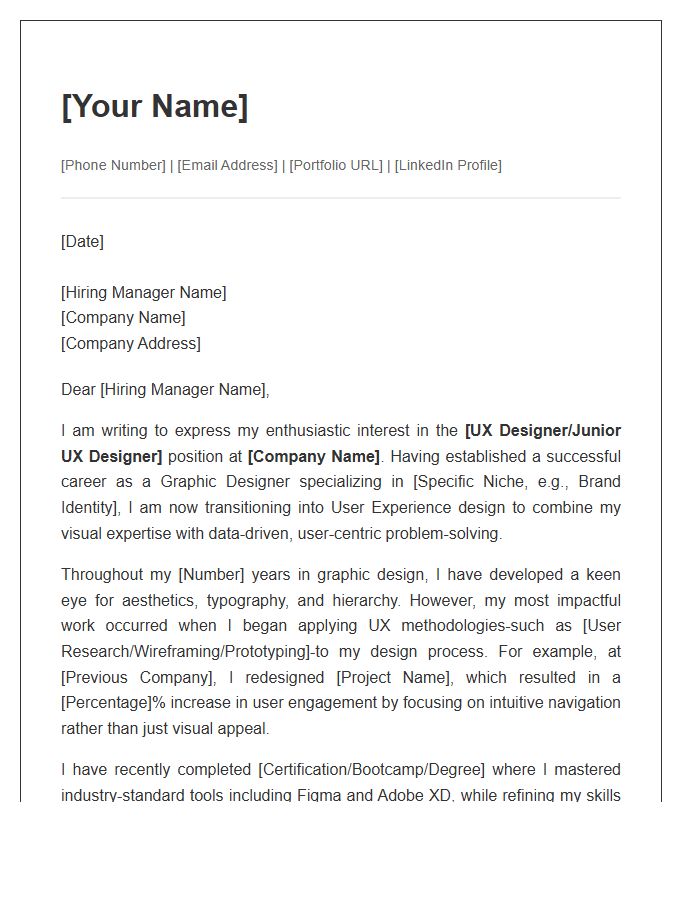
Transitioning from graphic design to UX Design requires shifting the narrative from aesthetics to user-centric problem solving. This template works because it bridges the gap between visual craft and functional logic, showing recruiters that your eye for detail now serves Information Architecture-the structural design of shared information environments. By highlighting data, such as a percentage increase in engagement, you prove that your creative choices drive measurable business results. The layout focuses on transferable skills like Wireframing (creating low-fidelity structural sketches) and usability testing to demonstrate technical readiness. It reframes your past experience not as "just art," but as a foundation for User Journeys, ensuring the hiring manager sees you as a hybrid professional who understands how beauty and utility coexist. This strategic approach helps you bypass the "no experience" hurdle by leveraging your existing design authority. Note: Always link your portfolio early, as UX managers prioritize your case studies over your list of previous graphic design clients.
Mid Level Graphic Designer Moving To UX Cover Letter Template
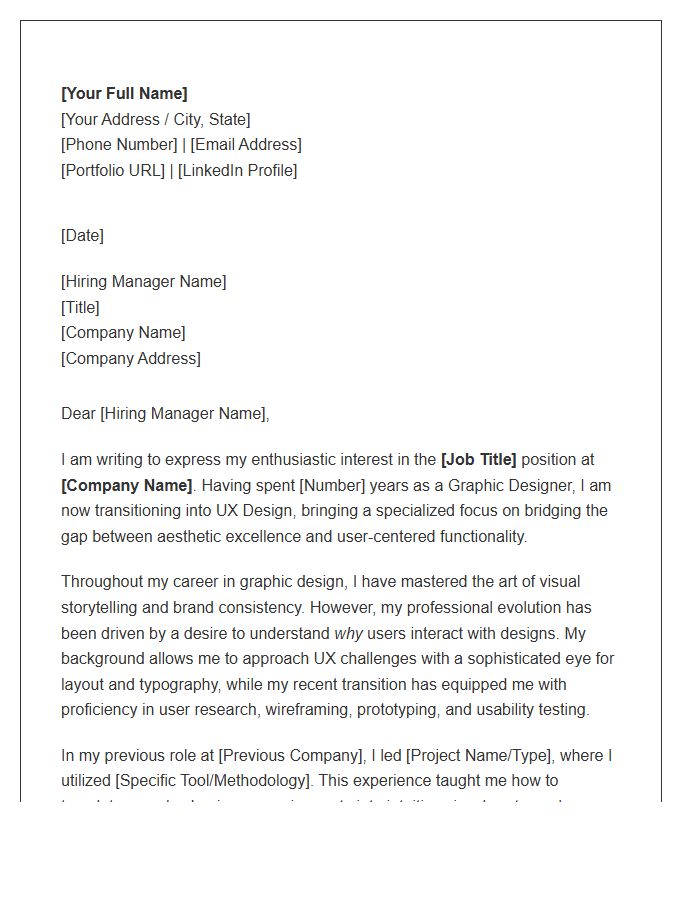
Transitioning from a mid-level graphic design role to UX Design requires a strategic shift in how you present your expertise. This template works because it emphasizes transferable skills-moving the focus from purely aesthetic output to User-Centered Design (UCD), which is the practice of designing products based on specific user needs and constraints. By using this structure, you highlight your mastery of visual hierarchy while proving your proficiency in technical UX methodologies like wireframing (low-fidelity blueprints) and usability testing (evaluating a product with real users). Data shows that hiring managers value candidates who can bridge the gap between "how it looks" and "how it works." This document acts as a bridge portfolio piece, showcasing your ability to translate complex business requirements into intuitive digital systems. It reframes your years of experience as a foundation for solving functional problems, not just creating art. Note: Always quantify your graphic design achievements with data to prove you understand the business impact of your creative decisions.
Digital Designer Shifting From Graphic To UX Cover Letter Template
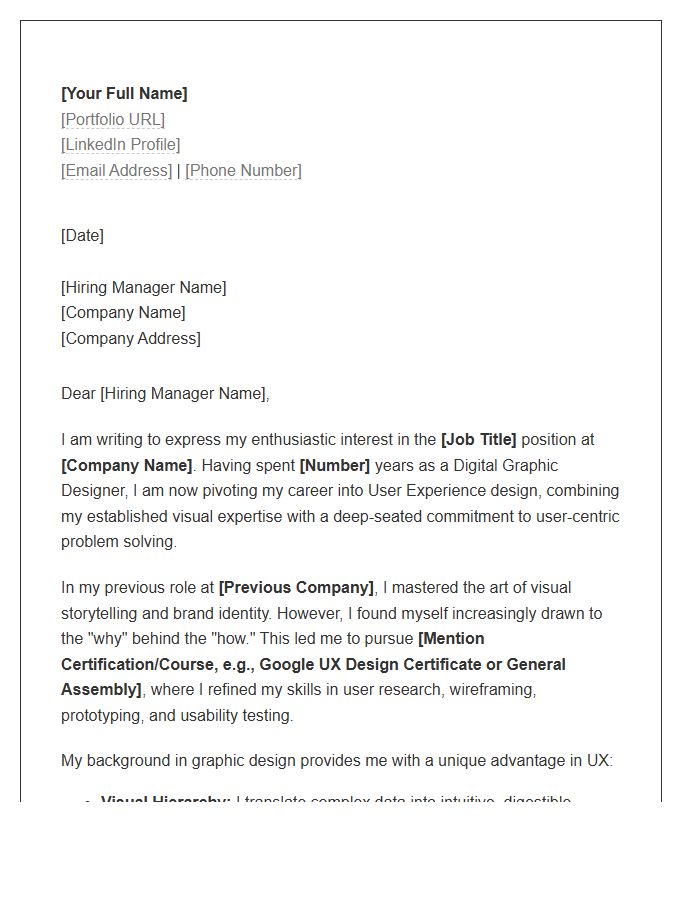
This UX Career Pivot template is designed specifically for digital designers transitioning from visual roles. It works by framing your Transferable Skills-like visual hierarchy and design systems-as high-value assets rather than starting from zero. Data shows that 85% of hiring managers value diverse creative backgrounds if the candidate can demonstrate a mastery of User-Centric Design. By using this layout, you shift the narrative from "learning UX" to "applying seasoned design logic to human problems." The structure highlights your Iterative Process, bridging the gap between aesthetics and functionality. It addresses the Product Development Life Cycle, ensuring you speak the language of engineering and product teams. This template helps you stand out in a competitive market by proving your ability to balance business goals with seamless usability. Note: Always link your portfolio early, as recruiters spend an average of six seconds scanning your credentials before looking at your work samples.
Traditional Graphic Designer To Modern UX Design Cover Letter Template
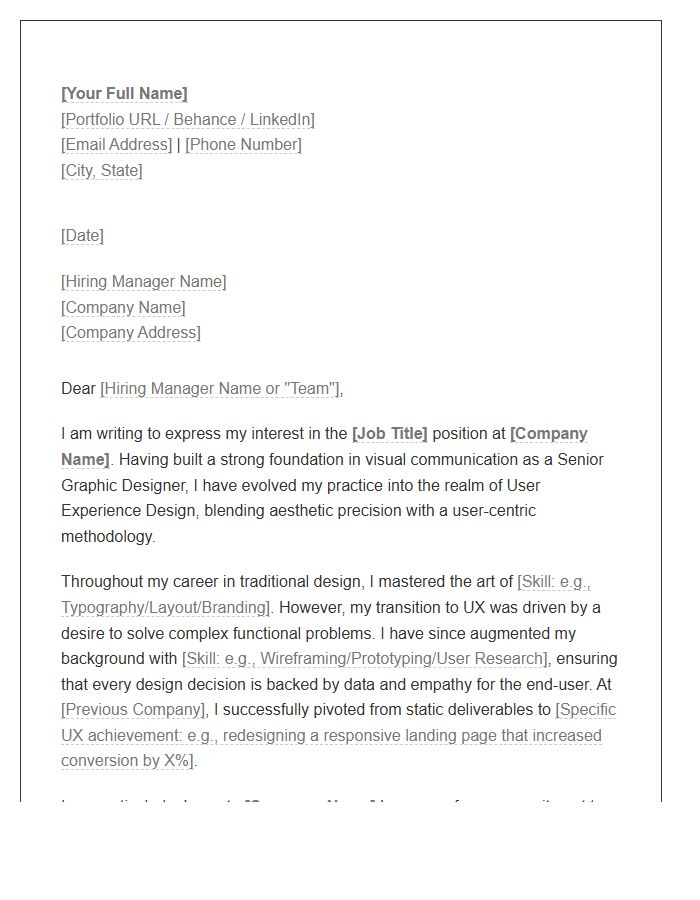
Transitioning from traditional graphic design to UX Design requires a strategic shift in how you present your skills. This template works by emphasizing transferable skills-like visual hierarchy and typography-while pivoting towards a user-centric methodology. Instead of focusing solely on aesthetics, this layout encourages you to highlight data-driven results, such as increasing conversion rates by specific percentages. It bridges the gap between static art and functional problem-solving. Key terms to include are Wireframing (creating a skeletal framework of a website), User Research (gathering insights from real users), and Prototyping (building interactive models). By using this structure, you demonstrate that you aren't just making things look good; you are designing for utility and engagement. This approach proves to hiring managers that your foundation in branding strengthens your ability to build intuitive digital interfaces. Note: Always link your portfolio early to show the evolution from print or brand work to interactive case studies.
Graphic Designer Expertise Applied To UX Design Cover Letter Template
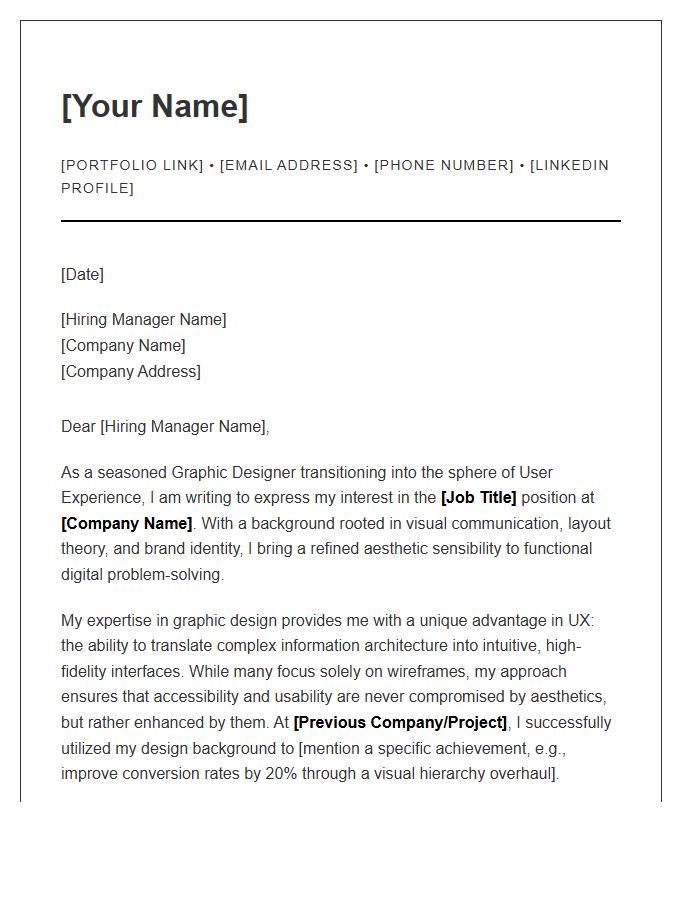
Transitioning from graphic design to UX requires showing how visual skills solve digital problems. This Graphic Designer Expertise Applied To UX Design Cover Letter Template works by framing your visual communication skills as a foundation for usability. It helps you articulate how your eye for hierarchy-the arrangement of elements to imply importance-and High-Fidelity designs-detailed, realistic prototypes-directly impact the user journey. By focusing on data, such as a 20% increase in engagement, you prove that your aesthetics serve a functional purpose. This template bridges the gap between art and Information Architecture, which is the structural design of shared information environments. It signals to hiring managers that you understand how to balance brand identity with User-Centered Design. This approach transforms your background from a change in career into a powerful, multidisciplinary advantage for any product team. Note: Always quantify your design decisions with metrics to show your work drives business results.
Strategic Alignment of Visual Hierarchy and User-Centricity
Transitioning from Graphic Design to User Experience (UX) design necessitates a paradigm shift from aesthetic-driven deliverables to cognitive-load optimization. The integration of Gestalt Principles into functional interfaces ensures that the visual structure supports user task completion rates rather than just brand expression.
- Heuristic Evaluation: Systematic assessment of interface usability against established UI patterns.
- Information Architecture (IA): Structural design of shared information environments to improve findability.
- Affordance & Signifiers: Leveraging visual cues to communicate functional possibilities to the end-user.
Quantifying Design Impact through UX Metrics
A data-driven cover letter must bridge the gap between creative output and business KPIs. By translating graphic design success into UX-specific performance indicators, candidates demonstrate their readiness for the analytical rigor of product design teams.
| Graphic Design Metric | UX Equivalent Metric | Business Impact (KPI) |
|---|---|---|
| Brand Consistency | Design System Adherence | Reduced Development Velocity |
| Visual Engagement | Click-Through Rate (CTR) | Conversion Optimization |
| Layout Clarity | Time on Task | Enhanced User Efficiency |
The Iterative Design Process: From Static to Dynamic
The core of a UX transition lies in mastering the iterative lifecycle. Unlike traditional print media, digital product design requires constant refinement based on Usability Testing and A/B Testing methodologies to mitigate friction in the user journey.
- Empathize: Conducting primary and secondary user research to define personas.
- Define: Synthesizing data into Problem Statements and User Stories.
- Ideate: Low-fidelity wireframing and rapid prototyping to explore solution spaces.
- Prototype: Developing high-fidelity Interactive Mockups for stakeholder review.
- Test: Validating designs through qualitative and quantitative user feedback loops.
Technical Proficiency and Cross-Functional Collaboration
Moving beyond the Adobe Creative Suite, the modern UX Designer must be fluent in industry-standard tooling that facilitates Handoff Documentation and Atomic Design methodologies. This ensures seamless communication with engineering teams and product managers.
- Prototyping Tools: Figma, Sketch, or Adobe XD for vector-based UI design and logic flow.
- Version Control: Utilizing tools like Abstract or Figma branching to manage design iterations.
- Accessibility (a11y): Compliance with WCAG 2.1 Guidelines to ensure inclusive design for diverse user abilities.
Optimized Cover Letter Structure for Career Changers
To bypass Applicant Tracking Systems (ATS), the cover letter should utilize semantic keywords that highlight Transferable Skills. The focus should remain on how graphic design expertise enhances Visual Communication within the UX framework.
| Introduction | State the specific UX role and mention the bridge between visual aesthetics and user psychology. |
| The "Why" | Focus on the shift from Output (deliverables) to Outcome (user success). |
| Evidence | Highlight a specific project where Data Synthesis led to a design pivot. |
| Closing | Reiterate commitment to Iterative Growth and cross-disciplinary collaboration. |
Note: Sometimes the .PDF file interface can be slightly different from the image preview. Our apology for this inconvenience.
Comments