
Making the leap from a culinary kitchen to a corporate facility requires a resume that speaks the language of high-volume output and Food Production Management. This transition focuses on your ability to oversee large-scale batch cooking, supply chain logistics, and rigorous safety protocols like HACCP. Instead of just plating meals, you are now managing the lifecycle of a product from the warehouse to the retailer. Employers in this sector prioritize candidates who understand cost control and labor efficiency metrics. Our guide explains how to translate your creative culinary background into a structured leadership role within a manufacturing environment. By highlighting your experience with quality assurance and inventory data, you can prove your readiness for a factory setting. Below are some ready to use cover letter templates to help you land the job.
Cover Letter Template and Sample List
Table of Content
- Executive Chef To Food Production Manager
- Head Chef Transitioning To Food Manufacturing Lead
- Culinary Arts Professional Moving To Production Management
- Senior Chef Shift To Large Scale Food Operations
- Sous Chef Advancing To Food Production Supervision
- Restaurant Chef Relocating To Industrial Food Processing
- Professional Chef Pivot To Food Quality Management
- Chef Career Change To Food Manufacturing Coordinator
- Culinary Manager Transitioning To Production Facility
- Kitchen Lead Switching To Commercial Food Production
- Experienced Chef Seeking Food Operations Management Role
- Executive Sous Chef Shift To Plant Management
- Culinary Specialist Entering Food Manufacturing Management
- Chef De Cuisine Shifting To Industrial Kitchen Oversight
Executive Chef To Food Production Manager Cover Letter Template
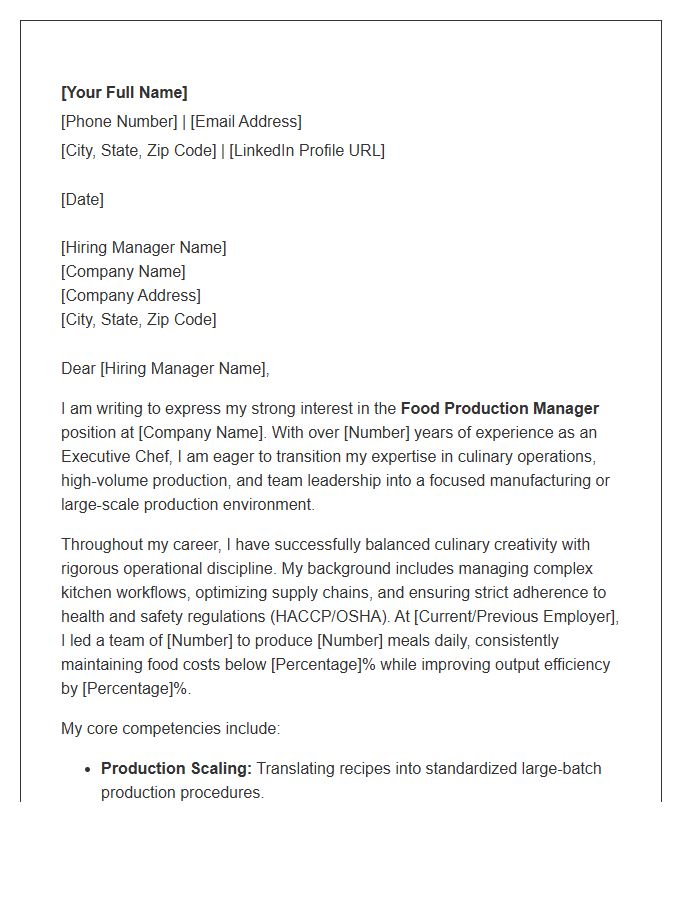
Transitioning from the kitchen to the factory floor requires a strategic shift in how you present your skills. This Executive Chef to Food Production Manager Cover Letter Template is designed to bridge that gap by emphasizing operational scalability and industrial efficiency over creative plating. It works by translating culinary leadership into technical language that plant directors value, such as HACCP (Hazard Analysis and Critical Control Points) compliance and SOP development (Standard Operating Procedures). Data shows that highlighting metrics like a 15% reduction in food waste or managing high-volume output helps recruiters see you as a systems-oriented leader. By using this template, you demonstrate that you understand Supply Chain Management and the rigors of high-output manufacturing environments. It reframes your "back-of-house" experience as professional Production Oversight. Note: Always quantify your achievements with specific percentages to prove you can handle the financial demands of large-scale food manufacturing.
Head Chef Transitioning To Food Manufacturing Lead Cover Letter Template
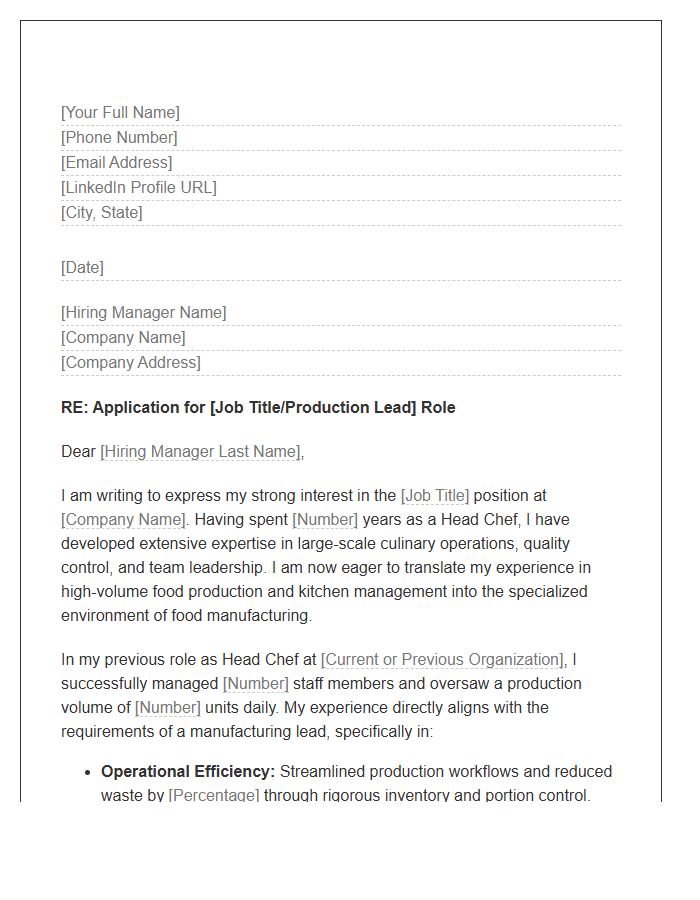
This Head Chef Transitioning to Food Manufacturing Lead template is designed to bridge the gap between culinary artistry and industrial production. It works by reframing your kitchen leadership into transferable skills like operational efficiency and Quality Assurance (maintaining high product standards). Instead of focusing on recipes, this layout emphasizes your ability to manage high-volume outputs and complex workflows. By including specific metrics, such as reducing waste by a certain percentage or managing a specific number of units, you provide the data-driven evidence manufacturing recruiters crave. Key terminology used includes HACCP (Hazard Analysis Critical Control Point), which is a systematic preventive approach to food safety, and SOPs (Standard Operating Procedures), which are step-by-step instructions for routine operations. This professional structure proves you can scale your expertise from a restaurant line to a manufacturing floor seamlessly. Note: Always quantify your achievements with specific percentages or unit counts to demonstrate your impact on production ROI.
Culinary Arts Professional Moving To Production Management Cover Letter Template
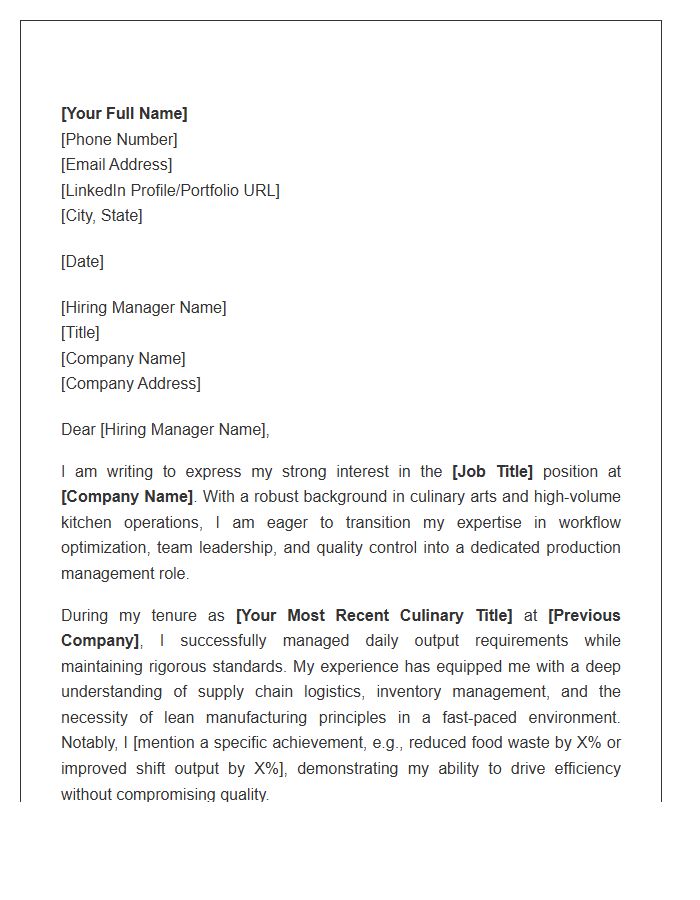
Transitioning from the kitchen to the factory floor requires a strategic narrative. This Culinary Arts Professional Moving To Production Management Cover Letter Template works by recontextualizing your kitchen experience into industrial language. Instead of talking about recipes, it highlights Workflow Optimization-the art of streamlining steps to increase speed and reduce errors. By emphasizing metrics like a 15% reduction in waste, you speak the language of Lean Manufacturing, a systematic method for minimizing waste within a manufacturing system without sacrificing productivity. This template bridges the gap between manual culinary precision and Supply Chain Logistics, ensuring hiring managers see your HACCP (Hazard Analysis and Critical Control Points) knowledge as a foundational block for safety compliance in any production setting. It shifts the focus from "cooking" to "output management," proving you can handle high-volume demands and resource allocation effectively. Note: Quantify your achievements with hard percentages or volume data to prove your operational impact immediately.
Senior Chef Shift To Large Scale Food Operations Cover Letter Template
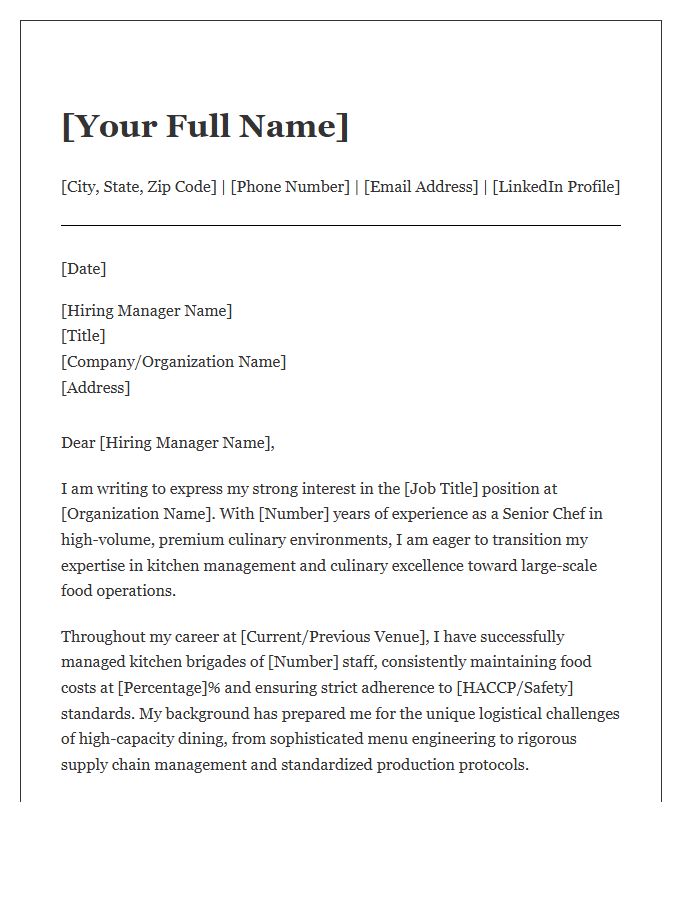
Transitioning from fine dining to industrial catering requires a strategic shift in focus. This Senior Chef Cover Letter Template is designed to bridge that gap by emphasizing operational scalability over individual plating. It works by highlighting your mastery of systems optimization-the ability to maintain high culinary standards while managing massive output. Instead of focusing solely on flavors, this template prompts you to include data regarding food costs and HACCP (Hazard Analysis and Critical Control Points) compliance, which are vital for safety in large facilities. By focusing on menu engineering (designing dishes for maximum profit and efficiency) and standardized production, you demonstrate that you can handle the logistical complexity of high-capacity feeding. This professional approach proves you are ready for the administrative and leadership rigors of volume efficiency without losing your culinary soul. Note: Always quantify your success by mentioning the specific number of daily covers or staff members you have previously managed.
Sous Chef Advancing To Food Production Supervision Cover Letter Template
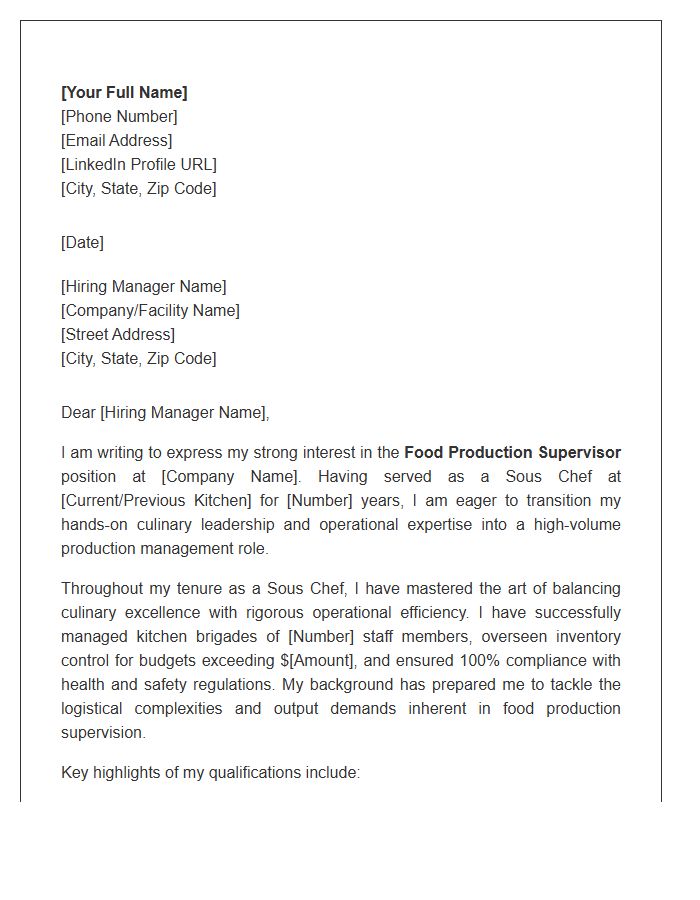
This Sous Chef Advancing to Food Production Supervision Cover Letter Template is a strategic tool designed to help culinary leaders pivot from the line to high-level oversight. It works by translating creative kitchen skills into Operational Efficiency and KPI (Key Performance Indicator) driven results. Instead of focusing only on flavors, the text highlights your ability to manage HACCP (Hazard Analysis and Critical Control Points)-a systematic preventive approach to food safety-and Scalable Systems, which refers to maintaining quality while increasing output volume. By utilizing hard data, such as waste reduction percentages and budget management, this template proves you can handle the logistical demands of a production facility. It bridges the gap between manual cooking and strategic supervision, ensuring hiring managers see your potential for Workflow Optimization. Tip: Quantify your past achievements with specific dollar amounts or staff sizes to prove you are ready for the administrative rigors of supervision.
Restaurant Chef Relocating To Industrial Food Processing Cover Letter Template
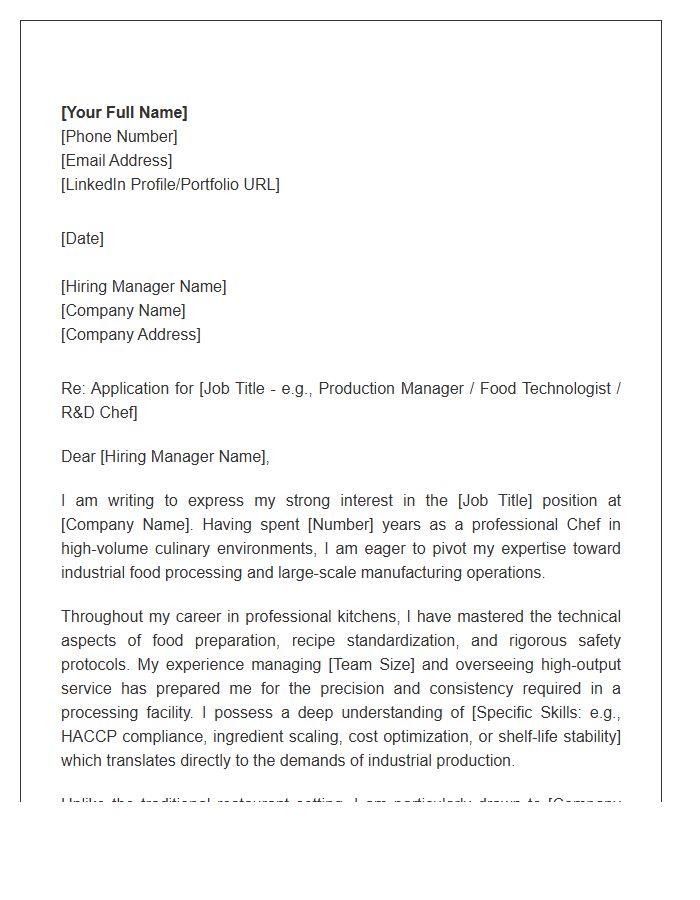
Transitioning from a restaurant kitchen to a factory floor requires a strategic career pivot. This template works by translating "chef-speak" into industrial terminology, helping recruiters see your value in high-volume settings. It emphasizes HACCP compliance (Hazard Analysis Critical Control Point), which is the gold standard for food safety, and recipe standardization, ensuring every batch tastes the same regardless of scale. By highlighting your experience with yield management-the process of reducing waste to maximize profit-you prove your business acumen. This conversational approach bridges the gap between culinary artistry and industrial food processing efficiency. The structure focuses on data-driven results, such as managing large teams or optimizing shelf-life stability, which are critical for mass production. This layout ensures your technical skills in ingredient scaling aren't lost in translation when applying for manufacturing roles. Note: Always quantify your success by mentioning the specific volume of meals or pounds of product you managed daily to demonstrate your readiness for scale.
Professional Chef Pivot To Food Quality Management Cover Letter Template
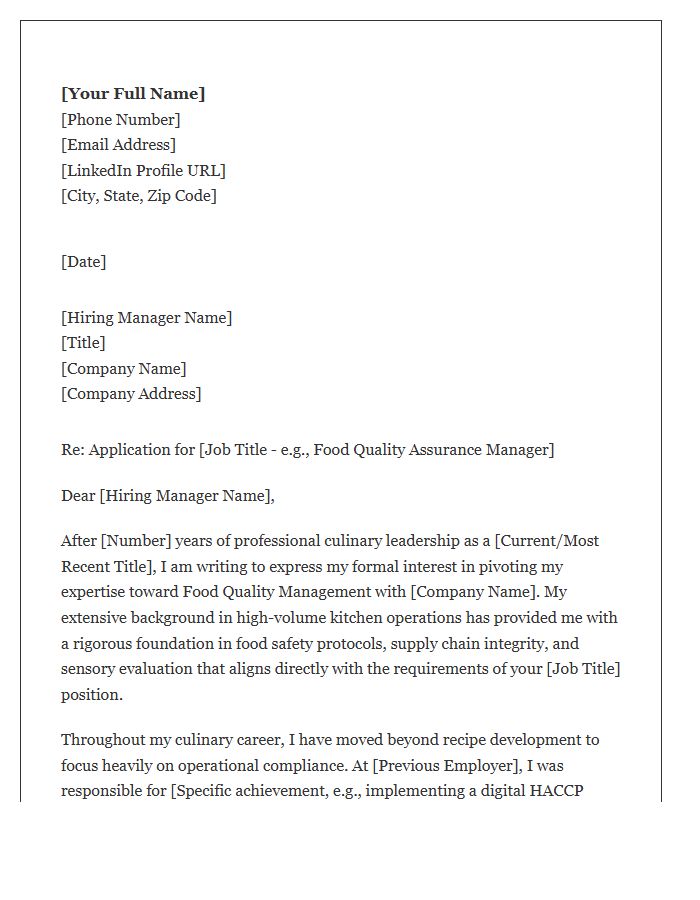
Making the leap from the kitchen line to a corporate office requires a strategy that translates culinary skills into technical assets. This Professional Chef Pivot to Food Quality Management Template works by reframing your hands-on experience as compliance-driven leadership. Instead of focusing on flavors, it highlights your mastery of HACCP (Hazard Analysis and Critical Control Points), which is the systematic preventive approach to food safety. The template bridges the gap between the "art" of cooking and the "science" of Quality Assurance (QA). By quantifying your impact-such as reducing waste or maintaining audit ratings-you prove that you understand SOPs (Standard Operating Procedures) and regulatory frameworks like GMP (Good Manufacturing Practices). This conversational yet professional layout ensures hiring managers see a technical specialist rather than just a cook. Note: Always quantify your results with percentages to show you understand the data-driven nature of quality management.
Chef Career Change To Food Manufacturing Coordinator Cover Letter Template
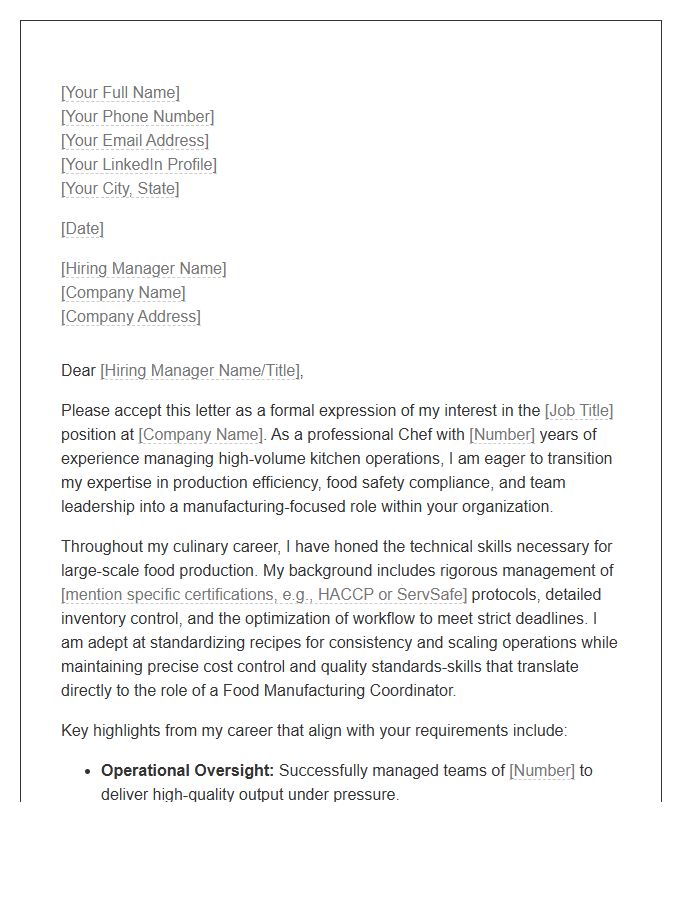
Transitioning from the kitchen to the industrial floor requires a strategic shift in how you present your skills. This Chef Career Change Cover Letter Template is designed to bridge that gap by reframing culinary experience into operational excellence. Instead of focusing on flavors, this template emphasizes your ability to manage high-volume production and Food Safety Compliance. It works by highlighting transferable data, such as reducing waste by specific percentages or managing large procurement budgets, which are critical for a Food Manufacturing Coordinator. By using terms like HACCP (Hazard Analysis and Critical Control Points)-a systematic preventive approach to food safety-and Batch Production, you demonstrate a technical understanding of Scalability and quality control. This approach proves you can handle the rigors of a factory environment using your existing leadership foundation. Note: Always quantify your achievements with data to show you understand the bottom-line metrics of manufacturing.
Culinary Manager Transitioning To Production Facility Cover Letter Template
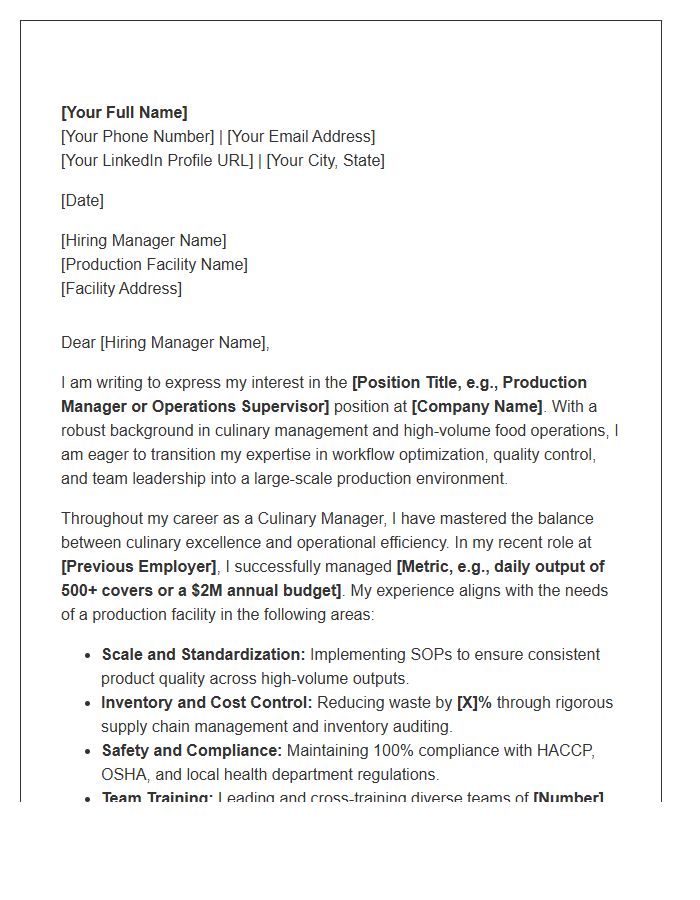
Moving from a kitchen to a industrial floor requires a strategy that mirrors operational scalability. This template works by translating your artistic culinary flair into measurable manufacturing metrics. Instead of focusing on flavors, it highlights your ability to manage high-volume output and strict SOPs (Standard Operating Procedures), which are the backbone of any production facility. The layout uses a conversational yet data-driven tone to prove you can handle the shift from individual plates to mass-market yield management. By emphasizing your mastery of HACCP (Hazard Analysis and Critical Control Points)-a technical system for food safety-and your experience reducing waste percentages, you demonstrate that you already speak the language of industrial efficiency. This approach bridges the gap between the chef's coat and the facility floor. Note: Always quantify your achievements with specific percentages or dollar amounts to show exactly how your leadership impacts the bottom line.
Kitchen Lead Switching To Commercial Food Production Cover Letter Template
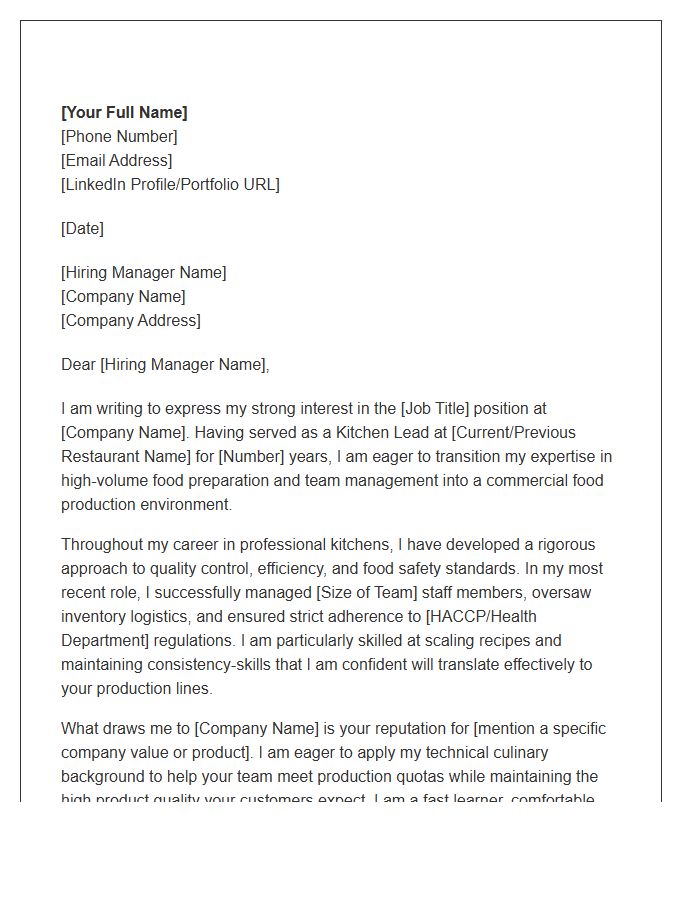
Transitioning from a restaurant kitchen to an industrial facility requires a specialized Kitchen Lead Switching To Commercial Food Production Cover Letter Template. This tool works by translating your culinary leadership into Transferable Skills, focusing on high-volume output rather than individual plates. It highlights your ability to manage a team and maintain strict quality standards, which is essential for manufacturing. The template emphasizes your familiarity with HACCP (Hazard Analysis Critical Control Point), a systematic preventive approach to food safety. By highlighting data such as team size and production quotas, you prove you can handle the Scalability required in a factory setting. This structured approach bridges the gap between artisanal cooking and Large-Scale Manufacturing, making you a prime candidate for production supervisor roles. It works because it speaks the language of efficiency and safety that industrial hiring managers prioritize. Remember to quantify your achievements by mentioning exactly how many units or pounds of product you oversaw daily.
Experienced Chef Seeking Food Operations Management Role Cover Letter Template
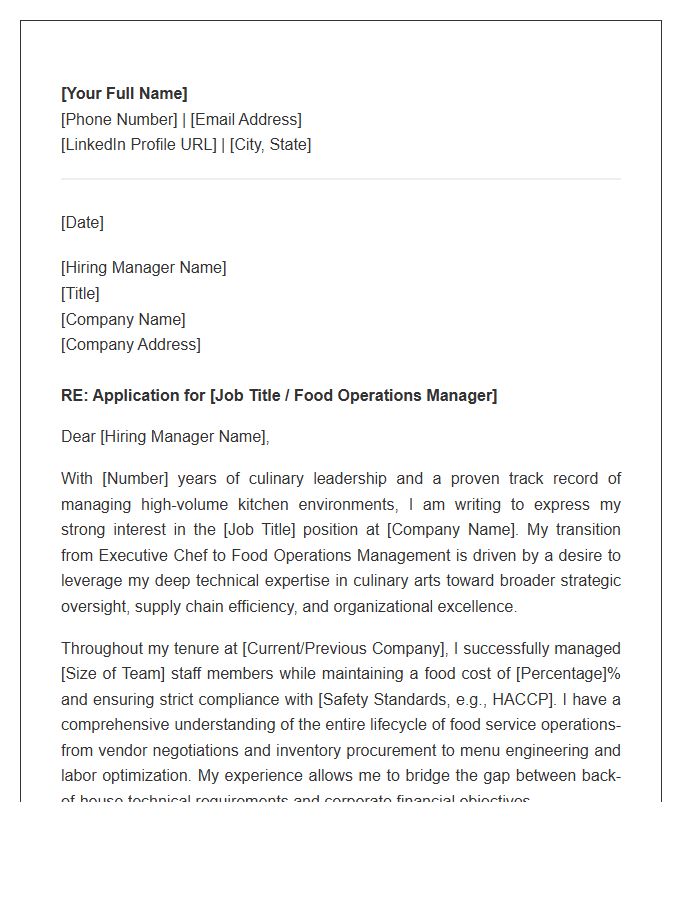
Transitioning from the kitchen to the office requires a strategic Food Operations Management cover letter. This template works because it pivots your identity from a creative cook to a data-driven leader. By highlighting metrics like Food Cost Percentage (the ratio of ingredient costs to revenue) and HACCP compliance (Hazard Analysis and Critical Control Points), you prove your ability to manage both safety and profitability. The layout emphasizes Menu Engineering-the systematic study of item popularity and pricing-to show you understand the "business" of food. It uses a professional tone to demonstrate that you can bridge the gap between back-of-house intensity and corporate Supply Chain efficiency. This approach ensures hiring managers see your Labor Optimization skills as a transferable asset for high-level oversight. Note: Always replace the bracketed placeholders with specific numbers, such as team size or budget savings, to quantify your operational impact.
Executive Sous Chef Shift To Plant Management Cover Letter Template
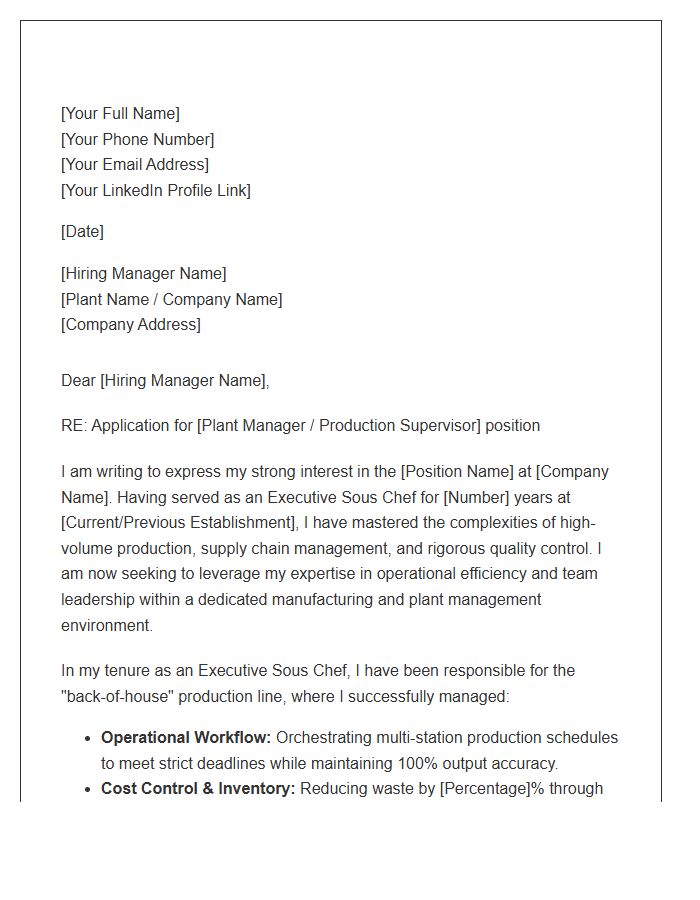
Transitioning from the kitchen to the factory floor requires a strategic narrative. This Executive Sous Chef to Plant Management Cover Letter Template works because it reframes culinary leadership as industrial Operational Excellence. Instead of focusing on recipes, this template highlights your experience managing high-volume production lines and labor costs. By using data-driven terms like Throughput (the rate at which a system generates its products) and HACCP (Hazard Analysis Critical Control Point), you prove that a kitchen is simply a high-speed manufacturing plant. This approach bridges the gap between different industries by focusing on universal metrics: safety, waste reduction, and Lean Management. Whether you are managing 20 cooks or 100 technicians, the core mechanics of workflow optimization remain the same. This template ensures hiring managers see your "back-of-house" experience as a professional manufacturing asset rather than just food service. Note: Always quantify your achievements by replacing bracketed text with specific percentages or headcount figures to demonstrate tangible impact.
Culinary Specialist Entering Food Manufacturing Management Cover Letter Template
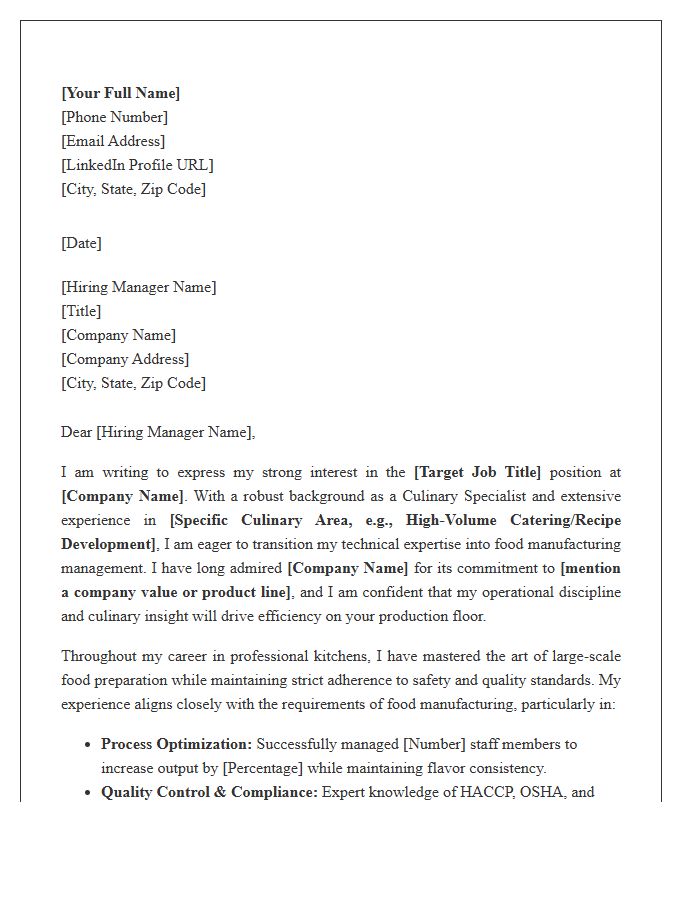
Transitioning from a kitchen to a production facility requires a shift in mindset, and this Culinary Specialist Food Manufacturing Management Cover Letter is designed to bridge that gap. This template works by translating your artistic culinary skills into measurable operational metrics that plant managers value. It highlights key data points-such as your ability to increase output by specific percentages or reduce waste-to prove you understand the bottom line. By using the "mise-en-place" philosophy (a French culinary term meaning "everything in its place"), you demonstrate a disciplined approach to Process Optimization and industrial-scale workflow. The structure focuses on HACCP (Hazard Analysis Critical Control Point) and compliance, showing you are ready for the rigorous safety standards of a factory floor. This conversational yet professional layout helps recruiters see a chef as a capable manager. Note: Always quantify your achievements with hard numbers to show you are ready for the data-driven world of manufacturing.
Chef De Cuisine Shifting To Industrial Kitchen Oversight Cover Letter Template
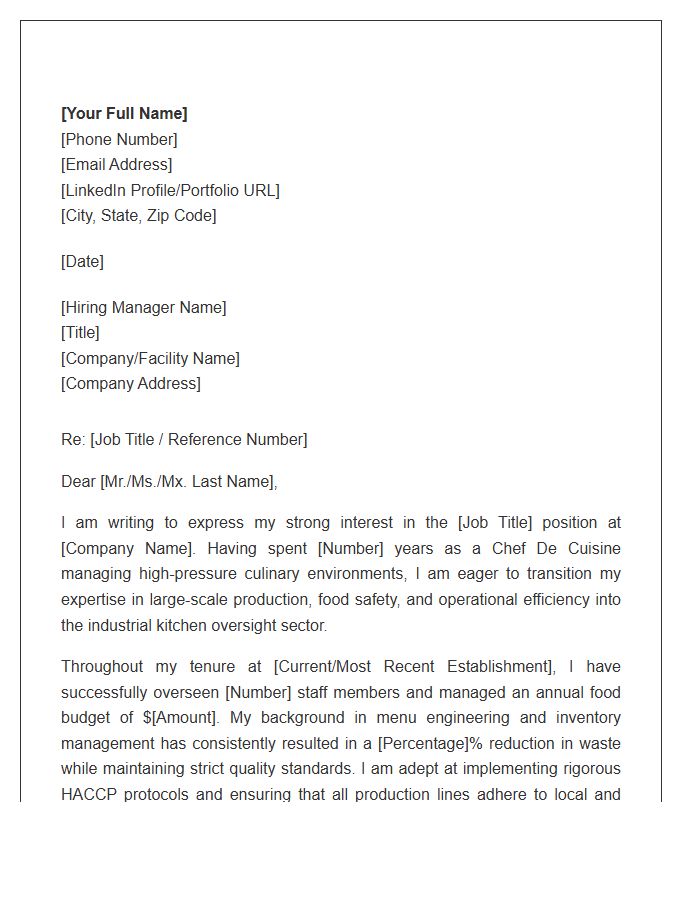
This cover letter template is designed for high-level culinary professionals transitioning into Industrial Kitchen Oversight. It works by pivoting your focus from creative plate presentation to large-scale operational efficiency and high-volume management. By highlighting specific data-such as staff count and budget size-the template demonstrates you can handle the complexity of an industrial setting. It bridges the gap between the artistry of a Chef De Cuisine and the rigorous demands of supply chain management. Key technical terms included are HACCP protocols (Hazard Analysis and Critical Control Points), which is a systematic preventive approach to food safety, and menu engineering, the data-driven study of the profitability and popularity of menu items. This structured approach proves you possess the leadership necessary to maintain quality while overseeing massive production lines and complex logistics. Note: Always emphasize your experience with batch cooking to show you understand industrial scale over individual orders.
Strategic Transition to Food Production Lifecycle Management
Transitioning from culinary execution to food production management requires a sophisticated understanding of Vertical Integration and Throughput Optimization. This cover letter template emphasizes the shift from artisanal preparation to scalable manufacturing workflows.
- Scalability Analysis: Translating recipe yields into high-volume production runs using industrial equipment.
- Quality Assurance (QA) Protocols: Implementing systemic checks beyond sensory evaluation to ensure batch consistency.
- Resource Leveling: Balancing labor distribution with machine uptime to minimize overhead.
Operational Efficiency and KPI Integration
Modern food production hinges on precise Key Performance Indicators (KPIs). The following table highlights the critical metrics a transitioning chef must manage to demonstrate competency in a production environment.
| Metric Term | Definition | Target Objective |
|---|---|---|
| OEE | Overall Equipment Effectiveness | Maximize availability and performance levels. |
| Yield Variance | Deviation between theoretical and actual output | Minimize raw material waste < 2%. |
| COGS | Cost of Goods Sold | Optimize procurement and direct labor costs. |
Regulatory Compliance and Safety Systems
While chefs are familiar with basic sanitation, production management demands rigorous adherence to GFSI (Global Food Safety Initiative) standards and systematic risk mitigation through data-driven documentation.
- HACCP Plan Oversight: Managing Critical Control Points (CCPs) via automated logging systems.
- FSMA Compliance: Ensuring adherence to the Food Safety Modernization Act requirements for preventive controls.
- Traceability Architecture: Utilizing ERP systems to manage "One Step Forward, One Step Back" recall readiness.
Supply Chain and Procurement Synchronization
Effective management requires moving beyond daily ordering to Just-In-Time (JIT) inventory strategies and Predictive Procurement to safeguard against market volatility.
- Inventory Turnover Ratio: Measuring the frequency of stock replacement to prevent capital stagnation.
- Lead Time Hedging: Mitigating delays in raw material arrival through strategic buffer stocks.
- Vendor Audit Frameworks: Quantifying supplier performance based on fulfillment accuracy and microbiological safety data.
Continuous Improvement and Lean Methodologies
Incorporating Lean Manufacturing principles is essential for a chef pivoting to management. This involves the elimination of Muda (waste) within the production line to enhance the Value Stream Map.
| Methodology | Application in Food Production |
|---|---|
| Six Sigma | Reducing process variation in portion control and packaging weights. |
| Kaizen | Incremental frontline adjustments to improve ergonomics and flow. |
| 5S System | Standardizing workspace organization to reduce motion waste. |
Note: Sometimes the .PDF file interface can be slightly different from the image preview. Our apology for this inconvenience.
Comments