
Writing a standout Academic Research Assistant Cover Letter is essential for bridging the gap between your raw data skills and a professor's project needs. This document serves as your narrative bridge, explaining how your background in statistical modeling or qualitative analysis directly supports complex investigations. Whether you are aiming for a position in STEM or the humanities, a targeted letter proves you can handle rigorous documentation and methodology. In the competitive world of academia, showing you understand the Research Lifecycle-the sequence from hypothesis to publication-sets you apart from other applicants. Mastering academic Nomenclature (specialized terminology) within your field ensures your expertise resonates with hiring committees. Explore the best practices for showcasing your scholarly impact in our guide. Below are some ready to use templates for your next application.

Cover Letter Template and Sample List
Table of Content
- Biomedical Research Assistant
- Clinical Psychology Research Assistant
- Undergraduate Academic Research Assistant
- Social Science Research Assistant
- Data Analysis Academic Research Assistant
- Laboratory Research Assistant
- History Department Research Assistant
- Environmental Science Research Assistant
- Graduate School Research Assistant
- Quantitative Academic Research Assistant
- Qualitative Sociology Research Assistant
- Humanities Research Assistant
- Medical School Research Assistant
- Public Health Research Assistant
- Remote Academic Research Assistant
Biomedical Research Assistant Cover Letter Template
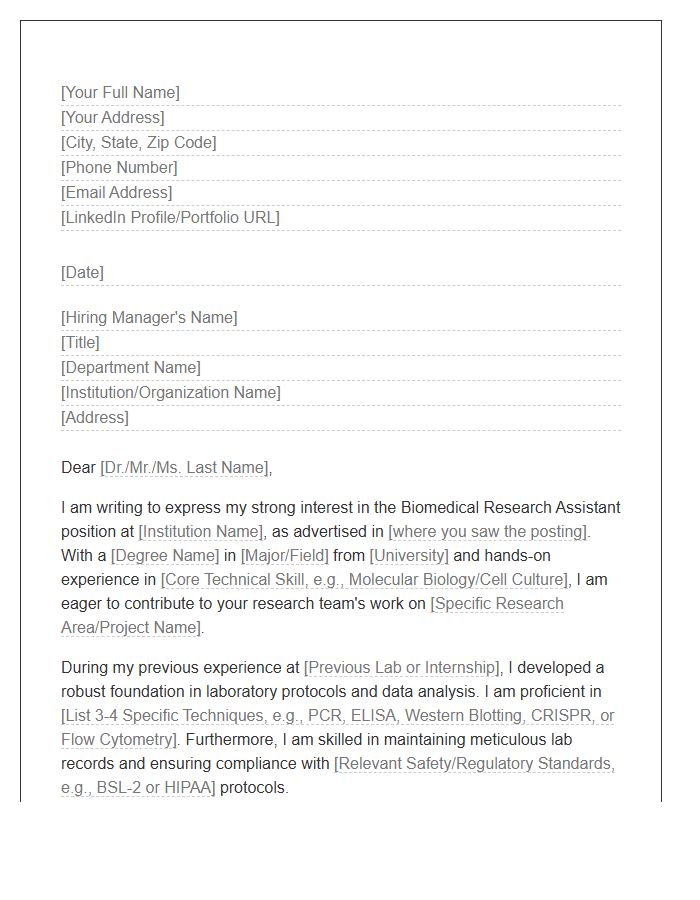
Finding the right lab role requires more than just a degree; you need a Biomedical Research Assistant Cover Letter that bridges the gap between academic theory and practical benchwork. This template works because it follows a structured flow that prioritizes your technical proficiency in specific assays and regulatory compliance. By highlighting measurable data-such as your experience with PCR, ELISA, or CRISPR-you demonstrate immediate value to a Principal Investigator. We use a conversational yet professional tone to explain "how" you manage experimental timelines and "why" your background aligns with their specific biomedical niche. In this context, benchwork refers to manual laboratory testing, while BSL-2 (Biosafety Level 2) indicates your ability to handle moderate-risk biological agents safely. This document transforms your resume from a list of courses into a narrative of scientific contribution. Note: Always customize the middle paragraph with the exact equipment or software mentioned in the job description to pass through automated screening systems.
Clinical Psychology Research Assistant Cover Letter Template
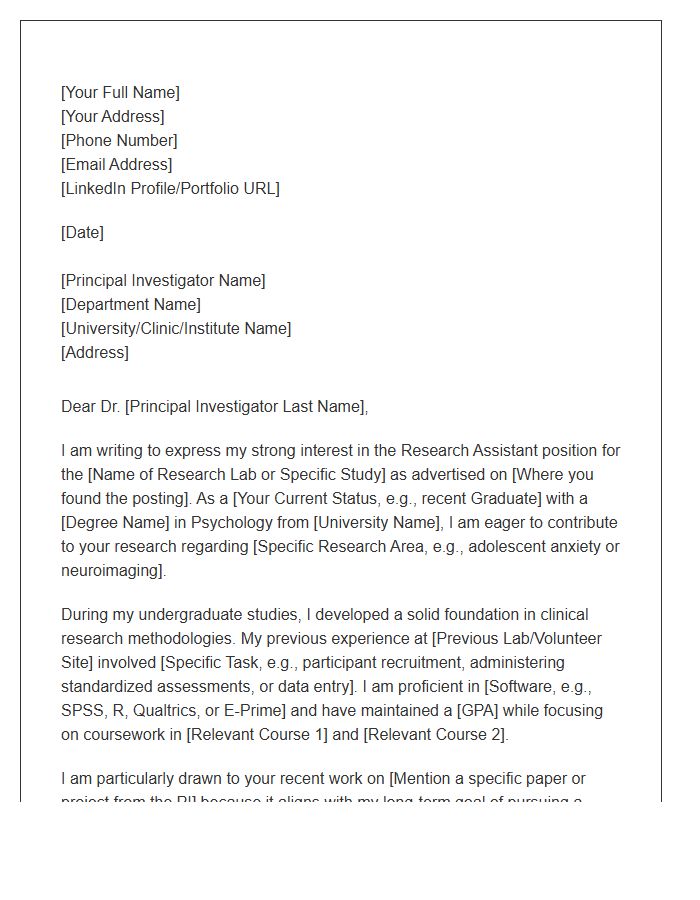
This Clinical Psychology Research Assistant Cover Letter Template is a professional framework designed to help you secure a position in a competitive laboratory. It works by bridging the gap between your academic credentials and practical data management skills. By focusing on your proficiency with software like SPSS or R, the template demonstrates your ability to handle complex quantitative analysis (the process of interpreting numerical data). It specifically targets IRB compliance-the essential ethical standards required to protect human subjects in a study. This template is effective because it shifts the focus from what you want to learn to how you can immediately contribute to a Principal Investigator's (PI) ongoing projects. Using specific keywords like "participant recruitment" and "standardized assessments" ensures your application passes through modern applicant tracking systems. Note: Always customize the section regarding the lab's recent publications to prove you have a genuine interest in their specific field of study.
Undergraduate Academic Research Assistant Cover Letter Template
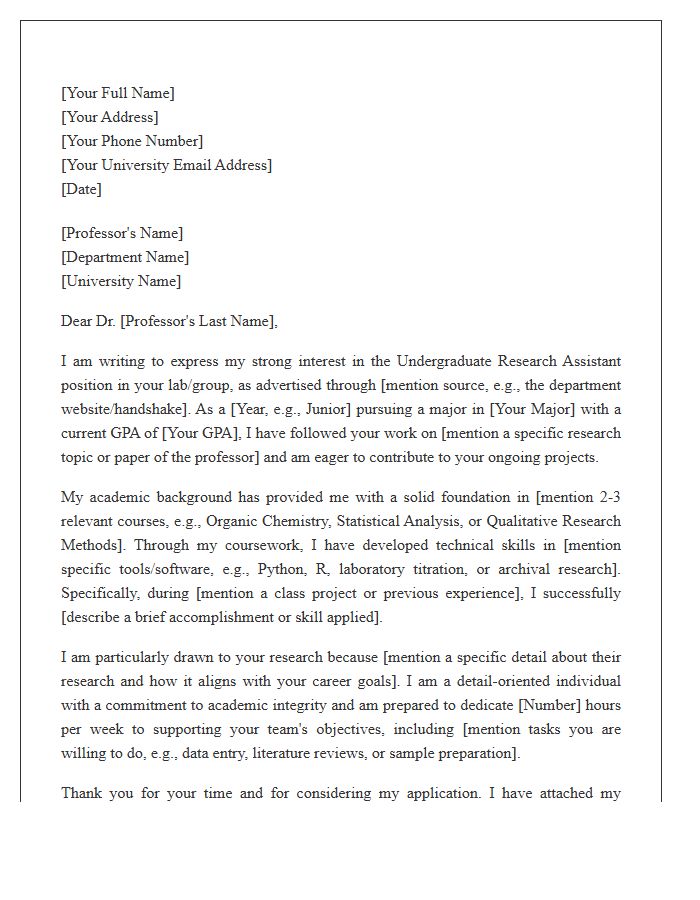
Securing a position as an Undergraduate Academic Research Assistant requires a cover letter that balances enthusiasm with technical precision. This template works by utilizing a direct-contact approach, immediately highlighting your GPA and relevant coursework to prove academic rigor. By referencing a professor's specific publications, the template demonstrates that you aren't just looking for any job, but are genuinely invested in their specific niche. It bridges the gap between classroom theory and practical methodology, such as quantitative analysis (using numbers to find patterns) or literature reviews (summarizing existing research). This structure is effective because Principal Investigators (PIs) value students who possess a high technical literacy and can commit to specific weekly hours. This data-driven personalization increases your conversion rate from applicant to interviewee. Note: Always mention a specific paper the professor wrote to show you have done your due diligence.
Social Science Research Assistant Cover Letter Template
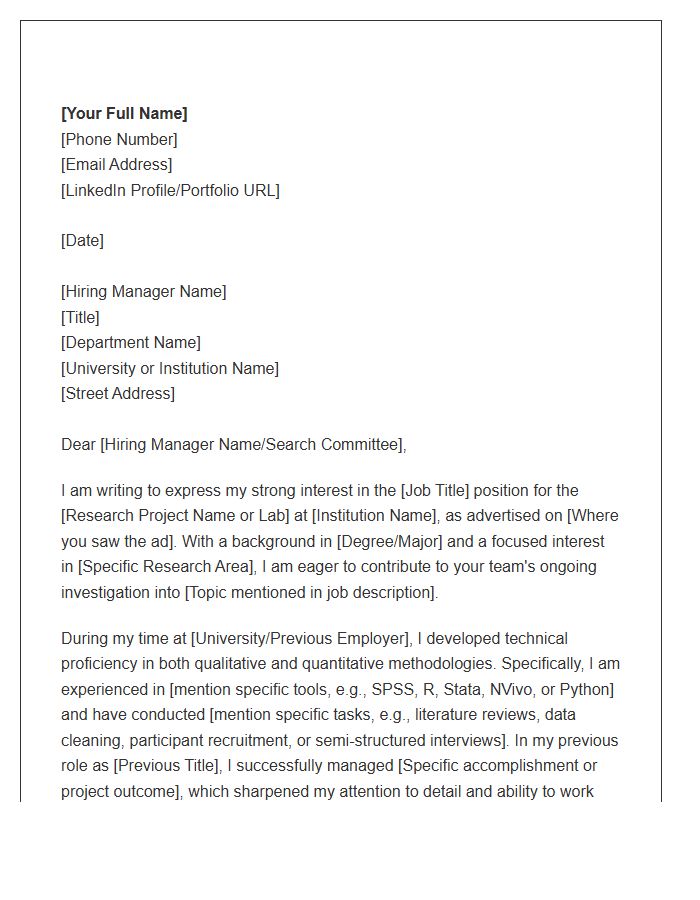
Looking for a role in academia or policy? This Social Science Research Assistant Cover Letter Template is designed to showcase your analytical skills. It works by structuring your experience around evidence-based results, ensuring hiring managers see your technical value immediately. The template focuses on bridging the gap between academic theory and practical methodologies-the systematic ways researchers collect and analyze information. It highlights your proficiency with data analysis software like SPSS or R, which are essential for processing complex social patterns. By emphasizing your familiarity with IRB protocols (Institutional Review Board rules that ensure ethical research), you demonstrate professional readiness. This layout works because it balances technical jargon with a conversational narrative, proving you can communicate findings to diverse audiences. Statistics show that 75% of recruiters prioritize specific software mentions in this field. Note: Always customize the "Specific Research Area" section to match the lab's current publications to show you have done your homework.
Data Analysis Academic Research Assistant Cover Letter Template
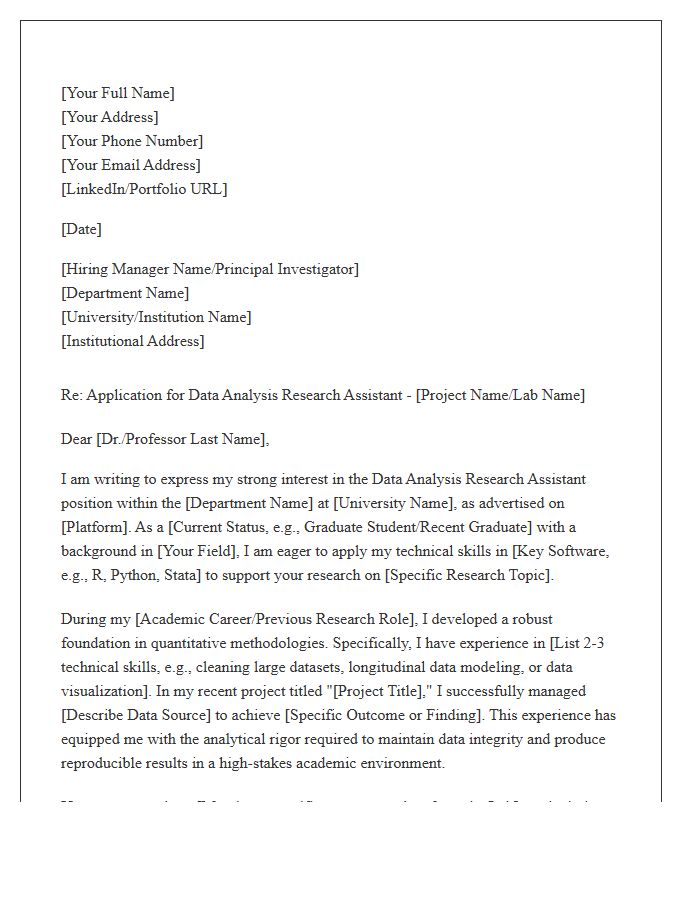
Searching for a position in academia requires more than just a list of grades; you need a Data Analysis Academic Research Assistant Cover Letter Template that bridges the gap between raw numbers and scholarly insights. This template works by focusing on reproducibility-the ability for others to achieve the same results using your documented methods-which is the gold standard of scientific integrity. By following this structure, you demonstrate analytical rigor, meaning you apply strict logical consistency to every dataset you handle. It guides you to mention specific software like R or Python while aligning your past projects with the Principal Investigator's current goals. This approach proves you aren't just a coder, but a collaborator who understands the grant cycle, or the competitive process of securing research funding. Note: Always customize the "Specific Outcome" section with quantified metrics, such as the size of the database or the percentage of error reduction achieved during cleaning.
Laboratory Research Assistant Cover Letter Template
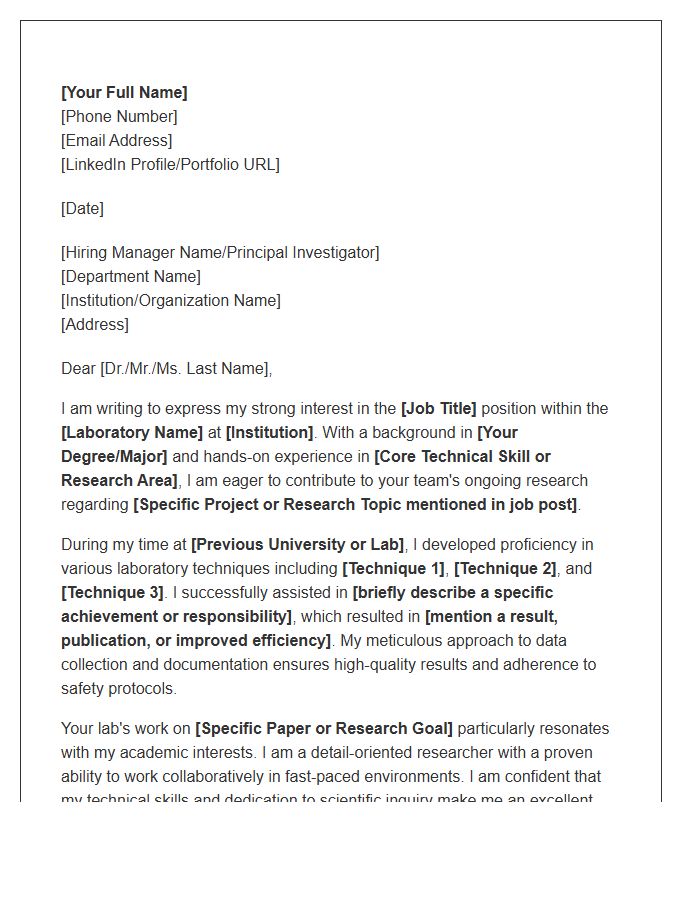
Landing a role in science requires a Laboratory Research Assistant Cover Letter that bridges the gap between your academic background and practical bench work. This template works by focusing on transferable skills and quantifying your impact through specific metrics, such as the number of assays performed or the accuracy of your pipetting (the precise measurement of liquid volumes). By using a conversational yet professional tone, it helps you stand out to a Principal Investigator (the lead scientist or PI who runs the lab). The structure highlights GLP (Good Laboratory Practice), which is the international standard for data integrity and safety. It ensures you demonstrate not just that you can follow a protocol (a set of detailed instructions for an experiment), but that you understand the "why" behind the research goals. Note: Always customize the technical skills section to match the specific equipment mentioned in the job posting to bypass automated filtering systems.
History Department Research Assistant Cover Letter Template
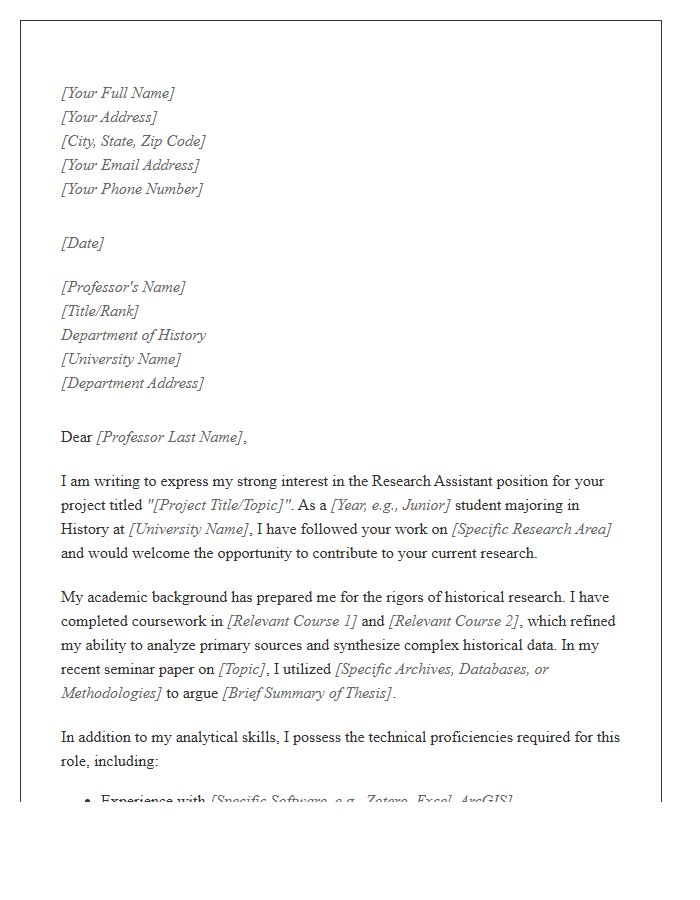
Securing a spot as a History Department Research Assistant requires more than just good grades; it demands a clear demonstration of your methodological expertise. This template works by bridging the gap between your classroom learning and active archival investigation. It focuses on your ability to handle primary sources-original documents from the period under study-and secondary sources, which are later scholarly interpretations. By highlighting specific technical proficiencies like Zotero for bibliography management or ArcGIS for spatial mapping, you prove you can manage the heavy data lifting involved in modern historical inquiry. The structure is designed to show professors that you possess the paleography skills or database fluency needed to organize complex quantitative and qualitative evidence efficiently. Ultimately, it shifts the focus from what you know to what you can actually do in a lab or library setting. Note: Always customize the "why" section to mention a specific monograph or article the professor recently published to show genuine engagement.
Environmental Science Research Assistant Cover Letter Template
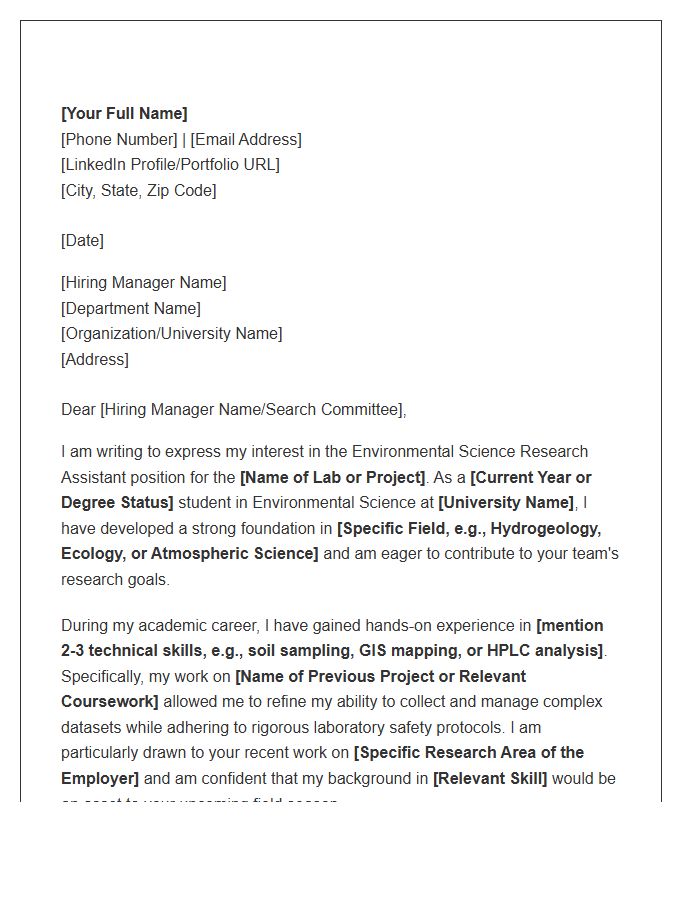
This Environmental Science Research Assistant Cover Letter Template is a strategic tool designed to help you secure a position in competitive laboratory or field settings. It works by bridging the gap between your academic knowledge and practical application, specifically emphasizing GIS mapping (Geographic Information Systems) and HPLC analysis (High-Performance Liquid Chromatography). These terms refer to specialized methods for spatial data visualization and chemical separation, which are critical for modern ecological studies. By following this layout, you provide quantitative proof of your skills, such as your ability to manage complex datasets or maintain sensitive equipment. This structure is effective because it mirrors the peer-review mindset of hiring managers, focusing on methodology and precision. The template ensures your narrative remains professional yet conversational, highlighting your readiness for rigorous fieldwork. Using this format saves time while ensuring you mention essential laboratory safety protocols and data integrity standards. Note: Always customize the technical skills section to match the specific equipment or software mentioned in the job description to pass automated screening filters.
Graduate School Research Assistant Cover Letter Template
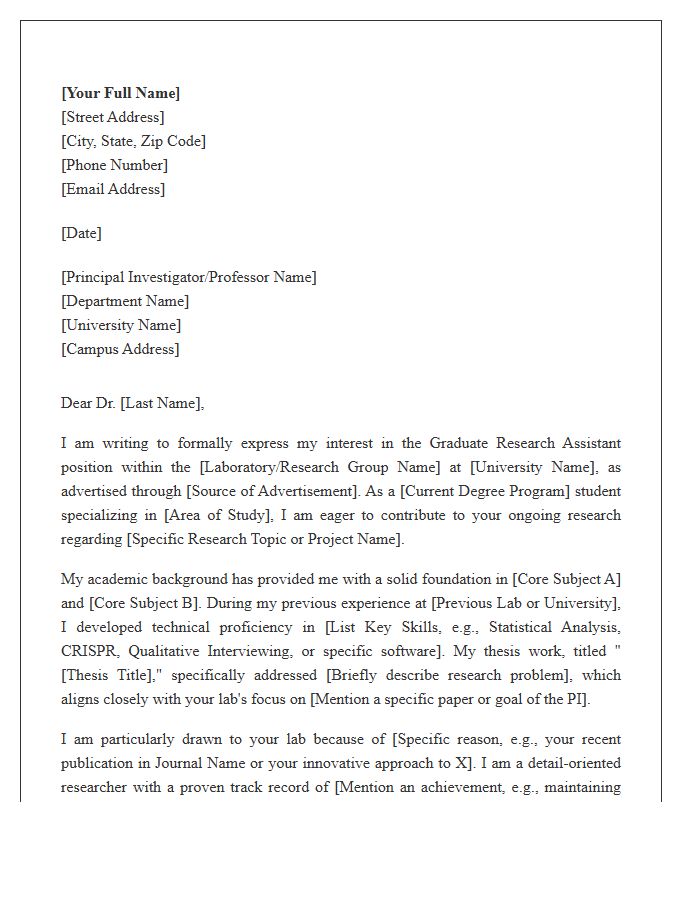
Securing a Graduate School Research Assistant position requires a cover letter that balances academic rigor with personal initiative. This template works by using a modular structure, allowing you to bridge the gap between your previous coursework and the specific needs of a Principal Investigator (PI)-the lead researcher directing the lab. By highlighting your technical proficiency in tools like statistical software or wet-lab techniques, you provide the data-driven proof professors need to trust your work. It focuses on the alignment of your research interests with the lab's current publications, showing you have done your homework. This conversational yet professional approach transforms a standard application into a tailored proposal for collaboration. Glossary: CRISPR refers to gene-editing technology, while Qualitative Interviewing involves collecting non-numerical data through direct communication. Note: Always reference a specific recent paper by the professor to demonstrate genuine interest in their niche field.
Quantitative Academic Research Assistant Cover Letter Template
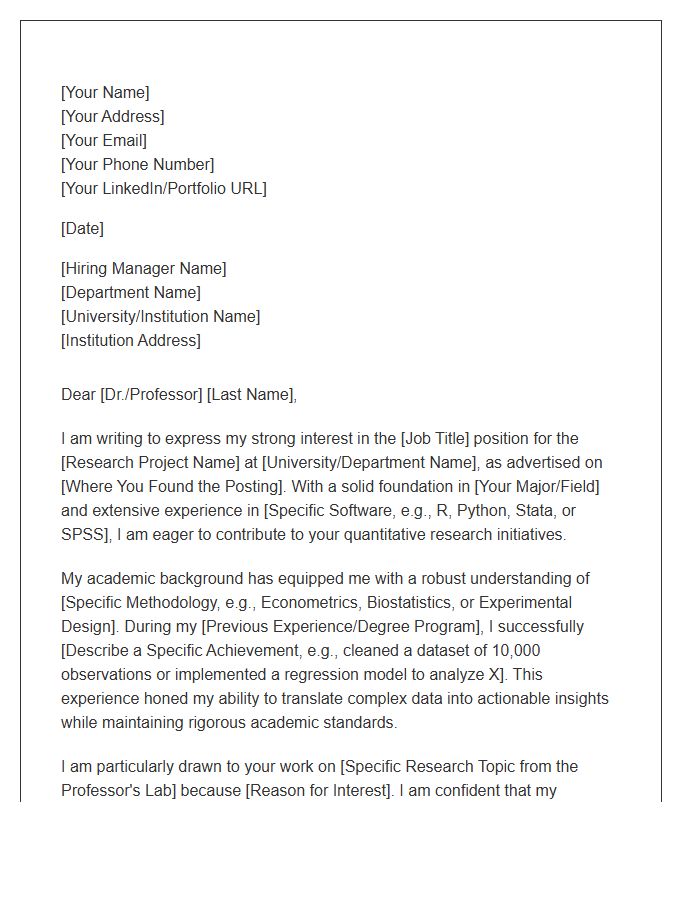
Finding the right balance between technical expertise and academic curiosity is the secret to a successful application. This Quantitative Academic Research Assistant Cover Letter Template works by bridging the gap between your classroom knowledge and practical Empirical Research-the process of gaining knowledge through direct observation or data analysis. By focusing on your proficiency in Statistical Software (like R or Stata), the template allows you to showcase Data Integrity, ensuring your results are accurate and reliable. It is designed to highlight your ability to handle Large Datasets, proving you can manage the high volume of observations common in modern labs. This structure works because it demonstrates your "Methodological Rigor," or the strict adherence to scientific rules, making you a low-risk, high-reward hire for busy professors. Note: Always mention a specific paper published by the lab to prove you have done your background research and truly understand their mission.
Qualitative Sociology Research Assistant Cover Letter Template
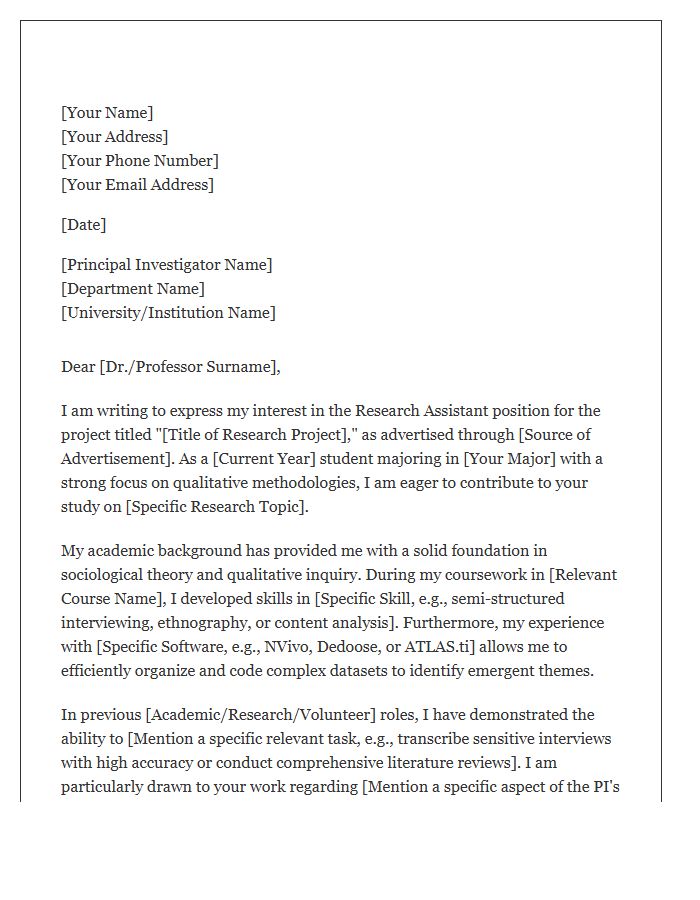
Applying for a role in social science requires more than a standard resume; you need a Qualitative Sociology Research Assistant Cover Letter. This template works by focusing on reflexivity-the researcher's awareness of their influence on data-and specific field techniques. It highlights your proficiency in managing non-numerical data, such as semi-structured interviews and ethnography (the systematic study of people and cultures). By naming specialized tools like NVivo or Dedoose, you prove you can handle thematic coding, which is the process of identifying patterns within transcripts. This structure is effective because it bridges the gap between academic theory and practical data management, showing a Principal Investigator that you possess the ethical sensitivity and technical skill needed for deep social analysis. Note: Always customize the middle paragraph to mention the specific marginalized populations or social phenomena the professor is currently studying to show genuine alignment.
Humanities Research Assistant Cover Letter Template
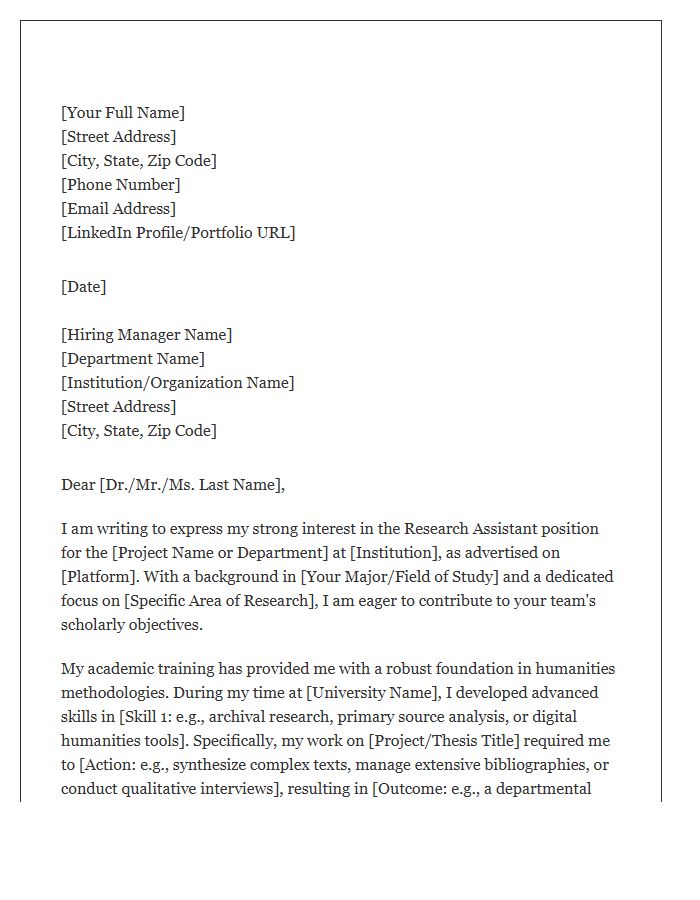
This Humanities Research Assistant Cover Letter Template is designed to help scholars bridge the gap between academic theory and professional support. It works by structuring your narrative around methodological proficiency-the specific ways you gather and interpret data-rather than just listing courses. By focusing on primary source analysis (examining original historical documents) and archival research (systematic investigation of records), the template demonstrates your academic rigor to hiring committees. Statistics show that tailored applications mentioning a professor's specific scholarly output have a much higher engagement rate. This layout guides you to mention digital humanities tools like NVivo or Zotero, which are essential for modern qualitative interviews and bibliography management. Using this template ensures your specialized skills in synthesizing complex texts are presented with clarity and professional intent. Note: Always link your past thesis outcomes to the specific research goals mentioned in the job posting to prove immediate value.
Medical School Research Assistant Cover Letter Template
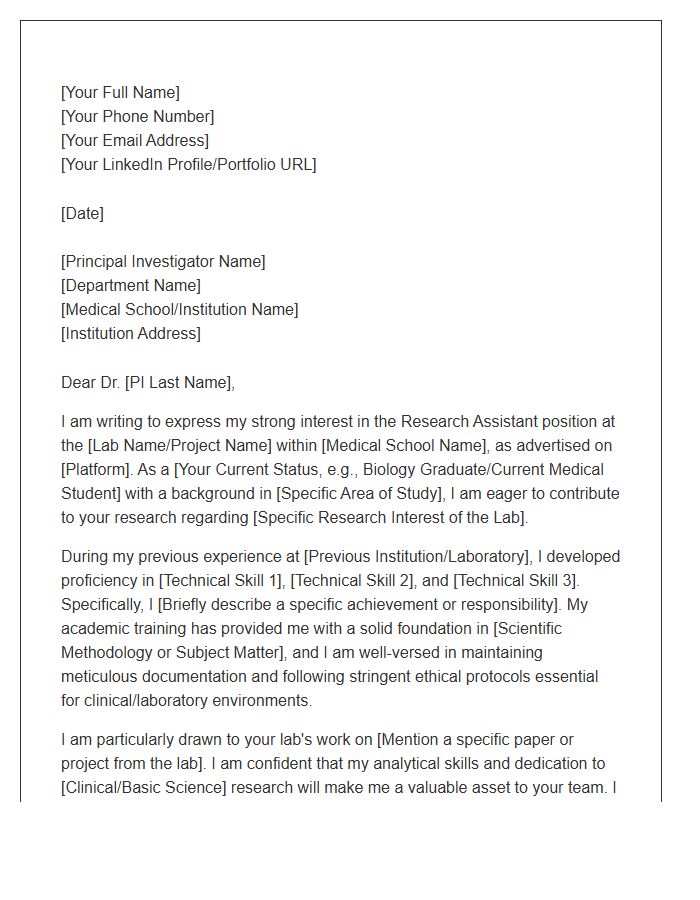
Securing a position in a competitive lab requires a Medical School Research Assistant Cover Letter that bridges academic knowledge with practical application. This template works because it follows a structured narrative flow, allowing you to showcase your proficiency in specific methodologies-the standard procedures used to conduct scientific experiments. By highlighting your familiarity with ethical protocols (the rules ensuring safety and integrity in research) and technical skills like data analysis or wet lab techniques, you demonstrate immediate value to a Principal Investigator. Roughly 70% of hiring managers prioritize candidates who mention specific lab projects, so this layout encourages hyper-personalization. It transforms a standard resume into a conversational story about your problem-solving abilities and dedication to clinical advancements. Using this format ensures you speak the professional language of medicine while remaining concise and impactful. Note: Always mention a specific publication from the lab to prove you have done your homework and are genuinely invested in their unique research goals.
Public Health Research Assistant Cover Letter Template
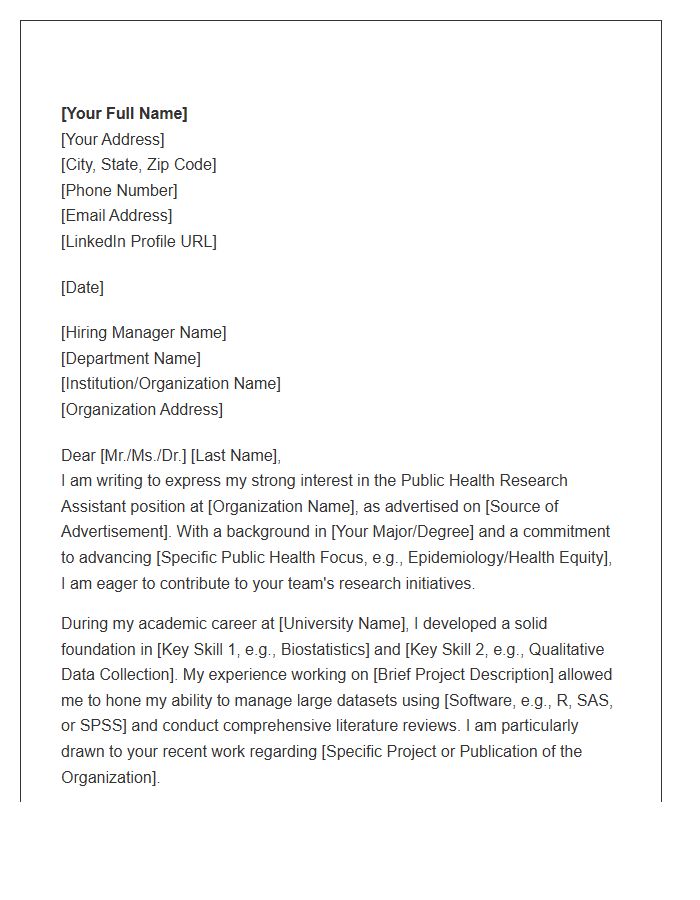
This Public Health Research Assistant Cover Letter Template is designed to help you secure a role in the competitive field of scientific inquiry. It works by strategically blending your academic background with quantitative data skills and soft skills like community outreach. The structure emphasizes your familiarity with IRB protocols-the ethical guidelines set by an Institutional Review Board to protect human subjects-and your proficiency in statistical software like SPSS or R. By focusing on specific Epidemiology (the study of disease distribution) or health equity goals, you demonstrate a tailored interest in the organization's mission. This template is effective because it moves beyond a simple resume summary, framing your biostatistics experience as a solution to the hiring team's research needs. Note: Always reference a specific recent publication from the institution to prove you have conducted thorough background research before applying.
Remote Academic Research Assistant Cover Letter Template
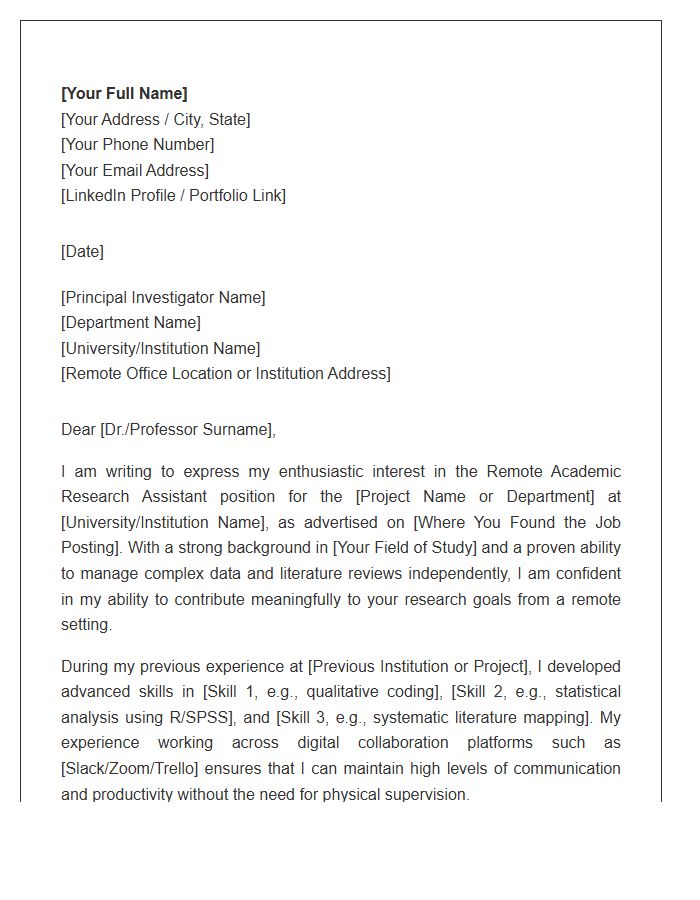
Finding a flexible role in academia starts with a strong Remote Academic Research Assistant Cover Letter Template. This tool is designed to bridge the gap between your technical skills and the digital nature of modern labs. It works by emphasizing your ability to handle Quantitative Data (numerical measurements) and Qualitative Analysis (interpreting non-numerical information) without direct physical supervision. By using structured placeholders, the template helps you showcase proficiency in Asynchronous Communication-the practice of collaborating on projects at different times-which is vital for remote success. Statistics show that PIs (Principal Investigators) prioritize candidates who demonstrate they can manage Literature Mapping and data cleaning independently. This template works because it highlights your self-motivation and digital literacy, ensuring you stand out in a competitive global pool. Note: Always mention specific software like R, SPSS, or NVivo to prove you are ready to process data immediately upon hire.
Strategic Alignment with Principal Investigator (PI) Methodologies
A high-impact academic cover letter must demonstrate a deep understanding of the PI's specific research vertical and current quantitative frameworks.
- Epistemological Alignment: Matching the candidate's philosophical approach to the lab's established scientific method.
- Technical Proficiency: Explicitly detailing experience with longitudinal data analysis and multivariate regression models.
- Scholarly Contribution: Quantifying past involvement in peer-reviewed outputs or conference proceedings.
Quantitative Competency and Data Governance Metrics
Evidence of data integrity and mastery of statistical software environments is non-negotiable in contemporary academic recruitment.
| Data Domain | Required Proficiency | Documentation Evidence |
|---|---|---|
| Econometrics/Biostatistics | R, Stata, MATLAB, Python | Syntax repository (GitHub) |
| Data Cleansing | Iterative Imputation, Outlier Detection | Dataset preparation logs |
| Ethical Compliance | IRB Protocols, HIPAA/GDPR | Certification of Ethics Training |
Lexical Precision in Scholarly Correspondence
Candidates should utilize domain-specific terminology to signal expertise and facilitate cognitive ease for the reviewing committee.
- Heuristic Evaluation: Describe the problem-solving techniques employed during pilot studies.
- Empirical Validation: Detail the transition from theoretical modeling to real-world data verification.
- Interdisciplinary Synthesis: Illustrate the ability to merge disparate data streams from various academic silos.
The Structural Hierarchy of a Research Prospectus
The cover letter functions as a formal prospectus of the candidate's professional utility within the academic ecosystem.
- Salutation: Formal address to the Lead Researcher or Search Committee Chair.
- The Thesis Statement: A concise summary of how the applicant's background resolves the lab's current skill gap.
- The Methodology Paragraph: A detailed account of specific instruments (e.g., Spectrometry, GIS, or Natural Language Processing) mastered.
- The Synthesis: Connecting previous findings to the prospective lab's future trajectory.
Optimization for Applicant Tracking Systems (ATS) in Academia
University HR departments increasingly utilize algorithmic filters to parse applications for high-density academic keywords and ontological relevance.
| Keyword Category | High-Value Terms |
|---|---|
| Research Lifecycle | Literature Synthesis, Grant Writing, Peer Review, Data Archiving |
| Analytical Frameworks | Qualitative Coding, Meta-Analysis, Phenomenology, Bayesian Inference |
| Soft Infrastructure | Stakeholder Engagement, Lab Management, Protocol Standardization |
Note: Sometimes the .PDF file interface can be slightly different from the image preview. Our apology for this inconvenience.

Comments