
Are you moving from volunteer management into the corporate world? Transitioning from a Volunteer Coordinator role to Talent Acquisition is a natural career pivot because both fields focus on the human element of growth. Whether you are sourcing unpaid supporters or full-time employees, your ability to assess cultural fit and manage the recruitment lifecycle is your greatest asset. Companies value your experience in high-volume screening and engagement. To help you translate nonprofit jargon into business-ready language, we have defined key terms like "Sourcing" (finding candidates) and "ATS" (Applicant Tracking Systems). This article explains how to frame your community leadership as professional recruitment expertise to catch a hiring manager's eye. Below are some ready to use volunteer coordinator transitioning to talent acquisition cover letter templates.

Cover Letter Template and Sample List
Table of Content
- Volunteer Coordinator To Junior Talent Acquisition Specialist
- Transitioning Volunteer Manager To Corporate Talent Acquisition
- Nonprofit Volunteer Coordinator Shifting To Talent Acquisition
- Volunteer Recruitment Background To Talent Acquisition Lead
- Volunteer Engagement Specialist Transitioning To Talent Acquisition
- Community Engagement To Talent Acquisition Professional
- Volunteer Program Manager To Recruitment Specialist
- Volunteer Coordinator Experience For Talent Acquisition Roles
- Career Change Volunteer Coordinator To Talent Acquisition
- Volunteer Operations Manager To Talent Acquisition Consultant
- Strategic Volunteer Coordinator Transitioning To Talent Acquisition
- Volunteer Sourcing Specialist To Talent Acquisition Partner
Volunteer Coordinator To Junior Talent Acquisition Specialist Cover Letter Template
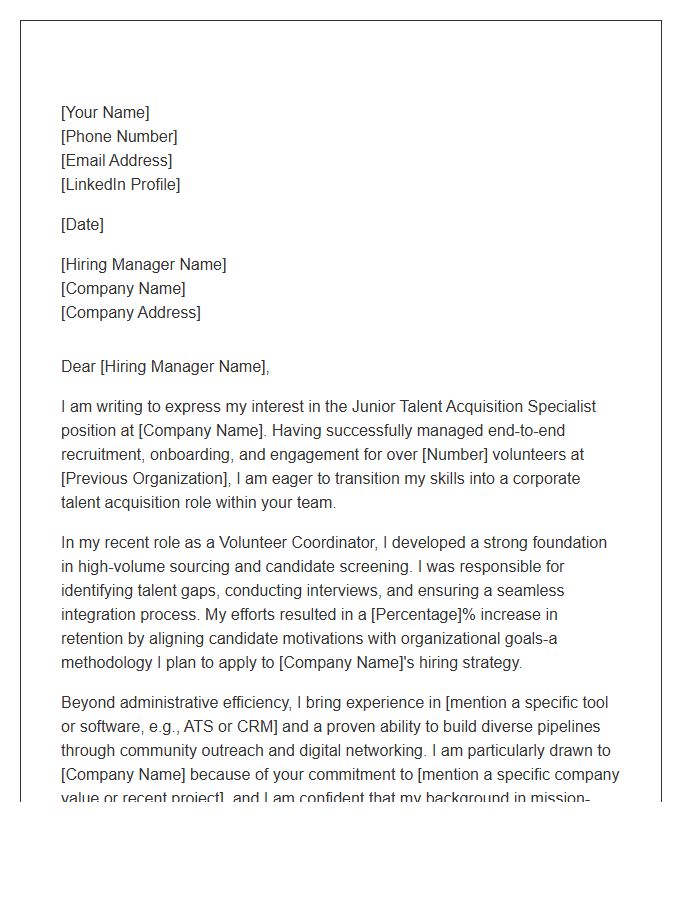
Transitioning from a volunteer lead to a corporate recruiter requires a strategy that bridges the gap between community management and professional hiring. This Junior Talent Acquisition Specialist Cover Letter works by reframing your history of "finding help" into the professional context of end-to-end recruitment. It highlights your ability to handle high-volume sourcing-the process of finding potential candidates-and candidate screening to ensure quality fits. By quantifying your success with data, such as retention percentages, you demonstrate a results-oriented mindset essential for human resources. The template utilizes an ATS-friendly structure, ensuring that your skills in managing a pipeline (a steady flow of potential hires) are recognized by automated filters. This conversational yet professional approach helps hiring managers see your transferable skills in action, proving that managing people is a universal asset regardless of the industry. Note: Always tailor the "Company Value" section to prove you have researched their specific corporate culture.
Transitioning Volunteer Manager To Corporate Talent Acquisition Cover Letter Template
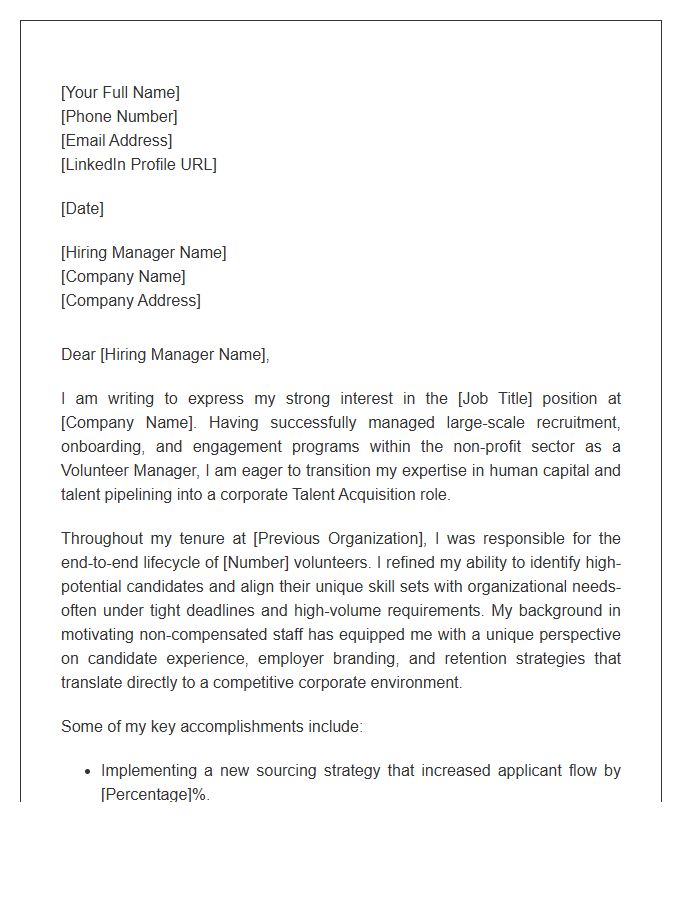
Making the leap from non-profit work to a Corporate Talent Acquisition role requires a strategic shift in how you present your expertise. This template works by framing Volunteer Management as a high-stakes form of human capital oversight. It focuses on the end-to-end lifecycle-the technical term for the entire process from sourcing to offboarding-to prove you understand professional recruitment workflows. By highlighting data like time-to-fill (the number of days it takes to finish a hire) and applicant flow, you demonstrate a results-oriented mindset that recruiters crave. This approach bridges the gap between unpaid engagement and corporate Sourcing Strategies, showing that if you can motivate people to work for free, you can certainly sell a paid career opportunity. This transition is successful because it translates "soft skills" into measurable ATS Management and relationship-building metrics. Note: Always quantify your volunteer pool size to prove you can handle high-volume corporate pipelines.
Nonprofit Volunteer Coordinator Shifting To Talent Acquisition Cover Letter Template
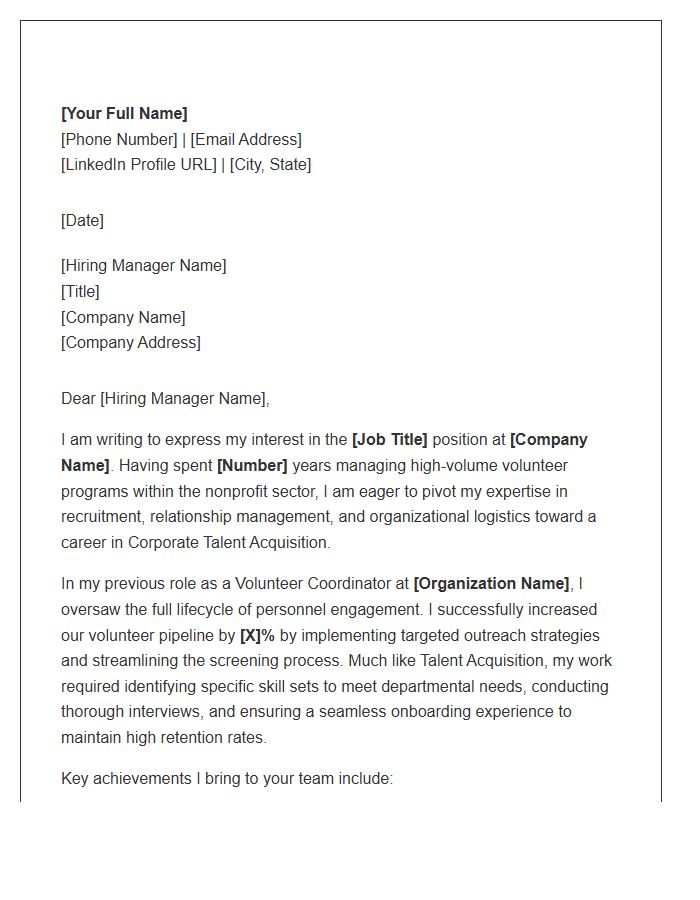
This Talent Acquisition Cover Letter Template is specifically designed for nonprofit professionals looking to pivot into corporate recruiting. It works by framing "volunteer coordination" through the lens of human capital management, focusing on high-volume sourcing and candidate experience. Instead of discussing community service, the template highlights transferable skills like managing the recruitment lifecycle-the end-to-end process of finding, vetting, and hiring talent. By utilizing data-driven metrics, such as percentage increases in pipeline growth, you demonstrate a results-oriented mindset essential for corporate HR. This approach helps recruiters see your nonprofit experience as a direct asset for identifying mission-aligned employees. Use terms like Applicant Tracking System (ATS)-software used to manage job applications-to show technical literacy. This template bridges the gap between social impact and corporate efficiency, making your non-traditional background a competitive advantage. Note: Always quantify your impact with hard numbers to prove your efficiency in high-pressure environments.
Volunteer Recruitment Background To Talent Acquisition Lead Cover Letter Template
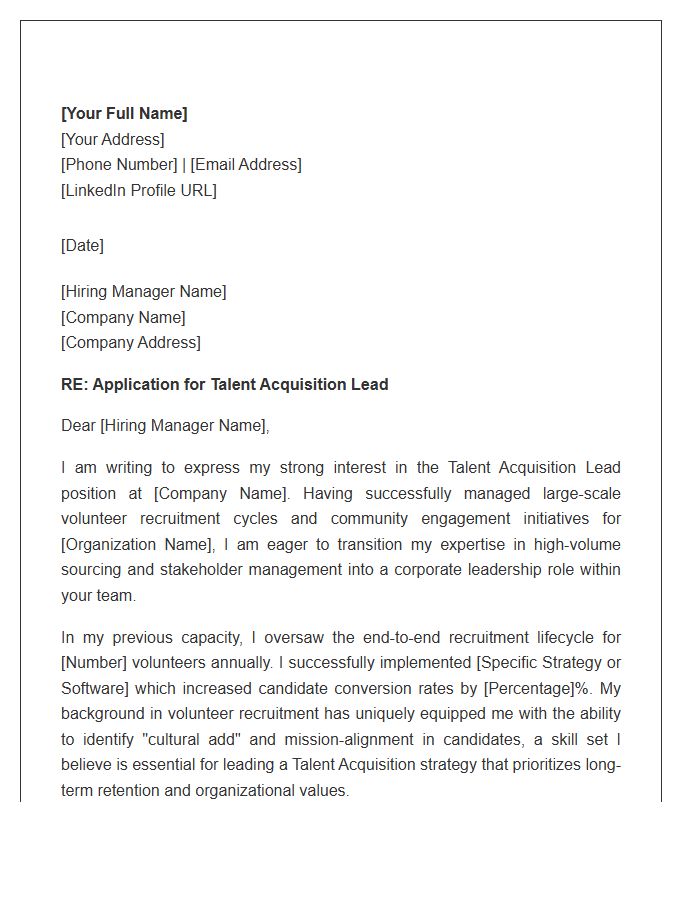
Transitioning from non-profit work to a corporate environment is all about framing your experience. This Volunteer Recruitment to Talent Acquisition Lead Template works because it bridges the gap between managing unpaid supporters and professional employees. In recruitment, the end-to-end lifecycle (the entire process from sourcing to onboarding) remains the same regardless of the pay scale. By focusing on high-volume sourcing-finding many qualified people quickly-and candidate conversion rates (the percentage of applicants who actually join), you demonstrate data-driven success. This template highlights your ability to find "mission-aligned" talent, a glossary term for candidates who share the company's core values. It treats workforce logistics as a transferable skill, proving you can manage complex schedules and diverse pipelines efficiently. Note: Always quantify your impact by mentioning exactly how many volunteers you managed or the specific percentage by which you improved recruitment speed.
Volunteer Engagement Specialist Transitioning To Talent Acquisition Cover Letter Template
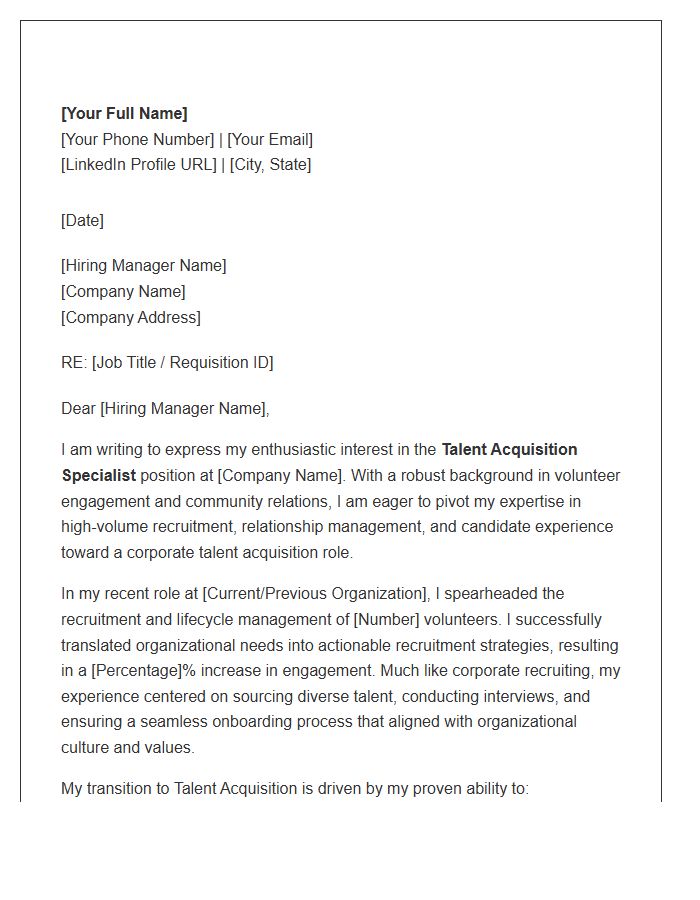
Transitioning from a Volunteer Engagement Specialist to a Talent Acquisition professional is a natural move because both roles focus on the human element of growth. This template works by framing your experience through the lens of the Full-Cycle Recruitment process-the industry term for managing a candidate from the initial search to their first day. By highlighting your ability to source talent and manage high-volume pipelines (a steady flow of potential candidates), you demonstrate that your skills are directly transferable to a corporate setting. The template emphasizes Candidate Experience, which refers to how an applicant perceives your organization during the hiring process. This data-focused approach proves you can handle metrics like Time-to-Fill and retention just as effectively as volunteer churn. Note: Always quantify your achievements, such as the specific number of people you onboarded, to give recruiters a clear picture of your operational scale.
Community Engagement To Talent Acquisition Professional Cover Letter Template
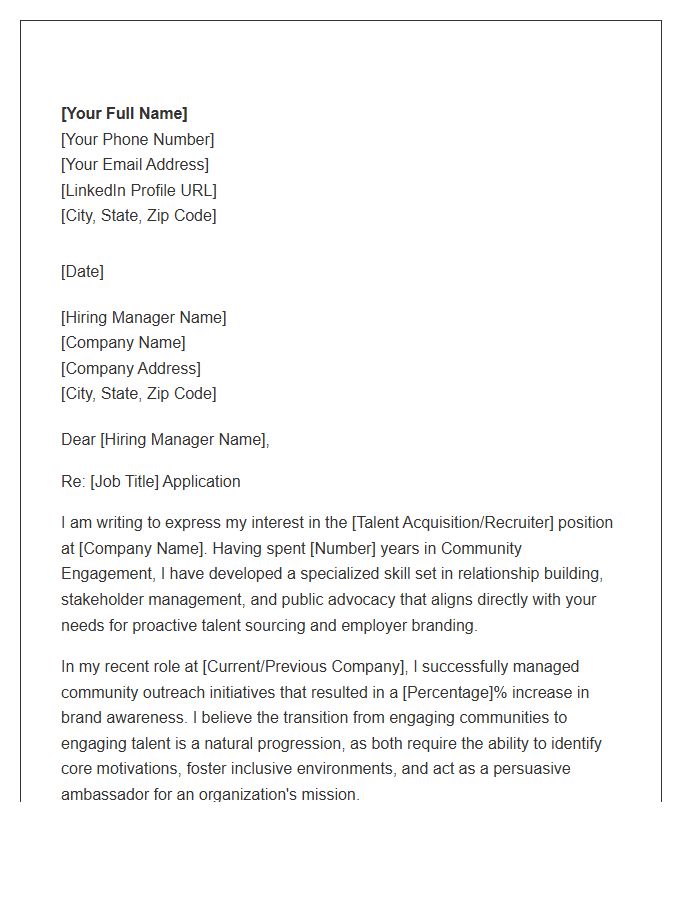
Transitioning from community work to recruiting is a powerful move because both roles focus on relationship capital. This template works by framing your experience in Community Engagement as a direct asset for Talent Acquisition. It highlights the transferable skills of sourcing (finding potential candidates in niche groups) and employer branding (acting as the company's voice). By focusing on data, such as a percentage increase in brand awareness, you prove your ability to drive measurable ROI (Return on Investment). This narrative bridges the gap between public advocacy and professional recruitment, showing hiring managers that you already know how to build a pipeline-the continuous stream of qualified candidates needed for open roles. This approach shifts the conversation from your lack of HR experience to your mastery of human connection. Note: Always customize the "Specific reason" section to show you have researched the company's current culture and values.
Volunteer Program Manager To Recruitment Specialist Cover Letter Template
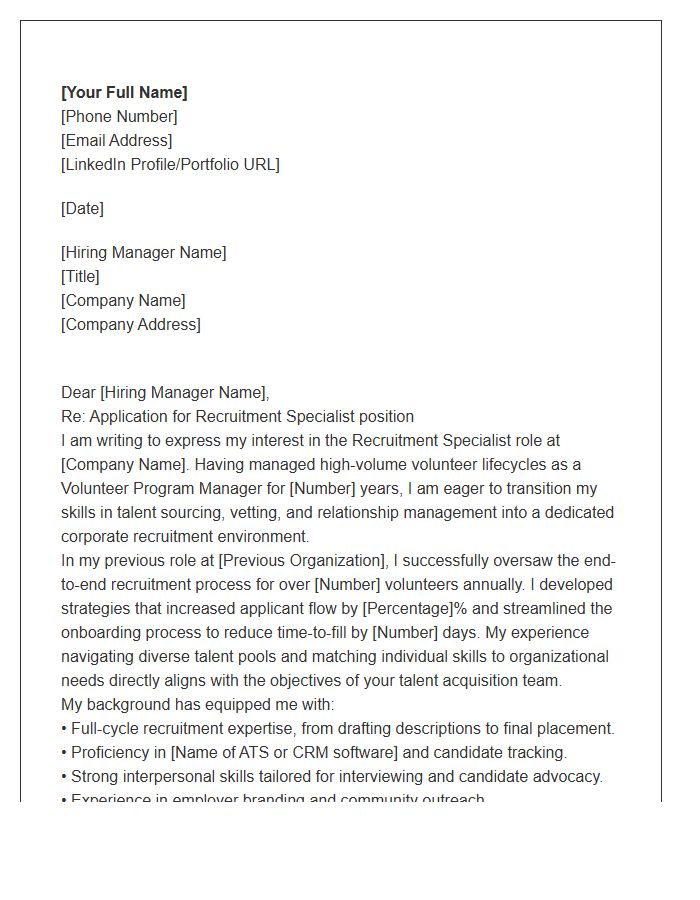
Transitioning from a Volunteer Program Manager to a Recruitment Specialist requires a strategic shift in how you present your background. This template works by framing "volunteer coordination" as high-volume Talent Acquisition, focusing on measurable data like a [Percentage]% increase in applicant flow. It highlights your mastery of the Candidate Lifecycle-the end-to-end process of finding, vetting, and onboarding individuals. By using this conversational yet professional format, you demonstrate that managing unpaid staff involves the same rigorous Sourcing (finding candidates) and ATS (Applicant Tracking System) management required in corporate HR. The layout emphasizes your ability to reduce Time-to-Fill, which is the speed at which a position is successfully closed. This approach bridges the gap between non-profit leadership and corporate recruitment efficiency. Note: Always quantify your impact with specific numbers to prove that your experience in managing people translates directly into driving company growth.
Volunteer Coordinator Experience For Talent Acquisition Roles Cover Letter Template
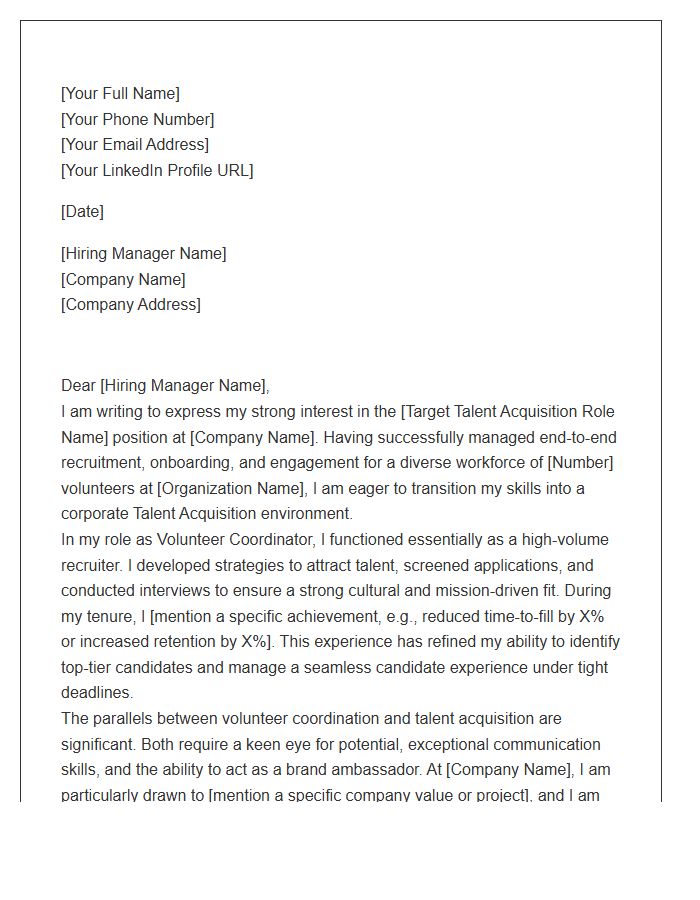
Transitioning from a Volunteer Coordinator to a corporate recruiter is a smart move because both roles focus on the human element of growth. This Talent Acquisition cover letter template works by bridging the gap between non-profit management and professional recruitment. It highlights your ability to handle Sourcing-the process of finding candidates-and Onboarding, which is the formal integration of new hires into an organization. By emphasizing data like "time-to-fill" or retention percentages, you prove your efficiency in managing the Candidate Pipeline, which is the flow of active applicants through the hiring stages. This template is effective because it frames your experience with unpaid staff as high-volume recruiting, proving you can sell a company's mission to attract top talent. It translates "soft skills" into measurable business value that hiring managers recognize instantly. Note: Always quantify your achievements with specific numbers to demonstrate your direct impact on organizational growth.
Career Change Volunteer Coordinator To Talent Acquisition Cover Letter Template
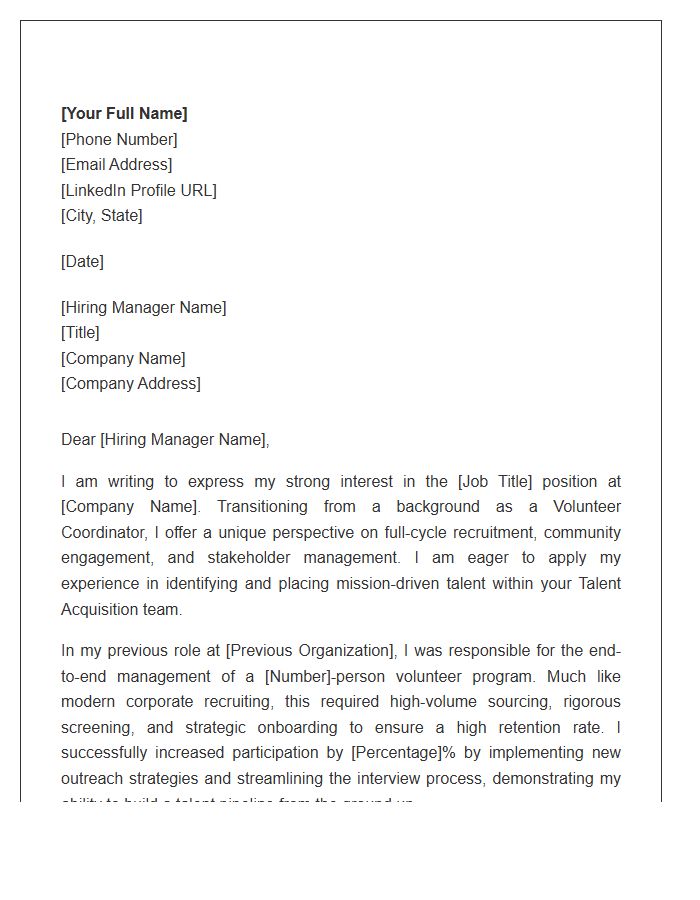
Transitioning from a volunteer lead to a corporate recruiter is a natural move because both roles focus on human capital management. This template works by framing your experience as a "pro bono" recruiter, emphasizing how you handled the full-cycle recruitment process-from sourcing to onboarding-without the leverage of a salary to attract candidates. By highlighting data like your retention rate and program growth, you prove that your skills in Talent Acquisition are already data-driven and results-oriented. A key term here is Applicant Tracking System (ATS), the software used to manage job applications; even if you used a simple database before, emphasize your data integrity and stakeholder communication. This approach bridges the gap between nonprofit community engagement and professional corporate hiring. Note: To stand out, explicitly mention how you evaluated soft skills during interviews, as this is a high-value transferable skill in modern recruiting.
Volunteer Operations Manager To Talent Acquisition Consultant Cover Letter Template
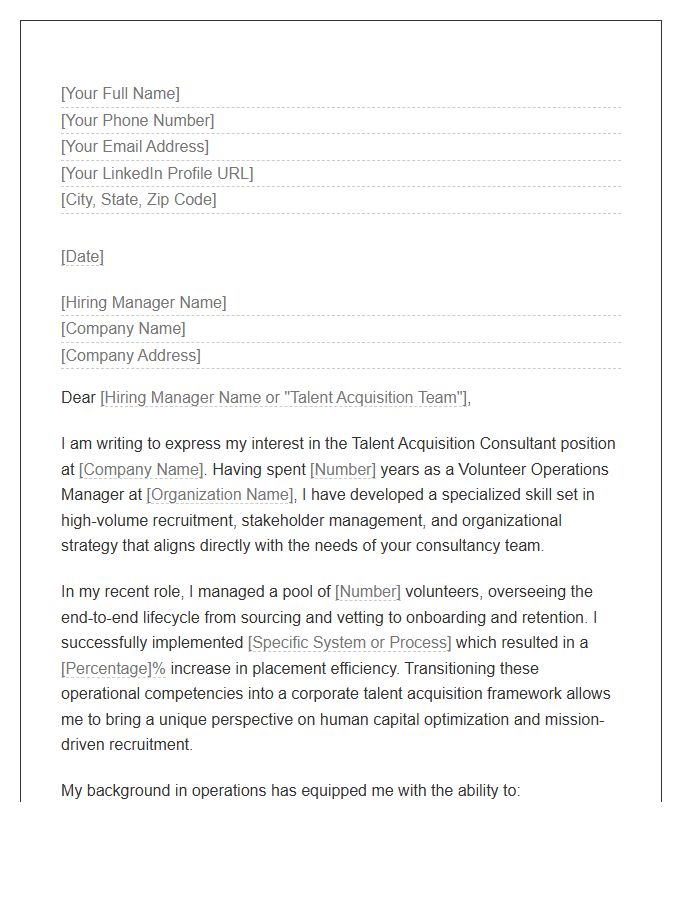
Transitioning from a Volunteer Operations Manager to a Talent Acquisition Consultant requires showcasing how managing people translates into corporate recruitment. This template works by framing High-Volume Recruitment-the process of filling many roles quickly-as a core competency developed while managing large volunteer pools. It emphasizes Human Capital Optimization, which refers to improving how an organization uses its workforce to increase value. By using this layout, you highlight key data like "placement efficiency" and "retention rates" to prove your operational impact. The conversational tone helps bridge the gap between non-profit leadership and corporate consulting. In technical terms, it focuses on the End-to-End Lifecycle, meaning you handle every step from finding a candidate to their first day on the job. This approach proves your skills are transferable and data-backed for a fast-paced environment. Note: Always quantify your volunteer impact with specific numbers to show you can handle the scale of professional recruitment.
Strategic Volunteer Coordinator Transitioning To Talent Acquisition Cover Letter Template
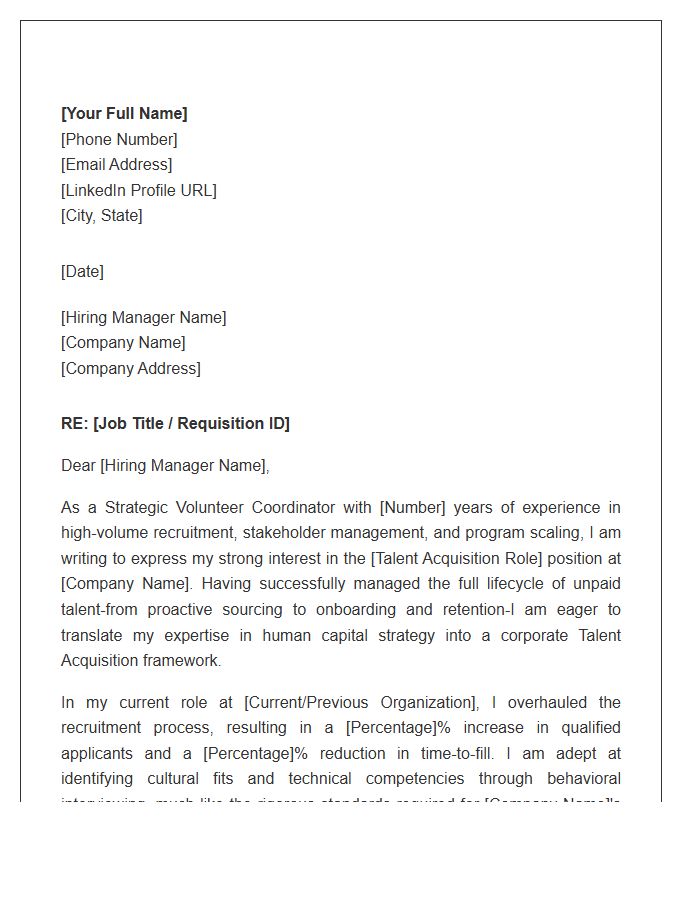
Transitioning from volunteer management to corporate recruitment requires a bridge between community engagement and Talent Acquisition. This template works by framing your experience with "unpaid talent" as Full Lifecycle Recruiting, proving you can attract, vet, and retain high-quality contributors without the leverage of a salary. By focusing on data like Time-to-Fill (the days taken to hire) and ATS (Applicant Tracking Systems), you speak the language of HR professionals. This strategic approach highlights your Human Capital expertise-the collective skills and value of a workforce-ensuring hiring managers see your transferable skills rather than just a title change. It treats volunteer sourcing as a rigorous talent pipeline, emphasizing cultural fit and technical competency. This method shifts the focus from "charity work" to high-volume operational success, making you a competitive candidate for any recruitment team. Note: Always quantify your impact with specific percentages to prove you can handle the high-pressure demands of corporate hiring metrics.
Volunteer Sourcing Specialist To Talent Acquisition Partner Cover Letter Template
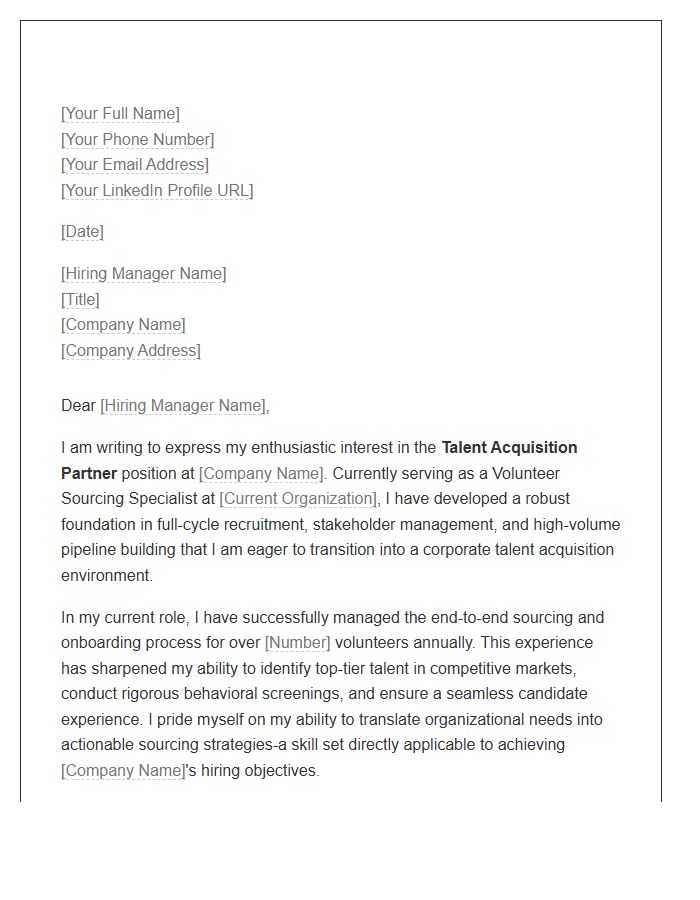
Transitioning from a volunteer-focused role to a corporate environment requires a strategic Talent Acquisition Partner cover letter that bridges the gap between community outreach and professional recruitment. This template works because it emphasizes transferable skills-specifically the ability to manage high-volume pipelines and full-cycle recruitment processes. By highlighting data, such as a percentage increase in lead generation or a reduction in "time-to-fill" (the duration from a job opening to an accepted offer), you demonstrate a results-oriented mindset. The structure focuses on "stakeholder management" (balancing needs between hiring managers and candidates) and "behavioral screenings" (interviewing based on past performance). This conversational yet professional approach positions your experience as a strategic asset rather than just administrative support, proving you can handle the complexities of corporate hiring. Note: Always customize the data points to reflect your specific impact on organizational growth to stand out from other applicants.
Strategic Alignment of Volunteer Life Cycle and Talent Pipeline
Transitioning from Volunteer Coordination to Talent Acquisition (TA) requires a paradigm shift from altruistic engagement to Human Capital Management (HCM). The core competency remains the optimization of the Sourcing-to-Selection Ratio, ensuring that the influx of unpaid labor translates into a scalable model for professional recruitment.
- Proactive Sourcing: Utilizing Boolean strings and ATS (Applicant Tracking Systems) to identify high-potential candidates.
- Employer Branding: Leveraging organizational mission to improve the Net Promoter Score (NPS) among prospective hires.
- Compliance: Adhering to EEOC guidelines and labor laws during the vetting process.
Comparative Analysis of Recruitment Metrics
Successful transitioners must quantify their impact using industry-standard Key Performance Indicators (KPIs). Transitioning the management of a 500+ volunteer database is functionally analogous to managing a high-volume corporate recruitment funnel.
| Volunteer Management Metric | Recruitment Equivalent | Strategic Value |
|---|---|---|
| Retention Rate | Employee Turnover Rate | Cost-per-Hire Reduction |
| Onboarding Time | Time-to-Fill (TTF) | Operational Continuity |
| Skill Alignment | Competency Mapping | Quality of Hire (QoH) |
Technical Proficiency in ATS and CRM Integration
Modern Talent Acquisition relies heavily on Recruitment Marketing Automation. A Volunteer Coordinator's experience with Volunteer Management Systems (VMS) like VolunteerHub or Galaxy Digital provides the technical foundation for mastering enterprise-level tools such as Workday, Greenhouse, or Lever.
- Data Integrity: Maintaining clean records for EEO/OFCCP compliance reporting.
- Workflow Automation: Streamlining the Candidate Experience (CX) through automated touchpoints.
- Predictive Analytics: Utilizing historical data to forecast future staffing needs and seasonal fluctuations.
Mastering the Behavioral Interviewing Taxonomy
The transition demands a move toward Evidence-Based Recruitment. While volunteer screening often focuses on passion, Talent Acquisition necessitates the STAR Method (Situation, Task, Action, Result) to evaluate Cognitive Ability and Soft Skill Proficiency.
- Psychometric Testing: Integrating assessments to determine cultural add rather than just "cultural fit."
- Competency-Based Assessment: Identifying Transferable Skills through targeted inquiry.
- Bias Mitigation: Implementing blind resume screening to foster Diversity, Equity, and Inclusion (DEI).
The Economics of Talent Acquisition Transition
Finalizing a cover letter requires demonstrating an understanding of the Total Cost of Vacancy (COV). A Volunteer Coordinator who has managed a zero-budget program is uniquely positioned to maximize Recruitment Marketing ROI through organic channel growth.
- Sourcing Channel Effectiveness: Identifying the lowest-cost, highest-yield platforms (e.g., LinkedIn vs. Niche Boards).
- Attrition Mitigation: Developing Employee Value Propositions (EVP) that resonate with mission-driven professionals.
- Internal Mobility: Creating pathways for existing talent to fill vacant roles, reducing external search fees.
Note: Sometimes the .PDF file interface can be slightly different from the image preview. Our apology for this inconvenience.


Comments