
Moving from a retail branch to a corporate office requires a strategy that treats your daily transactions as data points. If you are a bank teller looking to pivot, your cover letter must translate manual cash handling into Financial Analysis. This transition is highly achievable because you already possess a foundational understanding of fiscal compliance, risk assessment, and customer portfolios. By shifting your narrative from basic service to quantitative evaluation, you demonstrate an analytical mindset. This article explores how to highlight your proficiency in Variance Analysis (identifying differences between expected and actual figures) and Reporting to secure your new role. We focus on leveraging your front-line experience to provide actionable insights for stakeholders. To jumpstart your application process, below are some ready to use templates and examples.
Cover Letter Template and Sample List
Table of Content
- Bank Teller To Financial Analyst Career Change
- Junior Financial Analyst For Bank Tellers
- Entry Level Financial Analysis For Banking Professionals
- Retail Bank Teller To Financial Analyst
- Bank Teller Transitioning To Corporate Financial Analysis
- Financial Analyst Associate For Bank Tellers
- Career Pivot Bank Teller To Financial Analysis
- Bank Teller With Financial Modeling Experience
- Bank Operations To Financial Analysis Career Move
- Commercial Banking Background Financial Analyst
- Professional Bank Teller To Junior Financial Analyst
- Banking Clerk To Financial Analysis Specialist
- Analytical Bank Teller Transitioning To Finance
Bank Teller To Financial Analyst Career Change Cover Letter Template
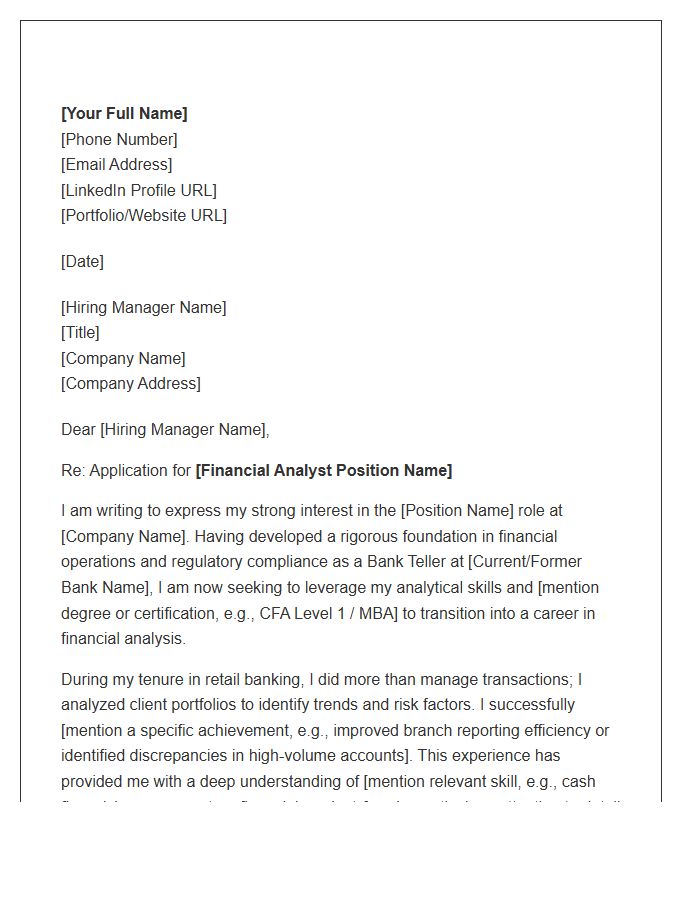
Transitioning from a retail role to corporate finance requires a strategy that emphasizes transferable skills. This Bank Teller to Financial Analyst Cover Letter Template works by recontextualizing daily branch tasks into high-level analytical achievements. Instead of focusing on cash handling, the template highlights your experience with risk assessment (evaluating potential financial loss) and regulatory compliance (adhering to strict industry laws). By showcasing technical proficiencies like Financial Modeling-the process of creating a summary of expenses and earnings to calculate the impact of future events-you demonstrate readiness for complex data tasks. Statistics show that emphasizing quantitative achievements, such as improving reporting efficiency by a specific percentage, significantly increases interview rates. This template bridges the gap by translating operational experience into the language of data-driven decision making. Note: Always customize the technical section with specific software like Excel VBA or SQL to bypass automated applicant tracking systems.
Junior Financial Analyst Cover Letter Template For Bank Tellers
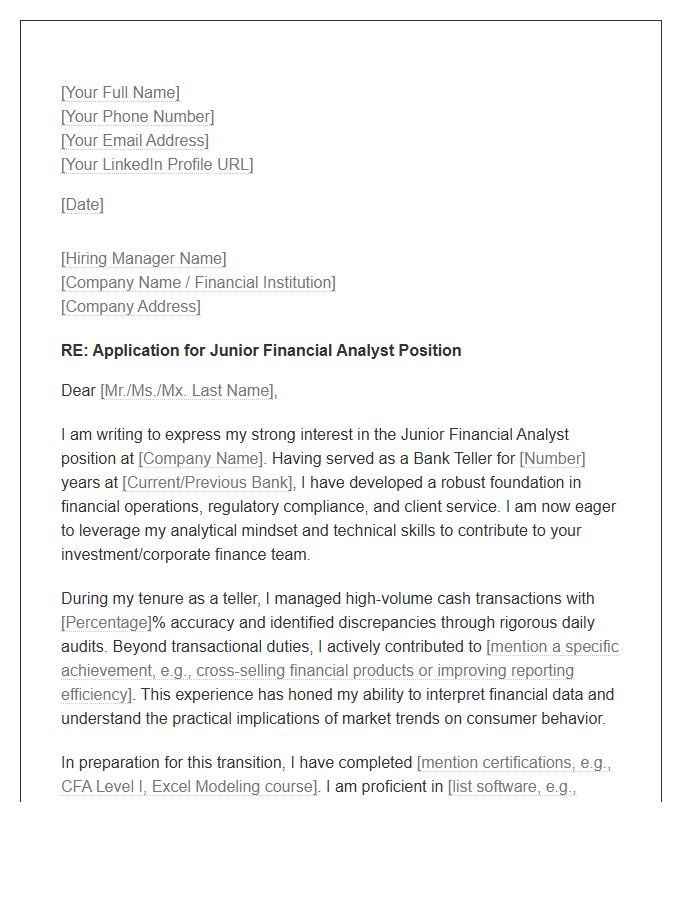
Transitioning from the branch floor to an analytical role is a strategic move, and this Junior Financial Analyst Cover Letter Template is designed to bridge that gap. This template works by translating your daily "front-line" tasks into high-level transferable skills. Instead of just listing duties, it focuses on Data Accuracy-the precision required to handle high-volume transactions without errors-and Regulatory Compliance, which refers to following strict legal guidelines like Anti-Money Laundering (AML) protocols. By quantifying your success, such as maintaining a 99% accuracy rate, you prove you possess the analytical mindset needed for complex Financial Modeling. This approach highlights your unique perspective on Risk Assessment, showing recruiters that your retail banking background is a professional asset rather than a limitation. Note: Always customize the technical skills section with specific software like Excel or SQL to pass automated applicant tracking systems.
Entry Level Financial Analysis Cover Letter Template For Banking Professionals
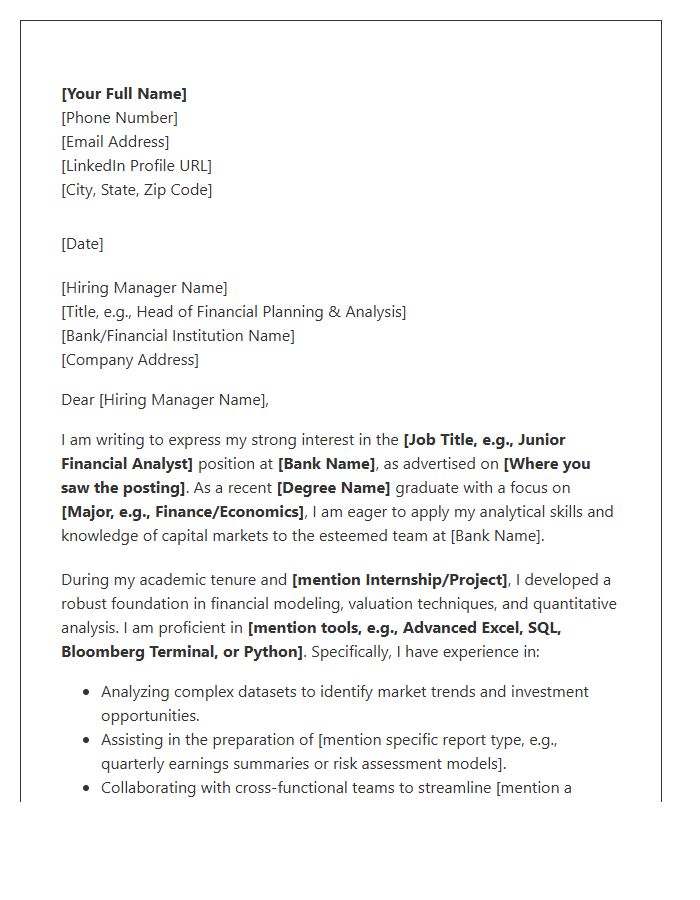
Landing your first role in banking requires a Financial Analysis Cover Letter that bridges the gap between academic theory and professional execution. This template works by focusing on transferable skills and technical proficiency rather than years of experience. By highlighting your knowledge of Financial Modeling-the process of creating a summary of a company's expenses and earnings-and Quantitative Analysis-using mathematical methods to evaluate data-you demonstrate immediate value to recruiters. Statistics show that clear mentions of tools like SQL or the Bloomberg Terminal can increase your visibility in automated screening systems. This structure allows you to showcase Capital Markets awareness while maintaining a professional, conversational tone that fits the banking culture. It emphasizes your ability to handle Valuation Techniques, which are crucial for determining the current worth of an asset. Note: Always customize the "why us" section with a specific recent deal or news item about the bank to show you have done your homework.
Retail Bank Teller To Financial Analyst Cover Letter Template
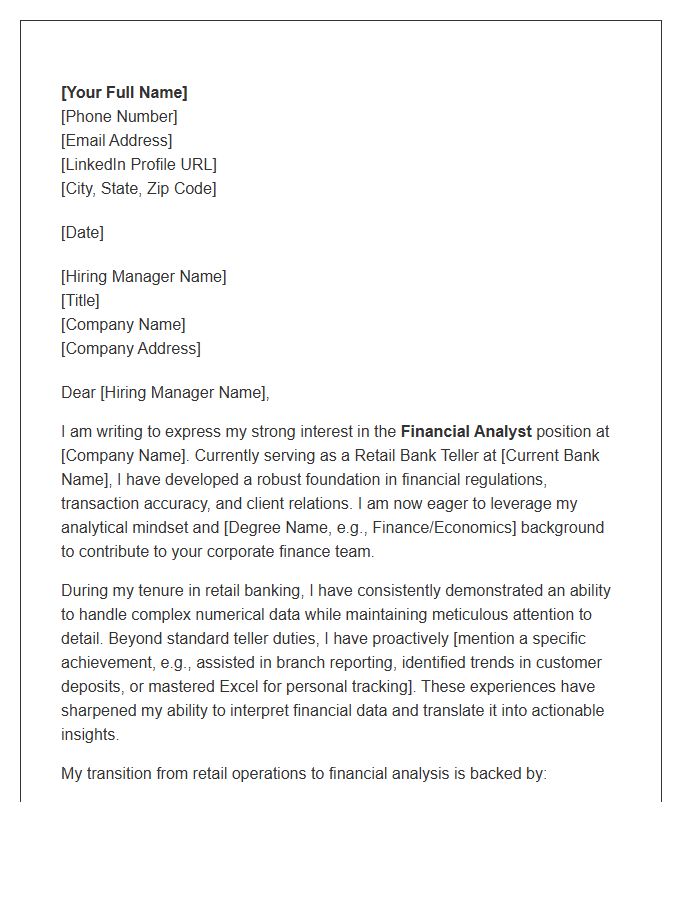
Transitioning from a retail branch to a corporate office requires a strategy focused on Transferable Skills. This template works by rebranding your front-line banking experience into technical assets. Instead of focusing on cash handling, it emphasizes Data Integrity-the practice of ensuring information remains accurate throughout its lifecycle-and Regulatory Compliance, which refers to adhering to laws like AML (Anti-Money Laundering) and KYC (Know Your Customer). By highlighting these areas, you prove that you already understand the "why" behind the numbers. The structure uses Financial Modeling and software proficiency as the bridge to bridge the gap between customer service and quantitative analysis. This approach is effective because it frames your teller background as a unique Operational Perspective that many traditional analysts lack. Note: Always quantify your achievements by mentioning the specific volume of transactions or the exact percentage of reporting accuracy you maintained daily.
Bank Teller Transitioning To Corporate Financial Analysis Cover Letter Template
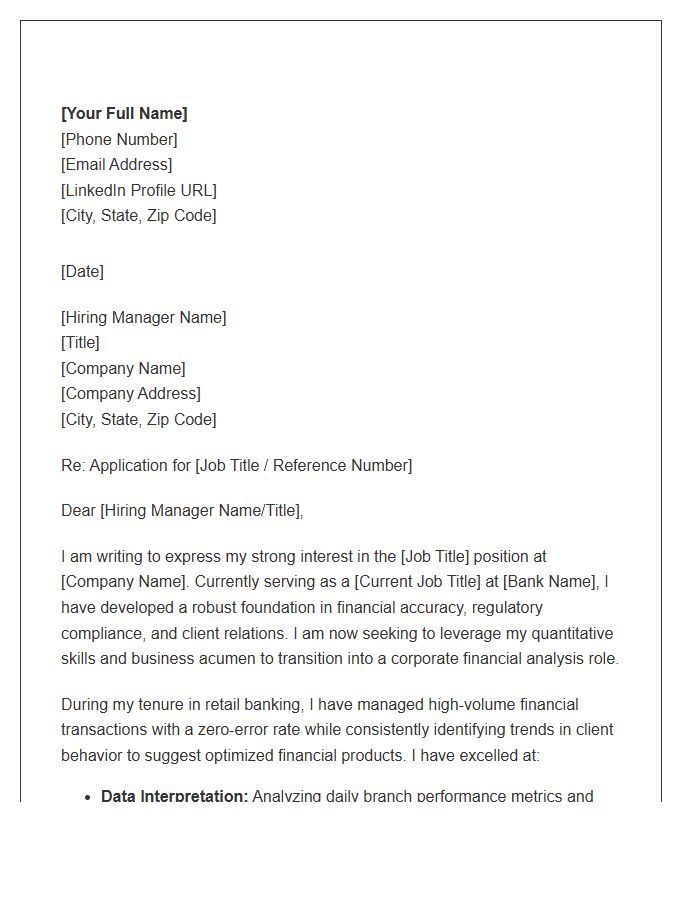
This Bank Teller to Corporate Financial Analysis template is designed to help you pivot from retail banking into high-level corporate finance roles. It works by strategically re-framing your daily banking tasks-like cash handling and customer service-into high-value technical skills. Instead of just listing duties, this template uses data-driven language to highlight your precision and analytical growth. It focuses on Quantitative Skills (the ability to work with numbers and statistics) and Financial Modeling (the act of creating abstract representations of a real-world financial situation). By emphasizing your familiarity with Compliance and your recent Technical Upskilling in tools like Excel or SQL, you demonstrate that you are ready to handle complex Forecasting. This conversational yet professional approach bridges the gap between the teller window and the corporate boardroom. Tip: Always quantify your achievements, such as mentioning your "zero-error rate" or the specific volume of transactions you managed daily, to prove your reliability.
Financial Analyst Associate Cover Letter Template For Bank Tellers
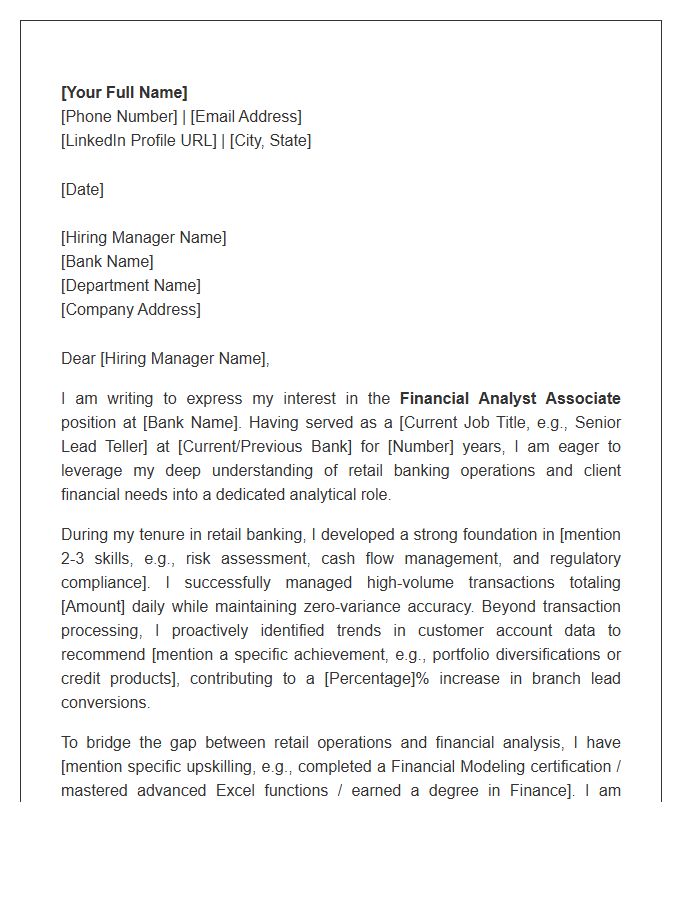
Transitioning from a retail branch to a corporate office requires a strategic Financial Analyst Associate Cover Letter. This template works by translating your daily banking tasks into high-level analytical achievements. Instead of just listing duties, it uses Transferable Skills-abilities like risk assessment and data interpretation-to prove you can handle complex Forecasting (predicting future financial trends). By highlighting Data-Driven Results, such as transaction accuracy rates or lead conversion percentages, you demonstrate a "numbers-first" mindset. The layout is designed to bridge the gap between frontline service and technical Financial Modeling. It emphasizes your Regulatory Compliance knowledge, which is a massive asset in banking. This approach works because it reframes your teller experience as a solid foundation in Asset Management and client behavior. Tip: Always quantify your achievements with specific dollar amounts or percentages to prove your impact on the branch's bottom line.
Career Pivot Bank Teller To Financial Analysis Cover Letter Template
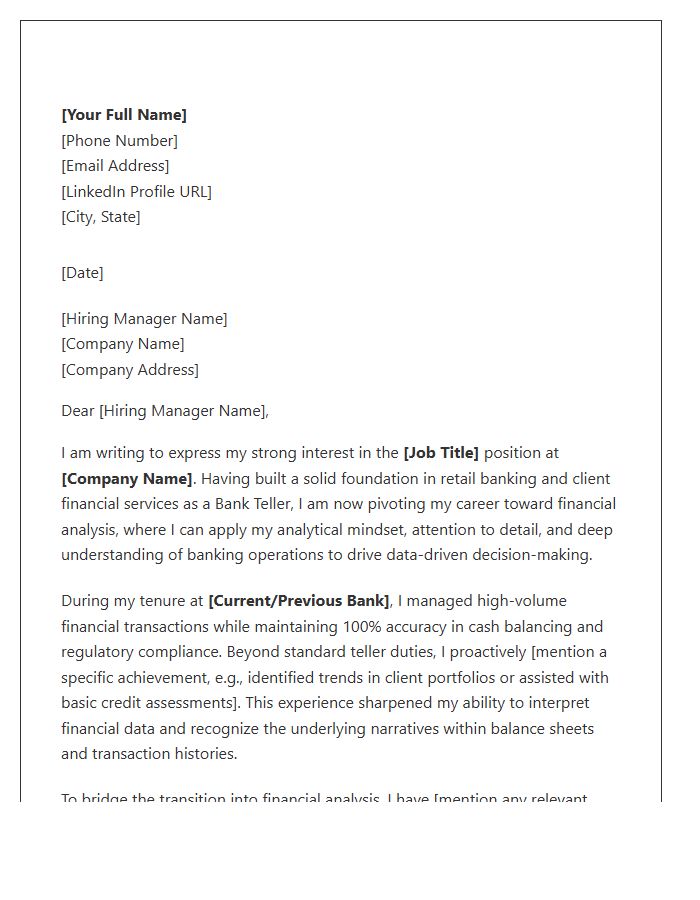
Switching from a bank teller role to Financial Analysis requires a cover letter that bridges the gap between operational accuracy and Strategic Forecasting. This template works by translating your daily "front-line" tasks into high-level data skills. For instance, instead of just mentioning cash handling, it emphasizes your ability to manage Quantitative Analysis and maintain 100% data integrity. It highlights your transition by focusing on Transferable Skills, such as recognizing trends in client portfolios or mastering complex spreadsheets. The structure is designed to prove you can handle the Glossary of the industry-terms like Variances (the difference between planned and actual numbers) and Financial Modeling (predicting a company's future performance). By showcasing specific certifications or technical tools like SQL and Pivot Tables, you demonstrate that you are ready to move from processing transactions to interpreting them. Note: Always quantify your banking achievements with percentages to prove your readiness for a data-heavy analytical role.
Bank Teller With Financial Modeling Experience Cover Letter Template
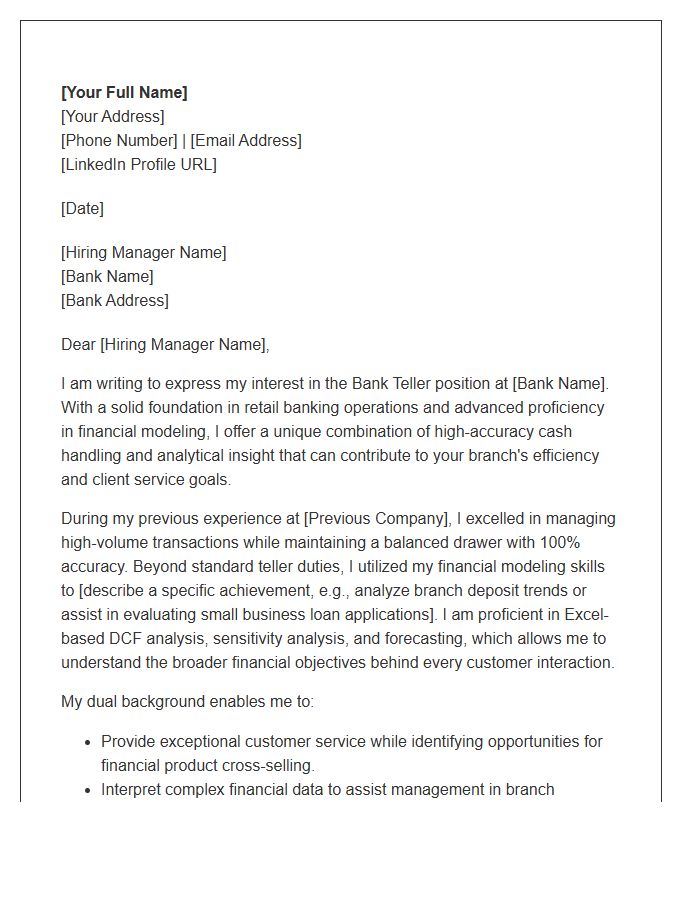
This Bank Teller Cover Letter Template is designed to bridge the gap between front-end customer service and back-end quantitative analysis. In a competitive job market, banks look for candidates who understand the "why" behind the numbers. This template works by showcasing your ability to handle daily cash management with 100% accuracy while highlighting your Financial Modeling skills-specifically DCF (Discounted Cash Flow) analysis and sensitivity analysis (testing how different variables affect financial outcomes). By mentioning cross-selling and forecasting, you signal to hiring managers that you are ready for upward mobility into roles like credit analysis or private banking. It effectively proves you can manage high-volume transactions while using data to improve branch performance. Note: Always quantify your achievements, such as the specific volume of transactions handled daily or the percentage of accuracy maintained over your tenure.
Bank Operations To Financial Analysis Career Move Cover Letter Template
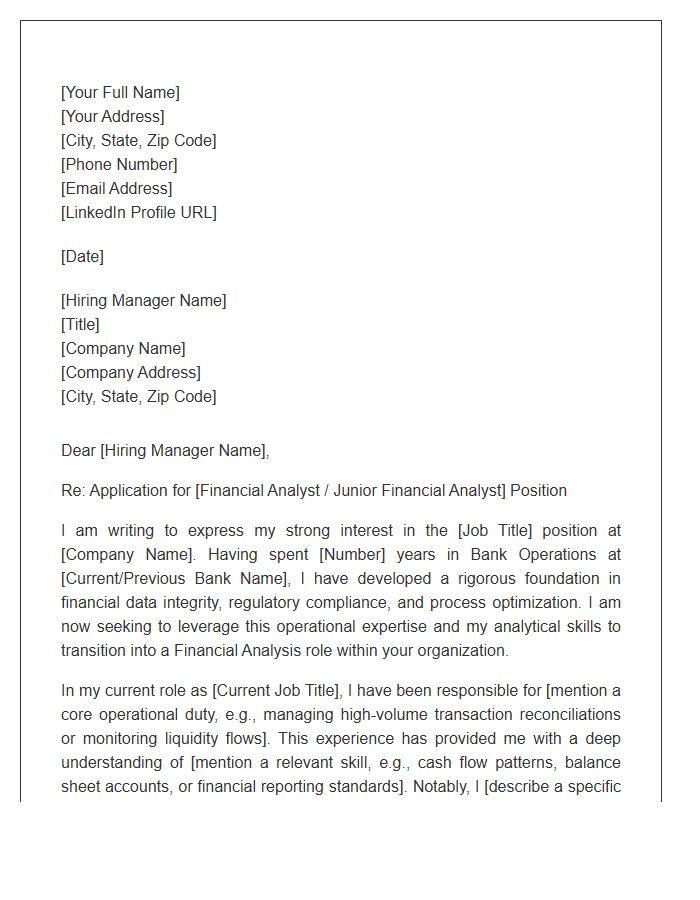
Transitioning from Bank Operations to a Financial Analysis role requires a strategic shift in how you present your experience. This template works by reframing your history of managing transactional workflows and data integrity as the essential foundation for forecasting. It bridges the gap between processing numbers and interpreting them for strategic decision-making. By highlighting your familiarity with reconciliations (matching records to ensure accuracy) and liquidity flows (the movement of cash within an institution), you demonstrate a "ground-up" understanding of financial health that pure analysts often lack. The conversational tone helps you explain how your operational reality informs more accurate financial modeling. This approach pivots your career by focusing on your technical proficiency in tools like SQL or advanced Excel, proving you can handle the quantitative rigor of an analyst position. Note: Quantify your achievements by mentioning the specific volume of data or the percentage of reporting efficiency you improved to catch a recruiter's eye.
Commercial Banking Background Financial Analyst Cover Letter Template
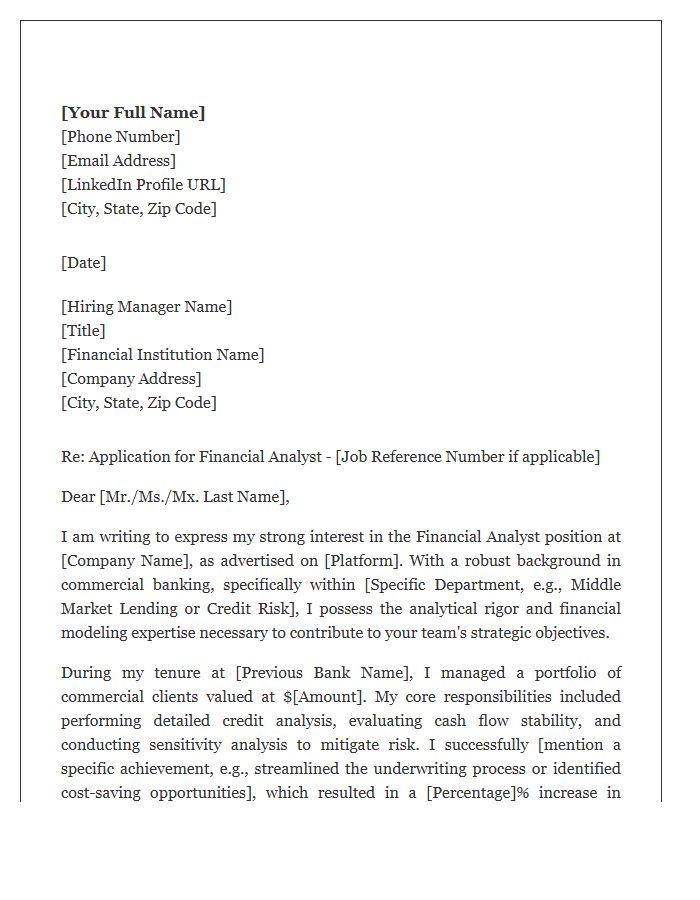
This Commercial Banking Financial Analyst Cover Letter Template is designed to help you pivot from traditional banking roles into high-level corporate analysis. It works by emphasizing your transferable skills, such as the ability to assess risk and manage large portfolios. Unlike general resumes, this template uses a conversational yet professional tone to highlight your Credit Analysis (the process of evaluating a borrower's ability to repay loans) and Sensitivity Analysis (a technique determining how different values of an independent variable impact a specific dependent variable). By quantifying your achievements-like managing a specific portfolio value or increasing efficiency by a certain percentage-you provide hard data that proves your worth to hiring managers. This structure ensures your Underwriting expertise translates into strategic decision-making value. Remember: always customize the bracketed sections with specific metrics to demonstrate how your banking background reduces financial uncertainty for your new employer.
Professional Bank Teller To Junior Financial Analyst Cover Letter Template
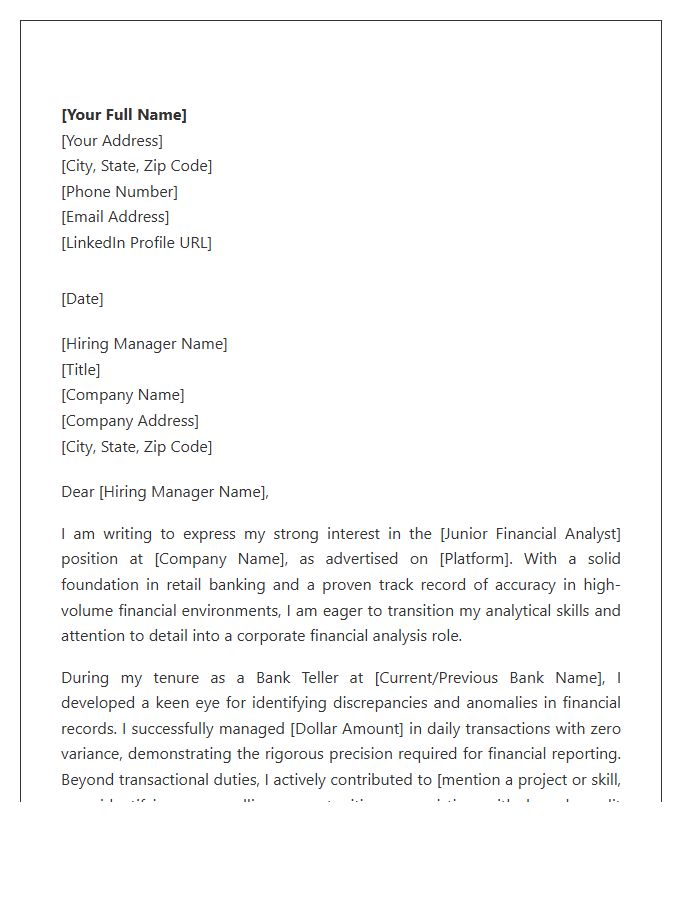
Transitioning from a retail branch to a corporate office requires a strategy focused on transferable skills. This template functions as a bridge, reframing your daily banking tasks into high-level analytical competencies. By highlighting your history of managing high-volume transactions with zero variance (the difference between actual and expected results), you prove your attention to detail is ready for complex financial reporting. The structure works by prioritizing "quantifiable achievements"-such as the specific dollar amounts you handled-to demonstrate your comfort with fiduciary responsibility (the legal and ethical duty to manage money carefully). This conversational yet professional approach shifts the narrative from basic customer service to trend forecasting and risk assessment. It explains the "how" by linking your banking background to technical tools like Excel modeling, ensuring recruiters see your potential rather than just your previous title. Note: Always customize the actionable insights section to match the specific industry software mentioned in the job description.
Banking Clerk To Financial Analysis Specialist Cover Letter Template
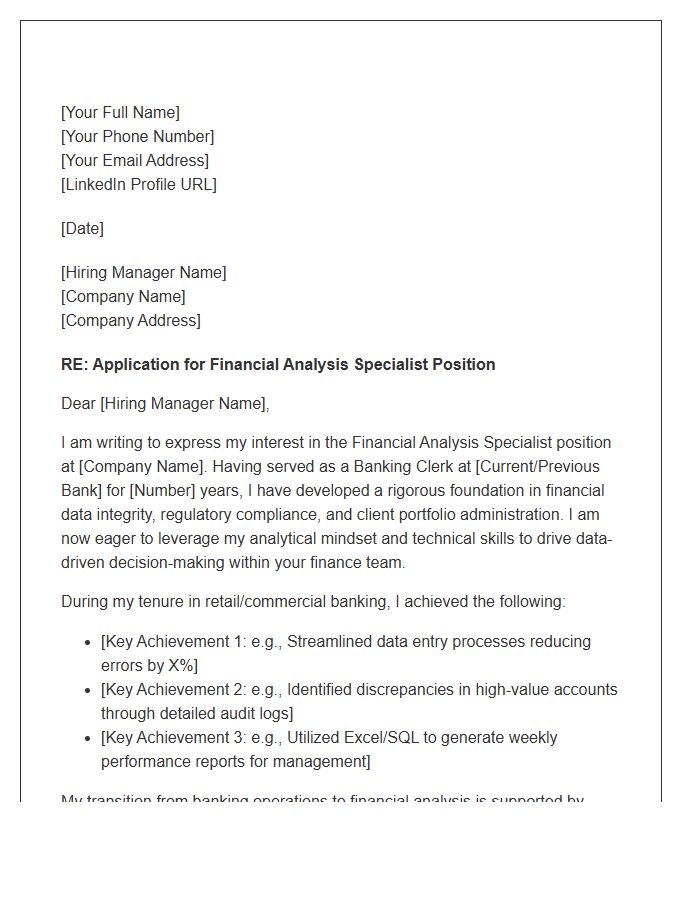
Transitioning from a Banking Clerk to a Financial Analysis Specialist requires a shift from operational tasks to strategic data interpretation. This template works by focusing on transferable skills, such as Data Integrity (the accuracy and consistency of data over its lifecycle) and Regulatory Compliance. It highlights your ability to handle complex Quantitative Analysis while framing your banking background as a solid foundation for Financial Forecasting-the process of predicting future financial outcomes based on historical data. By using this conversational yet professional structure, you demonstrate how your experience with Audit Logs and Portfolio Administration translates directly into the analytical rigor needed for high-level finance roles. This approach effectively bridges the gap between daily transactions and long-term Strategic Narratives. Note: Quantify your achievements with percentages or currency figures to prove you have an analytical mindset ready for a specialist role.
Analytical Bank Teller Transitioning To Finance Cover Letter Template
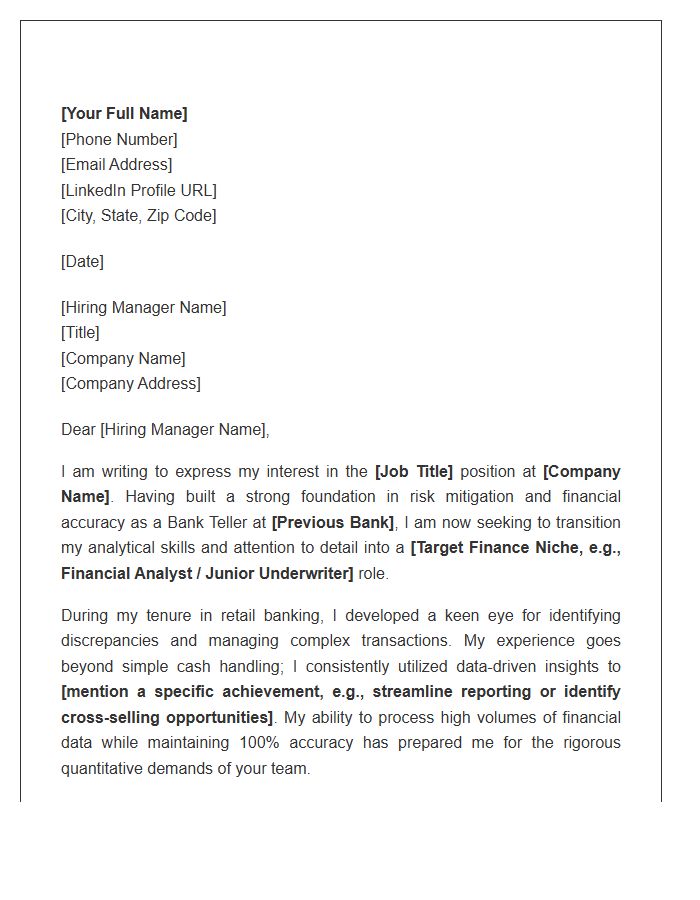
This Analytical Bank Teller Transitioning To Finance Cover Letter Template is designed to help you pivot from retail banking into high-level financial roles. It works by emphasizing your transferable skills-shifting the focus from basic customer service to quantitative analysis and risk mitigation. By highlighting your history of processing data with 100% accuracy, you prove that you possess the attention to detail required for complex financial reporting. The template uses a conversational yet professional tone to explain how your frontline experience with regulatory compliance (adhering to laws like AML or KYC) prepares you for back-end strategy. It effectively bridges the gap between manual transaction handling and data-driven decision-making. Glossary: Risk mitigation refers to the process of reducing potential financial losses, while quantitative demands involve the ability to work with large numerical datasets. Note: Always customize the software section to mention specific tools like Excel Pivot Tables or Bloomberg Terminals to stand out to hiring managers.
Strategic Pivot: From Retail Banking to Quantitative Financial Analysis
Transitioning from a frontline banking role to a back-office analytical position requires a paradigm shift from transactional processing to data synthesis. This transition leverages foundational knowledge of Capital Adequacy Ratios (CAR) and Net Interest Margin (NIM) to perform comprehensive corporate valuation and fiscal forecasting.
- Stochastic Modeling: Utilizing historical bank ledger data to predict future cash flow volatility.
- Variance Analysis: Examining discrepancies between projected budgetary allocations and actual expenditures.
- Risk Mitigation: Applying Basel III framework principles to organizational liquidity assessments.
Technical Competency Mapping: Bridging the Skill Gap
The evolution from a Bank Teller involves upgrading manual reconciliation skills to automated Extract, Transform, Load (ETL) processes. The following table delineates the functional transition of core competencies required for a Financial Analyst role.
| Bank Teller Functional Area | Financial Analysis Equivalent | Key Technical Instrument |
|---|---|---|
| Cash Handling & Audit | Treasury Management | ERP Systems (SAP/Oracle) |
| Customer Credit Profiling | Credit Risk Modeling | Python (Scikit-learn) |
| Daily Balance Reporting | Financial Statement Analysis | Advanced Excel (VBA/Power Query) |
Core Methodology: Applying Financial Ratios and Metrics
Effective financial analysis necessitates a deep dive into Solvency Ratios and Operational Efficiency metrics. While a teller monitors individual account health, an analyst evaluates the entire firm's Weighted Average Cost of Capital (WACC) to determine investment viability.
- Liquidity Assessment: Calculation of Current and Quick Ratios to ensure short-term obligation coverage.
- Profitability Profiling: Analyzing EBITDA margins to strip away non-operating distortions.
- Leverage Evaluation: Determining Debt-to-Equity thresholds to optimize capital structure.
Macro-Economic Integration and Market Sensitivity
A transitionary cover letter must highlight the ability to interpret Macroeconomic Indicators such as the Consumer Price Index (CPI) and Yield Curve Inversion. Understanding how Federal Open Market Committee (FOMC) decisions influence commercial lending rates is critical for long-term strategic planning.
- Fundamental Analysis: Assessing intrinsic value based on bottom-up financial health.
- Quantitative Easing Impact: Evaluating the effect of monetary policy on corporate bond pricing.
- Regression Analysis: Identifying correlations between interest rate fluctuations and sector-specific performance.
Narrative Structuring for the Transitionary Cover Letter
The final stage of the transition involves synthesizing professional experience into a narrative that emphasizes Predictive Analytics over historical record-keeping. The letter should follow a logical hierarchy that prioritizes Return on Investment (ROI) and Discounted Cash Flow (DCF) modeling capabilities.
- The Hook: Connecting frontline operational experience to high-level fiscal oversight.
- The Evidence: Quantifying achievements using terms like Basis Points (BPS) and Asset-Liability Management (ALM).
- The Value Proposition: Demonstrating how a background in rigorous compliance leads to more accurate Sensitivity Analysis.
Note: Sometimes the .PDF file interface can be slightly different from the image preview. Our apology for this inconvenience.


Comments