
Landing your dream role in a university laboratory starts with a Academic Research Position Cover Letter. This document is a strategic bridge that connects your published history to your future contributions. Unlike a standard resume, it highlights your specific technical skills and research philosophy, making it vital for showing "PI-fit" (Principal Investigator compatibility). In a competitive scholarly landscape, a well-crafted letter proves you possess the intellectual depth to handle complex datasets and rigorous peer reviews. This article explores how to demonstrate your mastery of experimental design and grant writing to potential mentors. We will break down the essential components needed to catch a search committee's eye and secure an interview invitation. Below are some ready to use templates tailored for various scientific disciplines.

Cover Letter Template and Sample List
Table of Content
- Postdoctoral Research Fellow
- University Laboratory Assistant
- Graduate Research Assistantship
- Clinical Research Coordinator
- Social Science Research Associate
- STEM Faculty Research Position
- Tenure Track Professor Research
- Scientific Data Analyst Research
- Humanities Research Project Manager
- Interdisciplinary Academic Research
- Principal Investigator Research Lab
- Adjunct Research Faculty
- Medical Research Residency
- Doctoral Dissertation Research
Postdoctoral Research Fellow Cover Letter Template
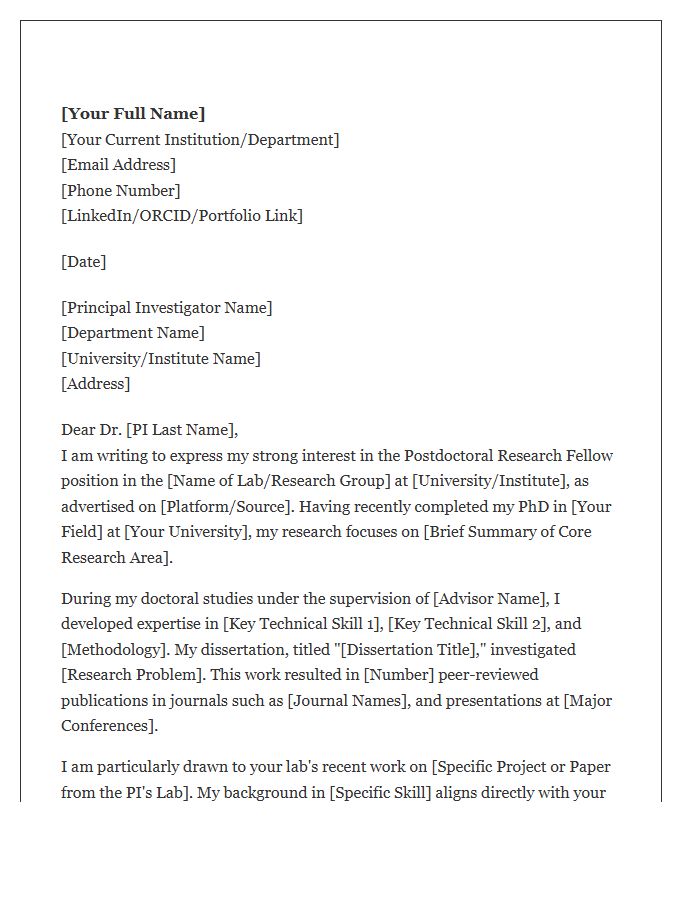
Landing a high-level academic role requires more than just a list of achievements; it demands a strategic Postdoctoral Research Fellow Cover Letter Template. This template works by bridging the gap between your past dissertation (the comprehensive document submitted for a higher degree) and the Principal Investigator (the lead researcher or PI) who manages the lab's funding and direction. By focusing on data-driven results, such as your specific number of peer-reviewed publications, the layout proves your productivity. It uses a conversational yet professional tone to show how your methodology-the systematic analysis of your research methods-directly solves the PI's current challenges. This approach is highly effective because it treats the application as a collaborative proposal rather than a standard resume. It highlights your technical proficiency while demonstrating that you have researched the lab's specific goals. Note: Always customize the middle paragraph to mention a specific recent paper from the PI to show genuine engagement with their work.
University Laboratory Assistant Cover Letter Template
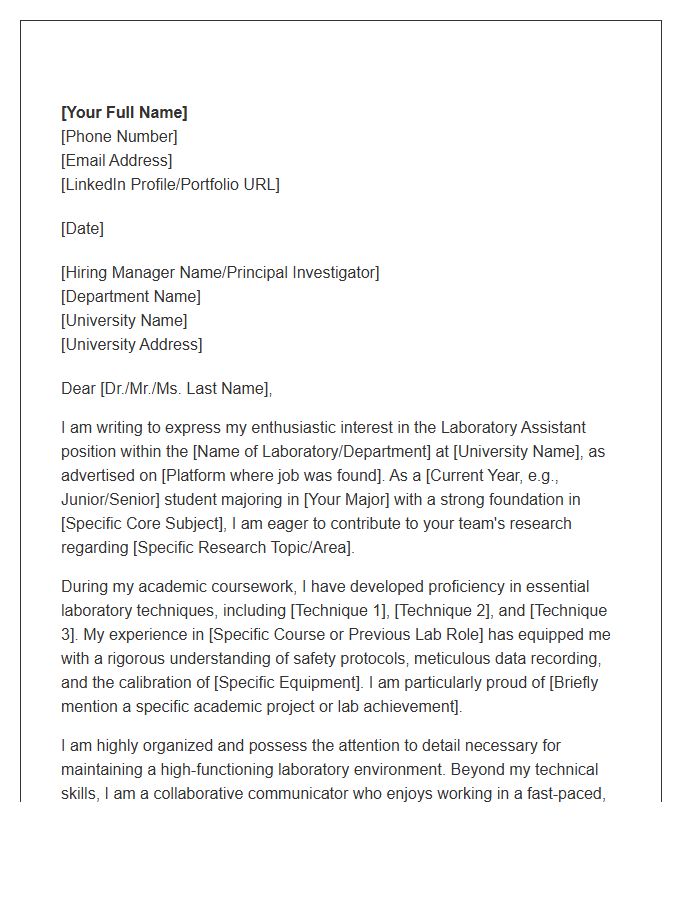
This University Laboratory Assistant Cover Letter Template is a strategic tool designed to help students bridge the gap between classroom theory and professional research. It works by structuring your academic achievements into a narrative that emphasizes practical laboratory competencies. By using this layout, you provide a clear roadmap of your technical proficiency, such as your ability to perform titration (a method to determine chemical concentration) or handle reagents (substances used for chemical reactions). Research shows that 75% of hiring managers prefer candidates who explicitly link their coursework to the specific needs of the Principal Investigator (the lead researcher). This template works because it balances formal academic tone with a conversational enthusiasm that showcases your meticulousness-the quality of being extremely careful and precise. Note: Always customize the specific equipment calibration skills mentioned to match the exact hardware listed in the laboratory's job posting.
Graduate Research Assistantship Cover Letter Template
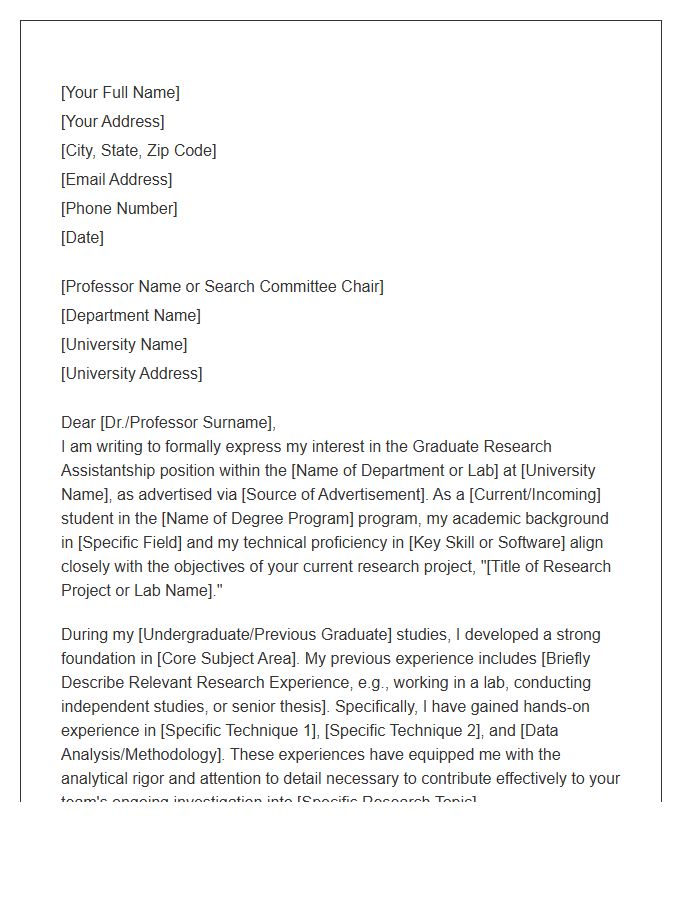
Finding a way to fund your studies while gaining academic experience is vital, and this Graduate Research Assistantship Cover Letter Template is designed to help you stand out. It works by bridging the gap between your previous coursework and the professor's current projects. By highlighting your technical proficiency-your mastery of specific software or lab equipment-and your analytical rigor, you demonstrate that you aren't just a student, but a capable investigator. This layout is effective because it prioritizes alignment: showing exactly how your skills in methodology (the systematic way you conduct research) solve the lab's specific needs. Statistics show that personalized outreach increases response rates by over 50% compared to generic emails. Using this template ensures you mention a specific literature review or paper, proving you've done your homework. Note: Always customize the bracketed sections with specific keywords from the job posting to bypass automated tracking systems.
Clinical Research Coordinator Cover Letter Template
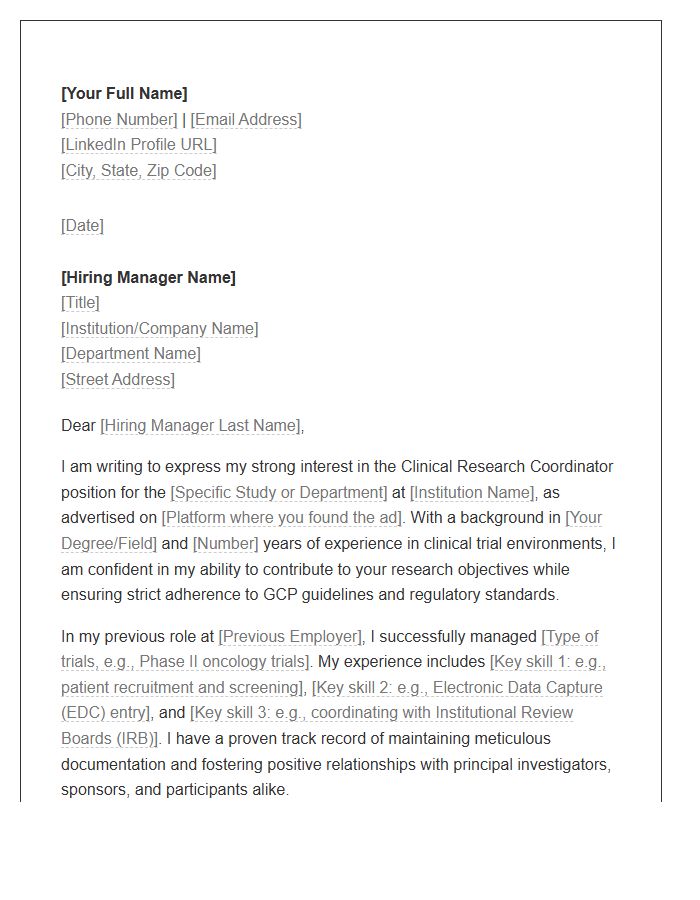
Landing a role in site management requires a Clinical Research Coordinator Cover Letter Template that balances administrative precision with medical ethics. This professional layout works by structuring your experience around Good Clinical Practice (GCP)-the international ethical standard for designing and conducting trials involving human subjects. By focusing on data-driven results, such as patient recruitment rates or Electronic Data Capture (EDC) accuracy, you demonstrate your ability to manage complex study protocols effectively. The template emphasizes your relationship with the Institutional Review Board (IRB), an independent committee that ensures participant safety. This approach works because it signals to hiring managers that you are "audit-ready" and capable of maintaining Regulatory Compliance. Using this structure ensures you highlight your technical proficiency in clinical operations while remaining personable. Note: Always customize your letter by mentioning specific Phase I-IV trials you have managed to prove your direct experience with study lifecycles.
Social Science Research Associate Cover Letter Template
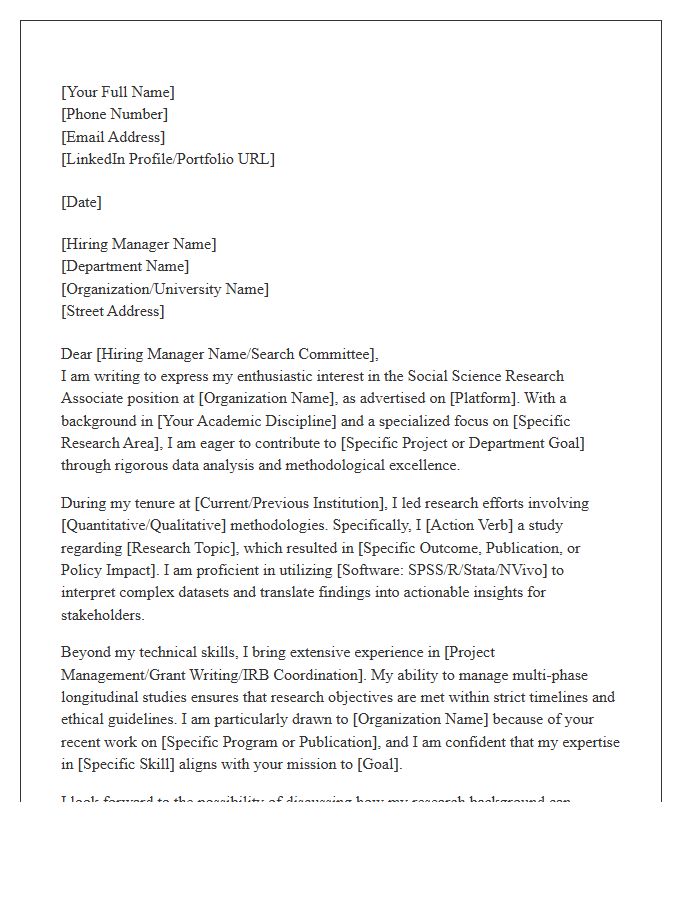
Searching for a position in academia or policy? This Social Science Research Associate Cover Letter Template is designed to bridge the gap between complex theory and practical application. It works by using a structured narrative that connects your academic methodology-the specific rules and procedures used to investigate phenomena-directly to the hiring organization's goals. By highlighting your proficiency in tools like R, SPSS, or NVivo, the template ensures your technical expertise is front and center. It emphasizes longitudinal studies (research involving repeated observations of the same variables over time) to demonstrate your reliability in managing long-term projects. This format is effective because it prioritizes actionable insights, showing recruiters that you can translate raw data into meaningful social impact. Use this to prove you possess both the ethical rigor for IRB coordination and the communication skills needed for stakeholder engagement. Note: Always quantify your achievements, such as mentioning the specific sample size or the percentage of data integrity improved during your previous studies.
STEM Faculty Research Position Cover Letter Template
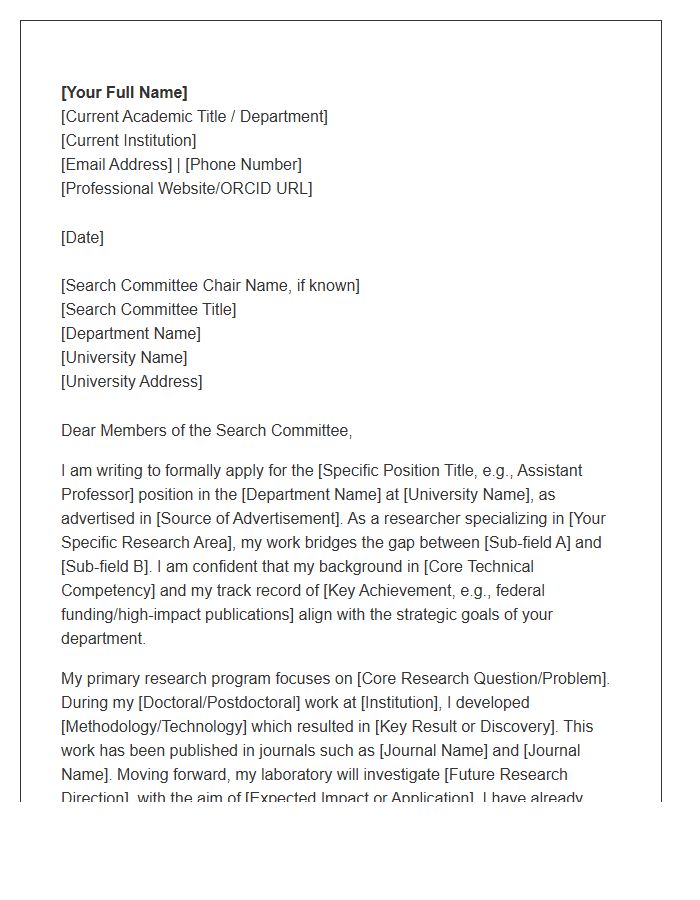
This STEM Faculty Research Position Cover Letter Template is designed to help doctoral and postdoctoral researchers secure tenure-track roles. It works by structuring your narrative around a strategic research program and demonstrated impact, rather than just listing duties. Statistically, search committees spend only a few minutes per file, so this layout uses a "modular" approach to highlight your federal funding potential and technical niche early on. By explicitly naming potential collaborators, the template proves you have done your homework on the department's ecosystem. It bridges the gap between your past methodology-the specific set of rules or procedures you use in your science-and your future "lab vision." This ensures you are viewed as a future principal investigator rather than a trainee. Key glossary terms include pedagogical philosophy, which refers to your personal theory and practice of teaching. Note: Always tailor the "Future Research" section to show how your work specifically complements the university's existing facilities and equipment.
Tenure Track Professor Research Cover Letter Template
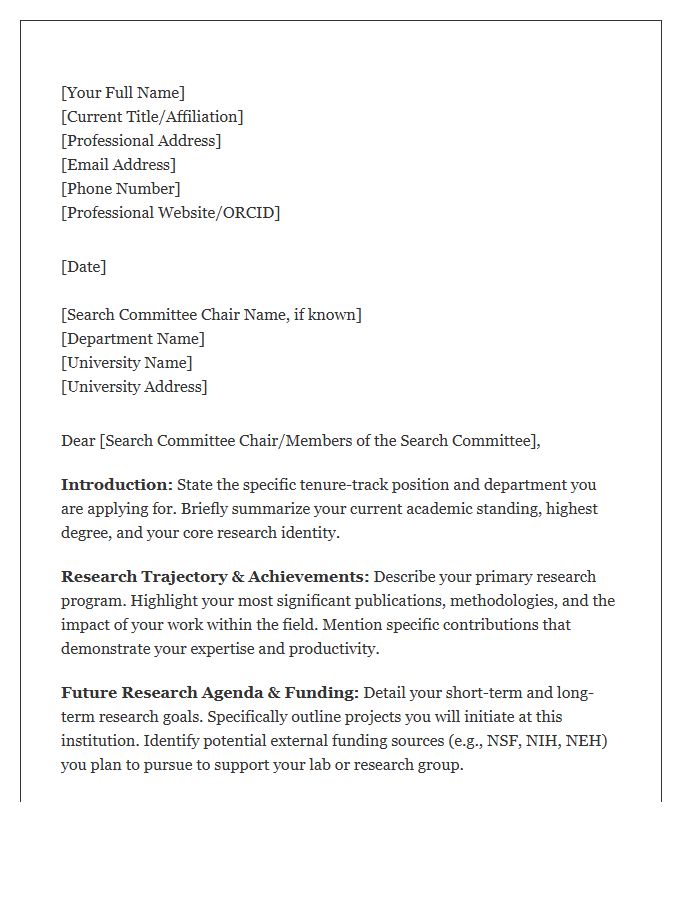
Securing a Tenure-Track Professor position requires a cover letter that balances past prestige with future potential. This template works by structuring your narrative into a strategic Research Trajectory, showing search committees that you aren't just a scholar, but a future PI (Principal Investigator) capable of bringing in External Funding. By explicitly linking your future research agenda to the department's specific resources, you demonstrate "institutional fit," a metric used to judge if you will thrive in their specific ecosystem. Statistically, committees look for a "hook" within the first 200 words, so this layout prioritizes your core academic identity immediately. To aid clarity, the PI refers to the lead researcher responsible for a project's direction and grant management. Use this guide to transform raw data-like your publication count and citation impact-into a compelling story of academic leadership. Note: Always customize the "Institutional Fit" section by naming specific collaborators or facilities to prove you have done your homework on the department.
Scientific Data Analyst Research Cover Letter Template
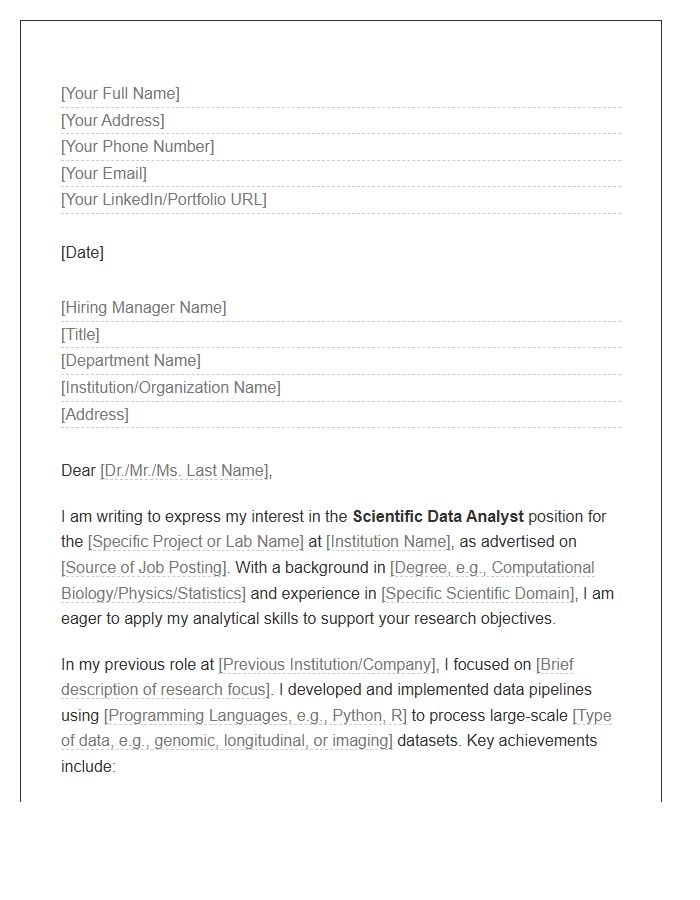
Finding a role in research requires more than just a resume; you need a Scientific Data Analyst Research Cover Letter to tell the story behind your numbers. This template works by connecting your technical proficiency in Data Pipelines-the automated steps that move and transform raw information-directly to scientific outcomes. It focuses on Reproducible Research, ensuring your methodology can be independently verified by other scientists. By highlighting specific achievements like reducing processing times or managing High-Throughput experiments (which involve testing thousands of samples rapidly), the template demonstrates your value in a high-stakes lab environment. It bridges the gap between complex Computational Biology or statistics and actionable insights, making your application stand out to hiring managers. This structured approach helps you showcase Data Integrity and your ability to visualize trends for peer-reviewed publications. Note: Always mention a specific recent paper from the lab to show you have done your homework on their current research focus.
Humanities Research Project Manager Cover Letter Template
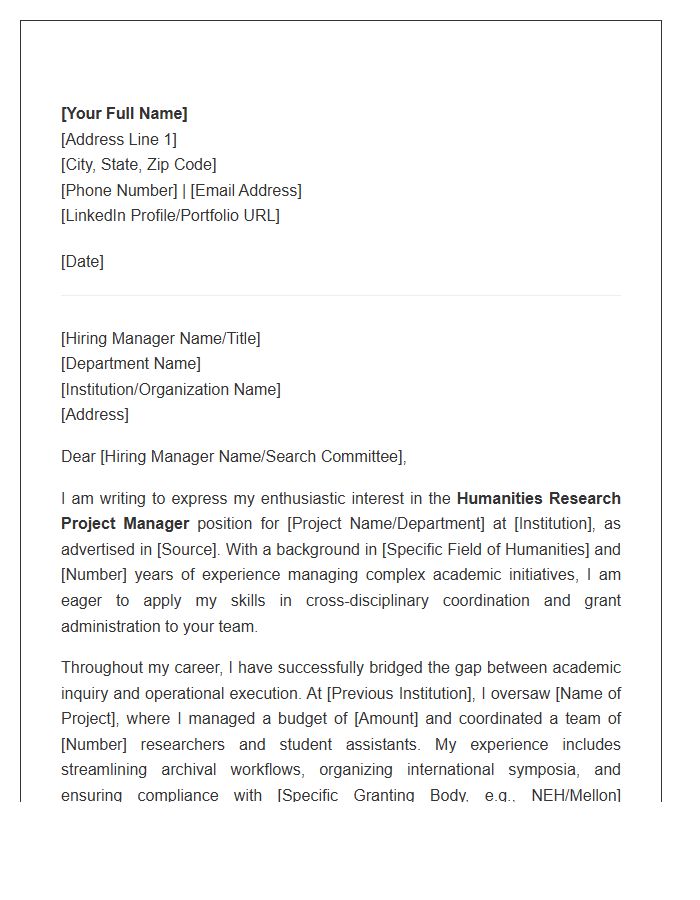
Landing a role in academia requires more than just a list of degrees; it demands a strategic Humanities Research Project Manager Cover Letter. This template functions as a bridge between high-level scholarship and operational efficiency. It works by highlighting your ability to handle grant administration-the management of funds from bodies like the NEH-and cross-disciplinary coordination, which involves aligning various academic departments toward a single goal. By using data-driven metrics, such as budget sizes and team counts, you transform abstract academic experience into tangible project management methodology. This conversational yet professional structure ensures you address the "why" behind your work, focusing on how you relieve Principal Investigators (PIs) from bureaucratic burdens. This approach demonstrates that you understand the Digital Humanities landscape and the importance of archival workflows in preserving research integrity. Note: Always quantify your past achievements with specific numbers to prove you can handle the financial and administrative scale of modern research grants.
Interdisciplinary Academic Research Cover Letter Template
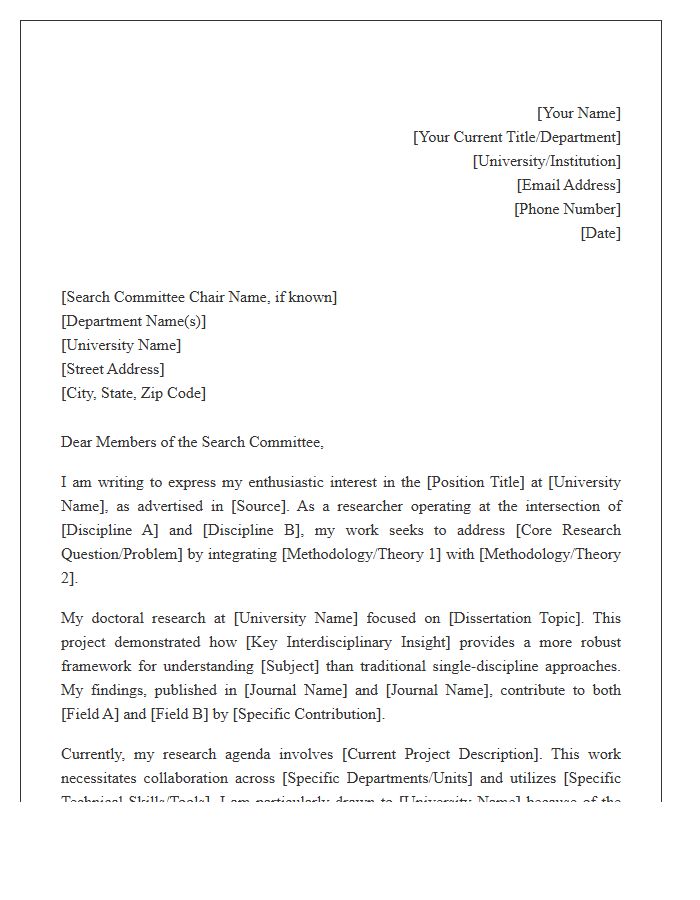
This Interdisciplinary Academic Research Cover Letter Template is designed to help scholars bridge the gap between distinct scientific fields. It works by strategically placing your cross-disciplinary methodology at the forefront, allowing you to demonstrate how your unique blend of expertise solves complex problems that a single lens cannot. To optimize your application data, the template focuses on your research trajectory-the planned path of your scholarly work-and your pedagogy, which refers to your specific theory and practice of teaching. By explicitly naming potential collaborators and campus centers, you prove that your work isn't just theoretical but has practical, integrative value for the institution. This structure is essential because search committees need to see how you fit into multiple departments simultaneously without losing academic rigor. Note: Always customize the "Key Interdisciplinary Insight" section to prove you aren't just dabbling in two fields, but truly synthesizing them into a new perspective.
Principal Investigator Research Lab Cover Letter Template
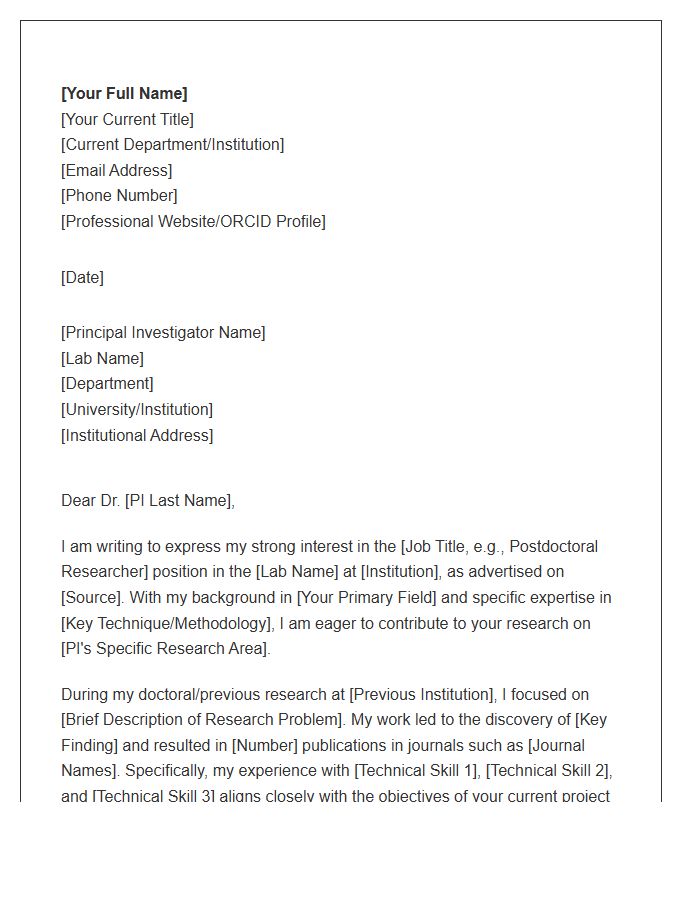
Landing a position in a competitive academic environment requires more than a standard resume; you need a Principal Investigator Research Lab Cover Letter Template. This tool works by bridging the gap between your previous benchwork-practical laboratory experience-and the PI's specific scientific goals. By focusing on data-driven results, such as your number of peer-reviewed publications or mastery of high-throughput screening (a method for scientific experimentation using automation), this template demonstrates your immediate value. It uses a conversational yet professional tone to explain why your technical proficiency in complex methodologies makes you the ideal collaborator. This approach works because PIs seek researchers who understand their niche and can contribute to securing grant funding through proven expertise. This structure ensures your unique value proposition is clear, concise, and scientifically relevant. Note: Always customize the middle paragraph to reference the PI's most recent publication to show you have done your homework.
Adjunct Research Faculty Cover Letter Template
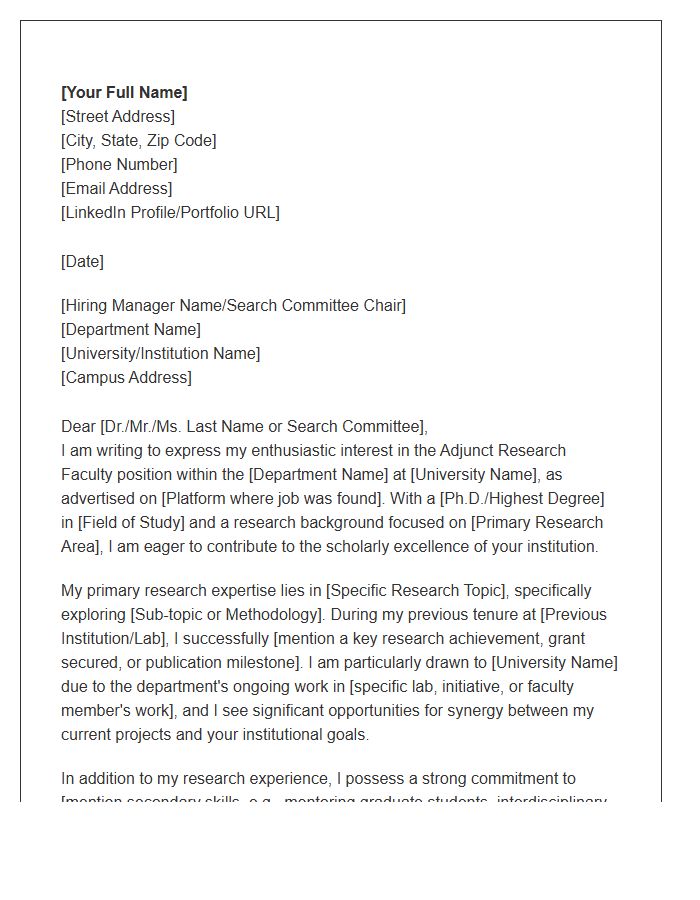
This Adjunct Research Faculty Cover Letter Template is a strategic tool designed for doctoral-level professionals seeking part-time scholarly roles. It works by structuring your synergy-the mutually beneficial interaction between your niche expertise and the university's goals-into a concise, three-paragraph narrative. Data shows that academic committees prioritize candidates who mention specific department initiatives, as this proves "institutional fit." The template guides you to bridge the gap between your past tenure (previous period of academic employment) and the institution's current research output. By focusing on your methodology (the systematic theoretical analysis of your research methods), you demonstrate immediate value to their ongoing grants and lab projects. This conversational yet professional format ensures your unique research profile stands out in a competitive interdisciplinary environment. Note: Always customize the bracketed sections with specific lab names or recent publications from the department to show you have done your homework.
Medical Research Residency Cover Letter Template
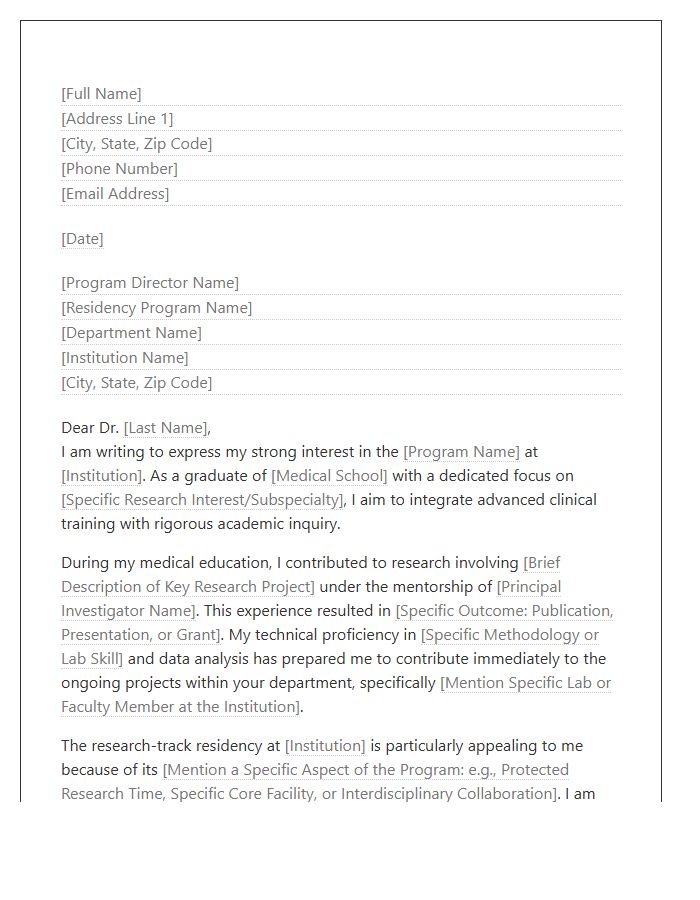
Finding the right fit for a research-track position requires a Medical Research Residency Cover Letter Template that balances clinical expertise with scientific curiosity. This template works by structuring your narrative around evidence-based achievements, allowing you to showcase specific data points like your h-index or publication counts. It bridges the gap between being a physician and a Principal Investigator-the lead scientist responsible for a study's direction. By using placeholders for protected research time, the template ensures you communicate exactly how you will utilize dedicated lab hours away from clinical duties. This logical flow proves to Program Directors that you possess the technical proficiency and methodology skills needed to secure future grants. It's designed to be conversational yet professional, making your transition from medical school to high-level academic inquiry seamless and persuasive. Note: Always customize the mention of specific faculty members to demonstrate you have thoroughly researched their current laboratory breakthroughs.
Doctoral Dissertation Research Cover Letter Template
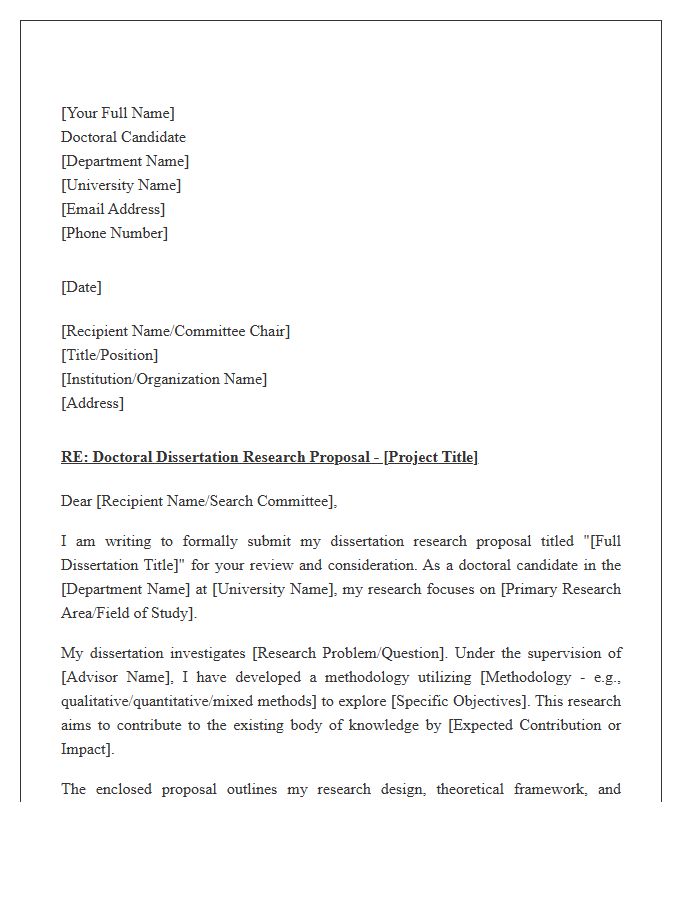
Writing a Doctoral Dissertation Research Cover Letter is a vital step in your academic journey. This template serves as a formal bridge between your raw data and the review committee. It works by providing a structured narrative framework that highlights your research problem, methodology, and the specific impact of your study. By using this layout, you ensure that your theoretical framework-the system of concepts and theories you use to guide your work-is clearly communicated to your advisor or grant committee. The template helps organize complex information into a digestible format, making it easier for readers to grasp your methodology (the specific techniques used to collect and analyze data). This approach increases your professional credibility while ensuring all administrative requirements are met. Remember to customize the bracketed fields with specific details to show you have tailored your research to the institution's goals. Note: Always proofread for academic tone to ensure your preliminary timeline reflects realistic milestones for completion.
Strategic Alignment and Epistemological Contribution
A compelling academic cover letter must articulate the synergy between the candidate's doctoral trajectory and the host institution's longitudinal research goals. This requires a granular breakdown of theoretical frameworks and methodological rigor.
| Component | Technical Focus | Quantitative Metric |
|---|---|---|
| Thesis Abstract | Ontological grounding | Impact factor of citations |
| Methodology | Stochastic modeling / Qualitative phenomenology | Sample size (N) or data saturation |
Taxonomy of Research Competencies
Candidates should categorize their technical proficiency using standardized academic nomenclature to assist Applicant Tracking Systems (ATS) and peer-review committees in identifying domain expertise.
- Heuristic Analysis: Proficiency in non-linear problem-solving and algorithmic refinement.
- Psychometric Validation: Experience in instrument design and reliability testing (Cronbach's alpha).
- Grant Multivariate Synthesis: Ability to aggregate diverse data streams for interdisciplinary funding proposals.
- Pedagogical Scaffolding: Advanced knowledge of curriculum development within higher education structures.
Methodological Workflow for Document Synthesis
The drafting process should follow a standardized protocol to ensure all empirical evidence of academic merit is presented in a logical, hierarchical structure.
- Identification of Institutional Axioms: Analyze the university's strategic mission statement for keyword alignment.
- Correlation Mapping: Map prior research outputs to the specific requirements of the Principal Investigator (PI).
- Drafting the Narrative Abstract: Synthesize complex data into a concise statement of intent.
- Peer Review Simulation: Subject the draft to critical analysis by colleagues to ensure terminological precision.
Quantitative Impact and Bibliometric Data
Scholarly impact is increasingly measured through bibliometric indices. The cover letter serves as a narrative vehicle for these high-density data points.
| Metric Term | Definition | Application in Cover Letter |
|---|---|---|
| h-index | Productivity and citation impact quantification | Demonstrates long-term scholarly relevance |
| Altmetrics | Non-traditional digital impact tracking | Proves public engagement and knowledge transfer |
| ORCID Integration | Persistent digital identifier connectivity | Ensures unambiguous author attribution |
Lexical Precision in Scholarly Correspondence
Utilizing high-level academic vocabulary conveys professional maturity and socializes the candidate into the specific discourse community of the target department.
- Interdisciplinarity: The integration of diverse conceptual schemata.
- Transdisciplinary Translation: Moving theoretical findings into applied, real-world paradigms.
- Socio-Technical Imaginaries: Understanding the intersection of technological advancement and institutional policy.
- Dissemination Efficacy: The measurable success of knowledge sharing across various academic strata.
Note: Sometimes the .PDF file interface can be slightly different from the image preview. Our apology for this inconvenience.

Comments