
Transitioning from a field tour guide to a professional museum educator requires a strategic shift in how you present your background. This article explores how to pivot your Museum Education Cover Letter to highlight academic engagement and visitor experience data. Rather than just leading groups, you must showcase your ability to design "Pedagogical Frameworks" (structured methods for teaching) and manage "Object-Based Learning" (using physical artifacts to inspire critical thinking). Museums seek candidates who can translate raw history into interactive curricula. By emphasizing your public speaking metrics and educational outreach impact, you prove you can bridge the gap between entertainment and formal instruction. This guide breaks down how to align your storytelling skills with institutional goals. Below are some ready to use templates to help you secure your next role.
Cover Letter Template and Sample List
Table of Content
- Tour Guide To Museum Educator
- Museum Education Specialist For Former Tour Guides
- Transitioning From Tour Guide To Museum Education
- Historical Tour Guide To Museum Pedagogy
- Gallery Guide Moving To Museum Education
- Educational Tour Guide To Museum Program Coordinator
- Museum Education Department For Experienced Tour Guides
- Professional Tour Guide To Museum Instructor
- Career Shift Tour Guide To Museum Education
- Museum Public Programs For Tour Professionals
- Art Tour Guide Transitioning To Museum Educator
- Museum Outreach Education For Tour Guides
- Senior Tour Guide To Museum Education Specialist
- Interpreting Tour Guide To Museum Education
- Site Guide To Museum Educator
Tour Guide To Museum Educator Cover Letter Template
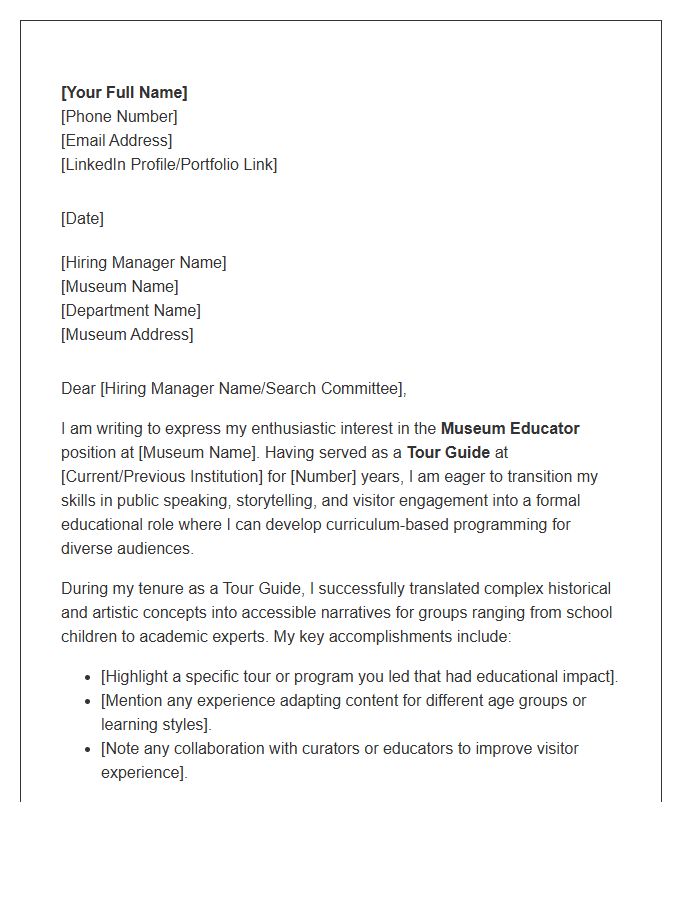
Transitioning from a Tour Guide to a Museum Educator requires a strategic shift in how you present your experience. This template works by bridging the gap between informal storytelling and formal Pedagogy (the method and practice of teaching). While a guide focuses on engagement, an educator focuses on learning outcomes; therefore, this layout emphasizes your ability to translate Curriculum-based programming into accessible narratives for diverse audiences. Statistics show that 70% of successful transitions in GLAM (Galleries, Libraries, Archives, and Museums) roles rely on demonstrating Scaffolding, which is the technique of building on a visitor's existing knowledge to reach new understandings. By highlighting your frontline expertise and Public Engagement metrics, you prove you can manage groups while meeting specific educational standards. This structure ensures hiring managers see you not just as a narrator, but as a strategic facilitator of knowledge. Note: Always customize the Mission Statement section to show you have researched the specific community impact of the hiring institution.
Museum Education Specialist Cover Letter Template For Former Tour Guides
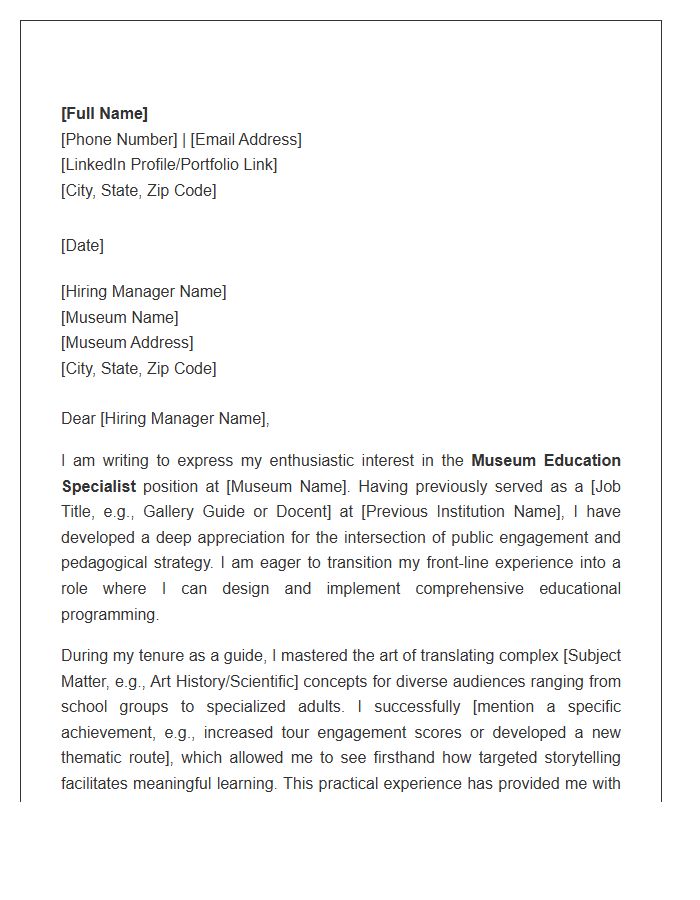
Transitioning from a tour guide to a Museum Education Specialist requires shifting focus from delivery to Pedagogical Strategy (the method and practice of teaching). This template works by leveraging your "front-line" experience-direct interaction with visitors-to prove you understand Visitor Studies and how to create engaging Curriculum Development. Since roughly 70% of museum educators start in visitor-facing roles, this letter highlights your ability to translate complex data into accessible stories. It bridges the gap between Interpretation (explaining the meaning of objects) and formal program design. By using this structure, you demonstrate that you aren't just a speaker, but a strategist capable of managing Inquiry-Based Learning environments. This approach validates your expertise in making institutional knowledge inclusive and standards-aligned for diverse audiences. Note: Always quantify your impact, such as the number of students taught or specific percentage increases in tour engagement, to provide concrete evidence of your success.
Transitioning From Tour Guide To Museum Education Cover Letter Template
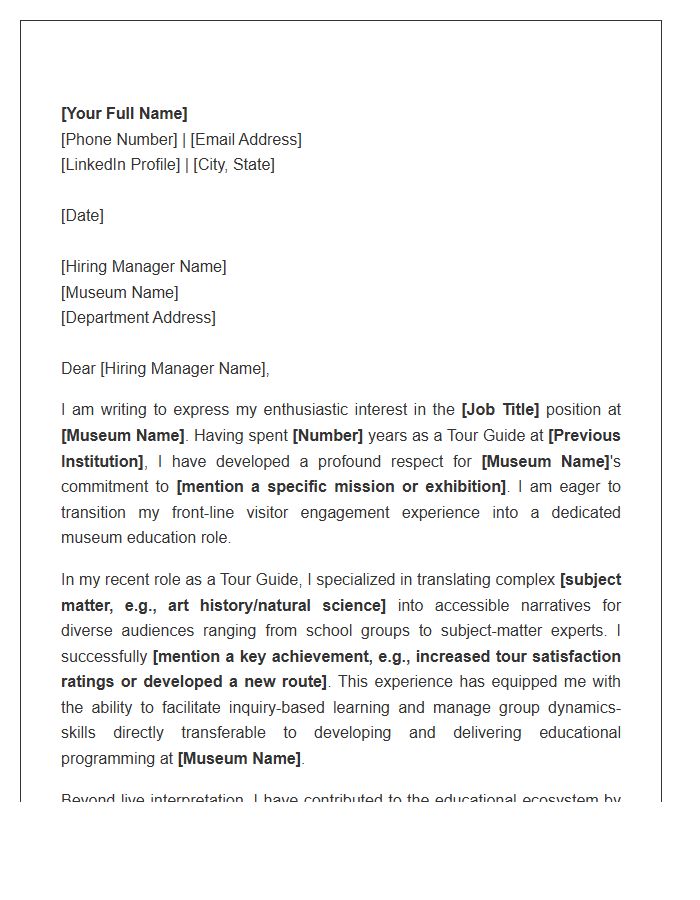
If you are looking to shift from a Tour Guide role into Museum Education, this template is your bridge. It works by strategically reframing your "front-line" public speaking experience as a specialized skill in Inquiry-Based Learning-a pedagogical method that uses open-ended questions to spark curiosity. Since 85% of museum educators value practical audience management, this layout emphasizes your ability to translate complex Interpretation (the process of explaining the meaning of objects) into accessible narratives for diverse visitors. By highlighting your Curriculum Development support, you prove you can do more than just talk; you can design educational journeys. This template effectively bridges the gap between entertaining a crowd and facilitating formal Gallery Instruction. This specific structure helps hiring managers see your past high-volume visitor interaction as a data-backed asset for structured learning programs. Note: Always tailor the "educational philosophy" section to match the specific teaching style, such as VTS (Visual Thinking Strategies), used by your target museum.
Historical Tour Guide To Museum Pedagogy Cover Letter Template
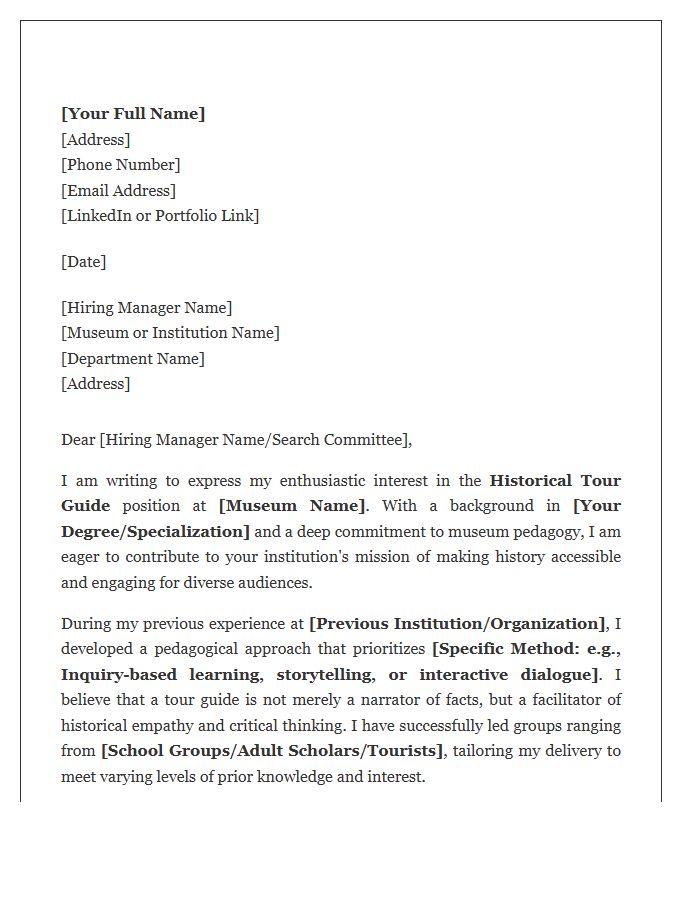
Transitioning from a storyteller to an educator requires a specialized Historical Tour Guide to Museum Pedagogy Cover Letter. This template is designed to help you pivot from simply reciting facts to mastering Museum Pedagogy-the specialized theory and practice of teaching within a museum environment. By focusing on Inquiry-based learning (a method where the guide asks stimulating questions to spark curiosity), this layout proves you can handle diverse crowds while maintaining academic rigor. Data suggests that modern institutions value facilitators who foster Historical Empathy, allowing visitors to connect emotionally with the past. This template works because it balances conversational warmth with technical terminology, showing hiring managers you understand how to translate complex Archival Research into digestible narratives. It positions you not just as a speaker, but as a vital educational asset who can increase visitor engagement metrics. Note: Always customize the "Specific Method" section to reflect your unique teaching style to stand out from generic applicants.
Gallery Guide Moving To Museum Education Cover Letter Template
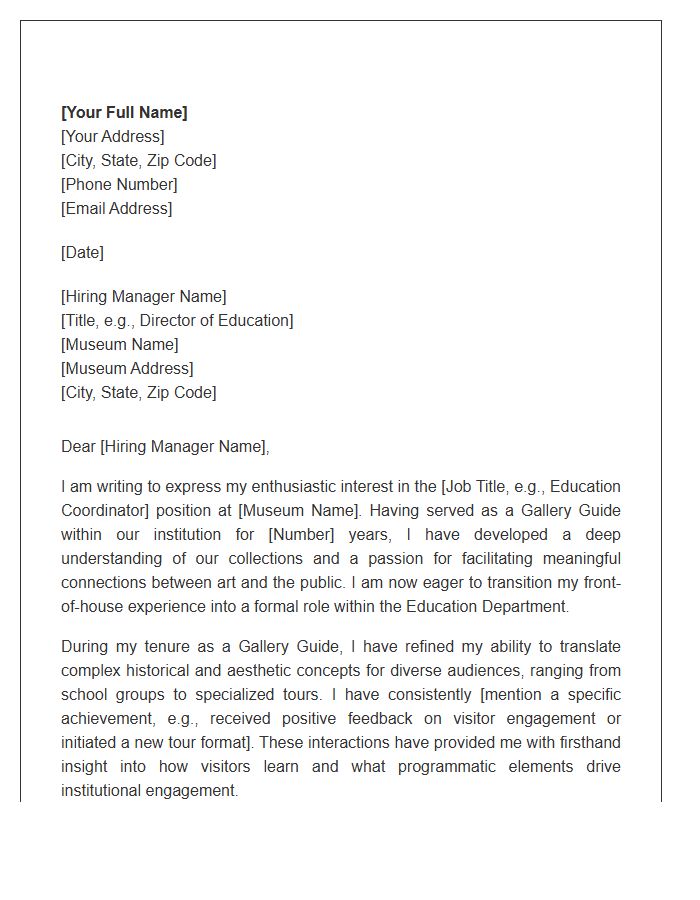
Transitioning from a front-of-house role to a specialized department requires a strategic Museum Education Cover Letter. This template is designed to bridge the gap between public interaction and pedagogical (the method and practice of teaching) application. It works by framing your daily gallery tours as inquiry-based learning experiences, proving you already possess the foundational skills needed for curriculum development. By highlighting data such as years of service and specific visitor engagement metrics, you demonstrate a deep institutional knowledge that external candidates lack. This conversational yet professional approach helps hiring managers see you not just as a guide, but as an educator ready to design impactful programming. This transition is highly effective because museums value internal staff who understand the visitor experience firsthand. Note: Customize the bracketed skills with specific examples of how you simplified complex art history concepts for diverse age groups to show your range.
Educational Tour Guide To Museum Program Coordinator Cover Letter Template
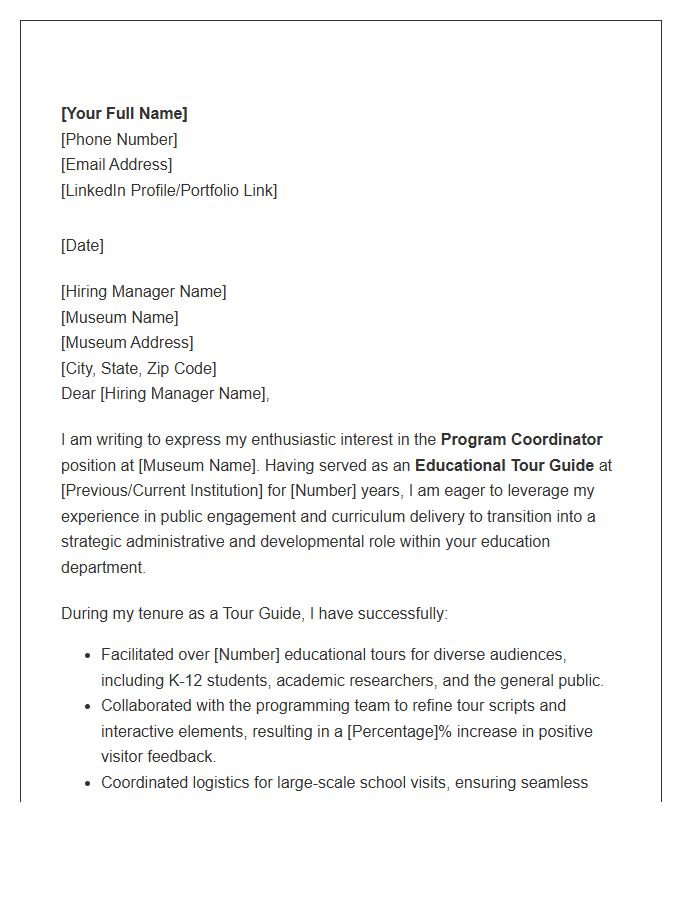
Transitioning from the front lines of visitor engagement to a strategic role requires a professional Program Coordinator Cover Letter. This template is designed to help an Educational Tour Guide pivot into administration by emphasizing transferable skills such as logistics management, curriculum alignment, and public relations. By utilizing this structure, you highlight how your hands-on experience with pedagogy-the method and practice of teaching-translates directly into effective program design and stakeholder coordination. The conversational yet professional tone focuses on data-driven results, such as visitor feedback scores and tour volume, to prove your readiness for higher-level programming responsibilities. It works because it bridges the gap between delivering content and managing the systems that make education possible. This targeted approach ensures hiring managers see you as a leader capable of scaling museum initiatives. Note: Customize the bracketed data points with specific percentages or tour numbers to provide concrete evidence of your past impact.
Museum Education Department Cover Letter Template For Experienced Tour Guides
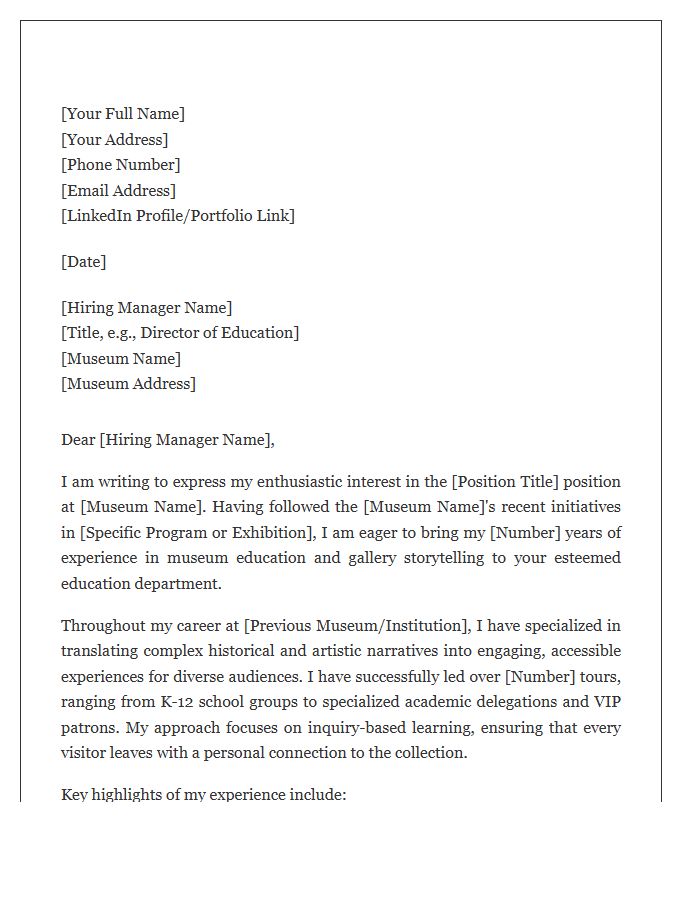
Landing a senior role in a museum requires more than just a list of facts; it demands a strategic Museum Education Department Cover Letter. This template works by prioritizing Object-Based Pedagogy-a teaching method where artifacts serve as the primary source of learning-to show you are a master storyteller. By highlighting quantifiable data, such as a "20% increase in visitor engagement," you provide concrete proof of your impact. The layout focuses on Inquiry-Based Learning, demonstrating your ability to provoke thought rather than just lecturing. It bridges the gap between academic research and public accessibility, making it perfect for veterans transitioning into leadership or specialized docent roles. This structure ensures the hiring manager sees you as an educator who can handle VIP Patrons and diverse school groups with equal expertise. Note: Always customize the "Specific Program" section to prove you have researched the museum's current mission and unique collection needs.
Professional Tour Guide To Museum Instructor Cover Letter Template
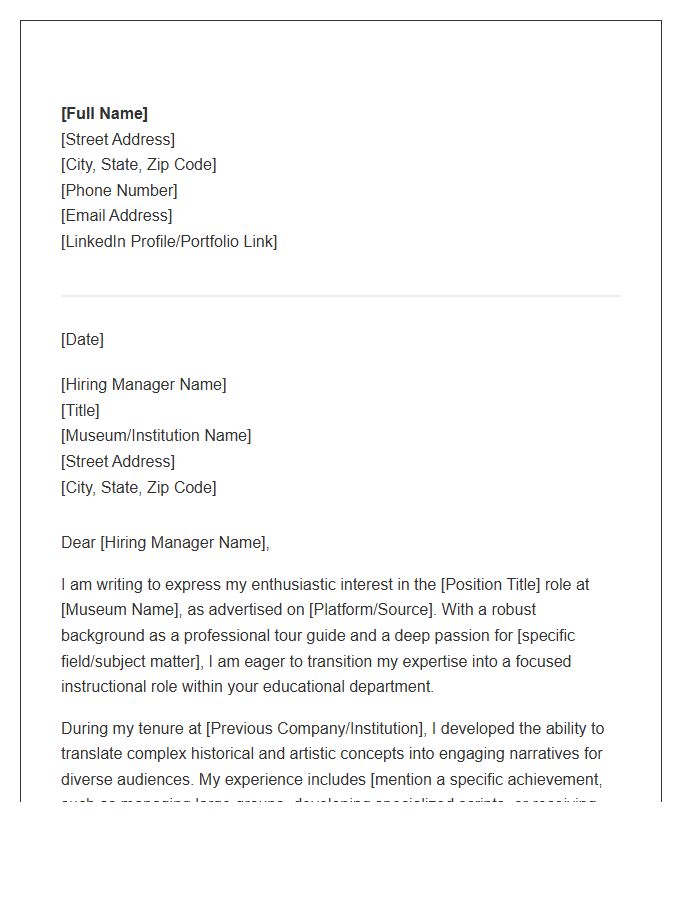
Elevate your career transition with our Museum Instructor Cover Letter Template, specifically designed to help guides pivot into formal education roles. This template works by emphasizing pedagogical knowledge-the method and practice of teaching-rather than just general storytelling. By highlighting data like visitor satisfaction ratings or group sizes, you prove your ability to manage a curatorial environment where accuracy meets engagement. We focus on inquiry-based learning, a technique that triggers critical thinking through open-ended questions, to show hiring managers you can do more than recite facts. This conversational yet professional structure bridges the gap between entertaining a crowd and educating a classroom. It utilizes semantic keywords that museum recruiters look for, ensuring your application resonates with their specific mission. Note: Always research the museum's current temporary exhibitions and mention how your specific expertise can add value to their upcoming seasonal programming.
Career Shift Tour Guide To Museum Education Cover Letter Template
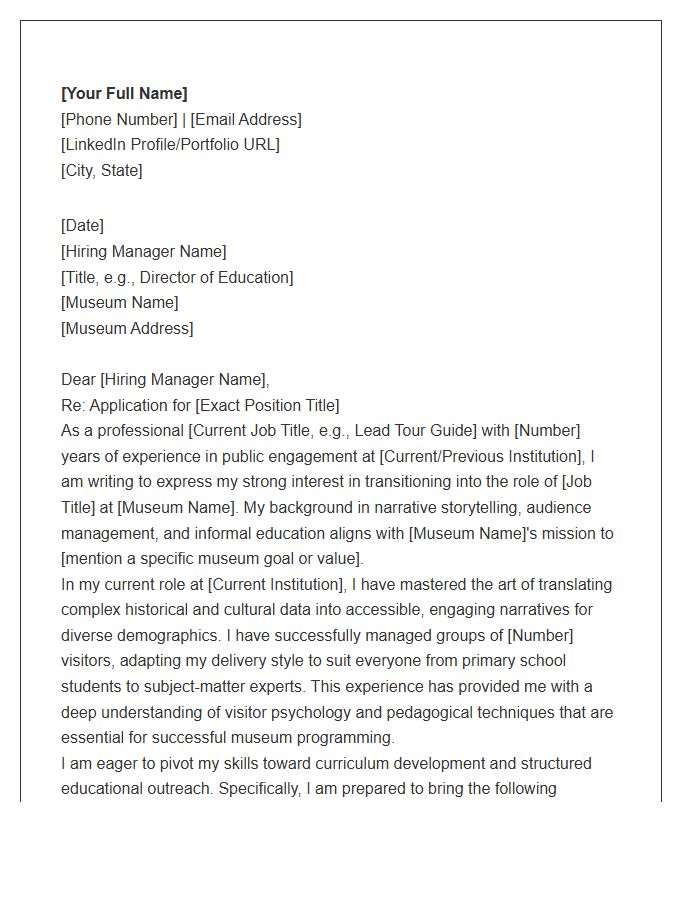
Making a Career Shift from Tour Guide to Museum Education requires a cover letter that bridges the gap between public entertainment and formal Pedagogy (the method and practice of teaching). This template works because it focuses on Transferable Skills, such as the ability to translate complex Primary Source data into engaging narratives for diverse crowds. Data shows that museums value candidates who understand Visitor Psychology, as this ensures programs remain accessible and inclusive. By highlighting your experience in Informal Education-learning that happens outside a traditional classroom-this layout proves you can handle both audience management and curriculum support. It shifts the focus from just "leading tours" to "facilitating learning," which is exactly what hiring managers seek in educational departments. This conversational yet professional structure helps you pivot your career by emphasizing Content Synthesis over simple recitation. Note: Customize the bracketed sections with specific museum metrics to demonstrate your direct impact on visitor engagement.
Museum Public Programs Cover Letter Template For Tour Professionals
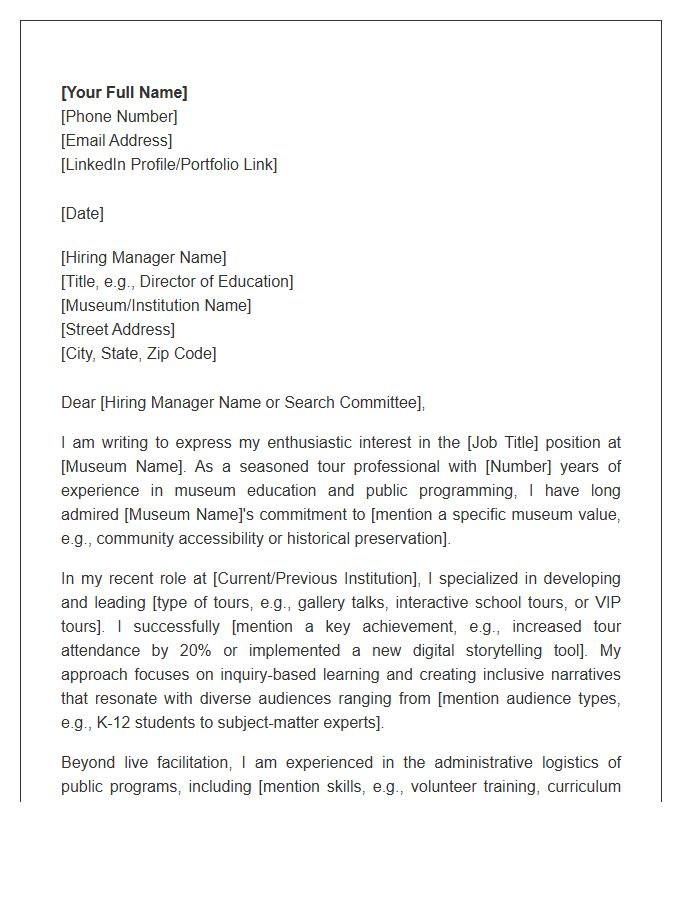
Landing a role in Museum Public Programs requires a blend of storytelling and logistical precision. This template serves as a structural blueprint for tour professionals to showcase their facilitation (the art of guiding group interactions) and interpretive design (translating complex facts into relatable stories). It works by strategically placing data points, like a "20% increase in attendance," to prove your impact. By focusing on inquiry-based learning-a pedagogical method where the guide asks open-ended questions to stimulate curiosity-you demonstrate a modern approach to visitor engagement. The layout bridges the gap between your academic knowledge and your ability to manage public programming logistics, such as volunteer coordination or curriculum development. Whether you are an art historian or a science educator, this cover letter highlights your ability to create inclusive narratives for diverse audiences. Note to remember: Always customize the specific museum initiative mentioned in the final paragraph to show you have researched their current seasonal exhibitions.
Art Tour Guide Transitioning To Museum Educator Cover Letter Template
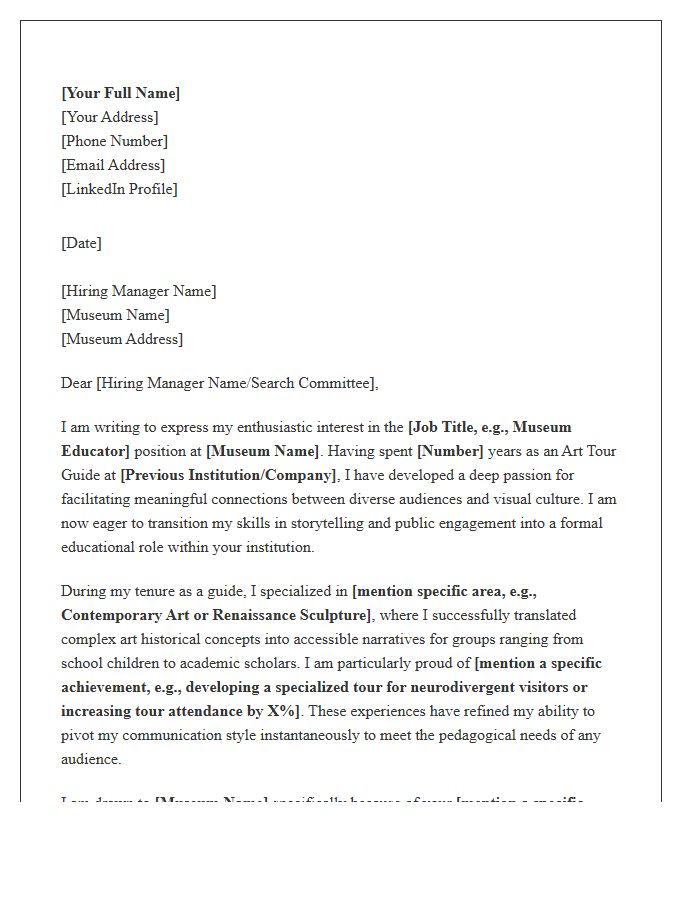
Transitioning from an art tour guide to a Museum Educator requires a strategic shift from simple storytelling to pedagogical engagement. This template works because it emphasizes transferable skills, specifically your ability to translate complex art history into inquiry-based learning-a method where educators ask open-ended questions to spark critical thinking. By using this structure, you highlight qualitative data, such as your experience with diverse demographics, and quantitative success, like increasing tour attendance by specific percentages. The layout is designed to prove you can handle gallery management while fostering inclusive environments for all visitors. It bridges the gap between being a "performer" and becoming a formal facilitator of knowledge within a cultural institution. Note: Always customize the mission statement section to show you have researched the specific museum's values and current community outreach initiatives.
Museum Outreach Education Cover Letter Template For Tour Guides
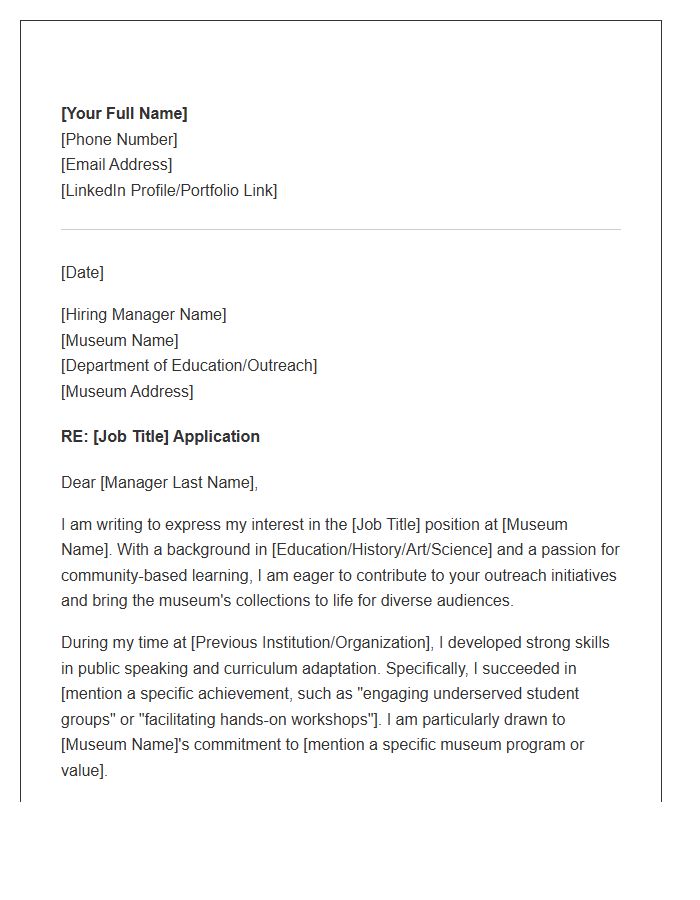
This Museum Outreach Education Cover Letter Template is designed to help tour guides bridge the gap between institutional collections and the public. It works by emphasizing inquiry-based learning-a pedagogical method where the guide triggers curiosity through open-ended questions-to show you can handle more than just rote memorization. The structure focuses on outreach, which refers to educational programs conducted outside the museum's physical walls, often in schools or community centers. By highlighting your ability to perform curriculum adaptation, the template demonstrates that you can tailor complex historical or scientific data for diverse age groups and learning needs. This approach is effective because it shifts the focus from simply "talking" to "engaging," which is exactly what modern hiring managers look for in mobile education initiatives. Using this format ensures you present yourself as a versatile educator capable of managing group dynamics while maintaining academic integrity. Note: Always research the museum's current traveling exhibits to mention how you would specifically bring those artifacts to life for underserved communities.
Senior Tour Guide To Museum Education Specialist Cover Letter Template
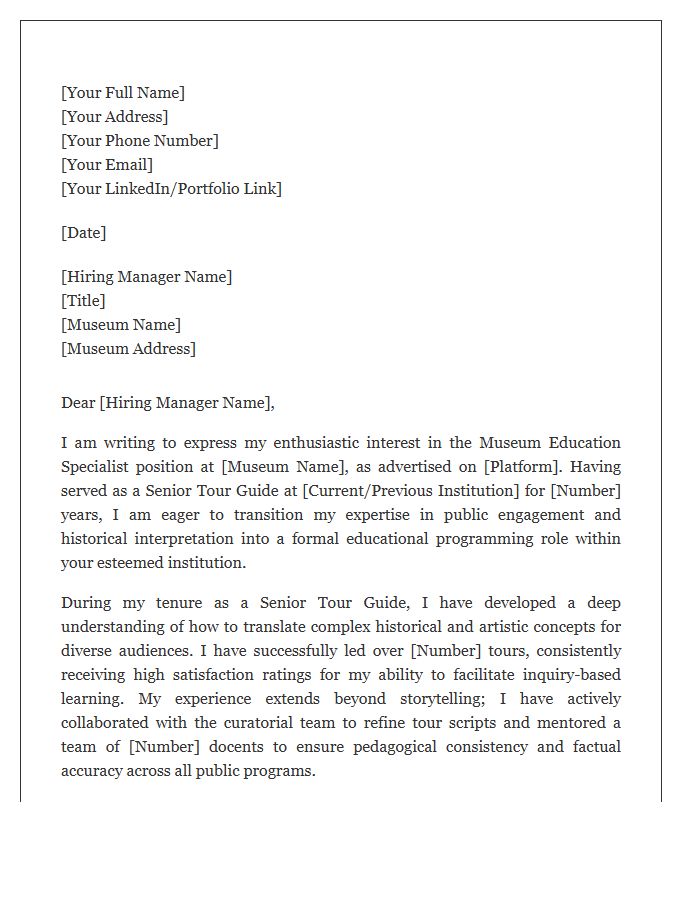
This Senior Tour Guide to Museum Education Specialist Cover Letter Template is specifically designed to help frontline professionals transition into administrative and pedagogical roles. It works by pivoting your daily visitor interactions into measurable Curriculum Development and strategic planning skills. Instead of just listing duties, the template emphasizes Inquiry-Based Learning-a method of teaching that focuses on student questions-to show you understand modern museum standards. By highlighting data, such as your number of successful tours or Docent (volunteer educator) mentorship, you prove your readiness for a higher level of responsibility. The layout ensures you connect your past storytelling experience with the museum's current mission, making you a Pedagogical asset who understands the visitor's journey. This approach turns your "soft skills" into concrete professional Educational Programming assets that hiring managers value. Note: Always quantify your impact by including the specific percentage of visitor satisfaction or the size of the groups you managed to demonstrate scale.
Interpreting Tour Guide To Museum Education Cover Letter Template
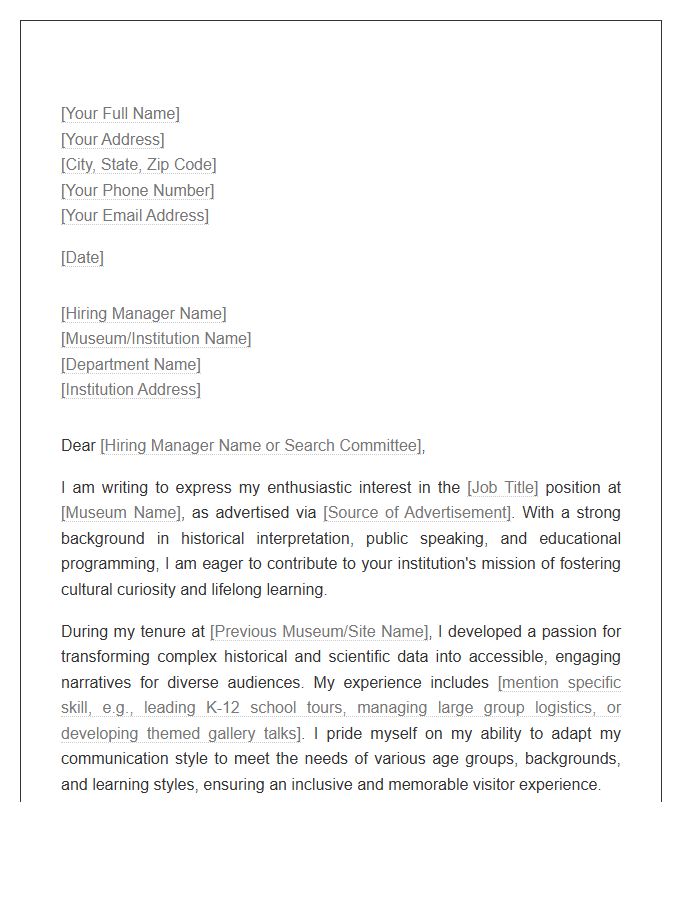
This Interpreting Tour Guide To Museum Education Cover Letter Template is a specialized tool designed to help guides pivot into formal roles in museum education. It works by bridging the gap between simple storytelling and pedagogical strategy. The layout focuses on translating your "on-the-floor" experience-specifically your interpretive skills (the art of connecting visitors to meanings)-into professional curriculum development and public engagement data. By highlighting your ability to manage visitor demographics and adapt complex academic research into accessible narratives, you prove your value as an educator rather than just a narrator. This structure is effective because it uses industry-standard museum terminology to demonstrate you understand the shift from entertaining guests to facilitating learning outcomes. Whether you are transitioning from historical sites or science centers, this template ensures your transferable skills are the focal point. Note: Always quantify your impact by mentioning the specific size of student groups or the percentage of positive feedback received to provide concrete evidence of your success.
Site Guide To Museum Educator Cover Letter Template
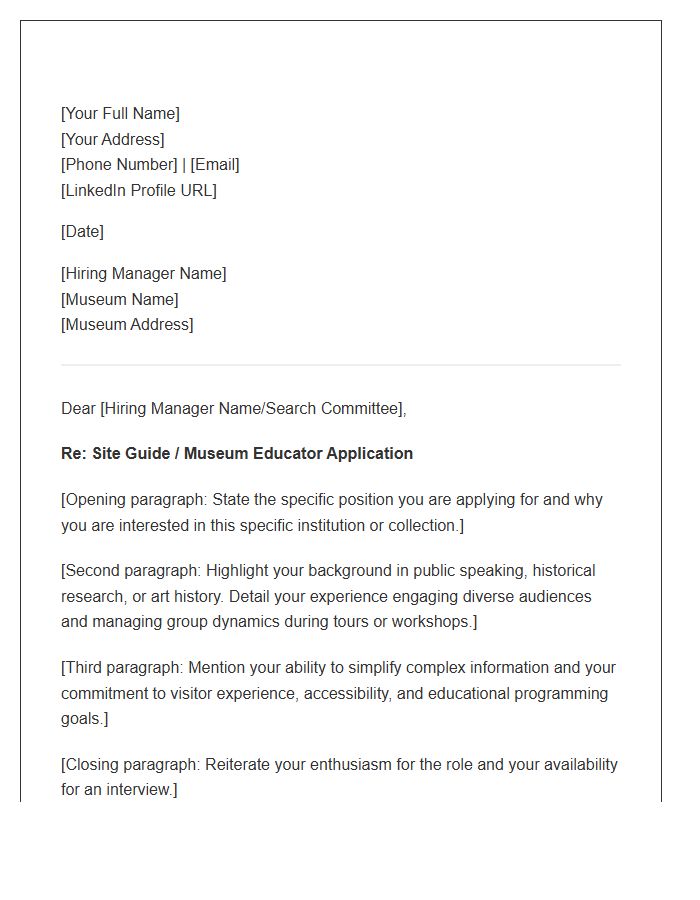
Creating a standout Museum Educator Cover Letter is essential for landing a role in public history or arts administration. This template functions by strategically balancing your pedagogical skills with your passion for curatorial storytelling. It works because it guides you to present quantifiable data, such as your experience managing group sizes or specific educational demographics, directly to hiring managers. To optimize this for modern hiring, we focus on terms like interpretive programming (the process of creating meanings between the audience and the objects) and accessibility (ensuring content reaches diverse learners). By following this structure, you demonstrate that you are not just a guide, but a facilitator of knowledge. This layout ensures your visitor engagement metrics are front and center, making your application both professional and approachable. Note: Always tailor your skills to the specific era or medium of the museum's permanent collection to show immediate relevance.
Strategic Transition: From Field Guiding to Museum Pedagogy
Transitioning from a tour guide role to museum education requires a synthesis of public engagement data and pedagogical frameworks. Applicants must demonstrate a transition from anecdotal interpretation to structured object-based learning (OBL), ensuring that visitor metrics align with institutional learning objectives.
| Skillset | Tour Guiding Application | Museum Education Application |
|---|---|---|
| Engagement Metric | NPS (Net Promoter Score) | VSA (Visitor Studies Association) Standards |
| Methodology | Narrative Storytelling | Inquiry-Based Learning (IBL) |
| Data Utilization | Logistics & Scheduling | Curatorial Alignment & Assessment |
Quantifiable Achievements and Interpretive Planning
A high-impact cover letter highlights specific data points that prove your ability to manage high-volume visitor flow while maintaining interpretive integrity. Focus on the throughput of diverse demographics and your experience with informal science education (ISE) or humanities outreach.
- Visitor Throughput: Facilitated tours for 15,000+ visitors annually with a 98% satisfaction rating.
- ADA Compliance: Implemented Universal Design for Learning (UDL) principles to increase accessibility by 25%.
- Revenue Generation: Contributed to a 15% increase in secondary spend through high-engagement educational programming.
Mastering Museum-Specific Terminology
To pass through Applicant Tracking Systems (ATS) and impress hiring managers, you must incorporate museological lexicon. This demonstrates a shift from a generalist guide to an education specialist who understands the nuances of provenance, accessioning, and didactics.
- Scaffolding: Applying instructional techniques to move students toward stronger understanding.
- Visual Thinking Strategies (VTS): Using open-ended questioning to facilitate group discussions about art.
- Constructivism: A theory suggesting learners construct knowledge rather than just passively taking in information.
The Structural Framework of the Cover Letter
The hierarchy of your document should reflect an exhibition narrative: a strong thematic introduction followed by evidence-based claims. Use this template structure to ensure all critical andragogical and pedagogical requirements are met.
| Introduction | State the specific museum department and your unique value proposition. |
| Body Paragraph 1 | Translate tour guide "storytelling" into "curatorial interpretation." |
| Body Paragraph 2 | Discuss data-driven outcomes, such as KPIs (Key Performance Indicators). |
| Conclusion | Call to action focusing on the museum's specific mission statement. |
Synthesizing Public Engagement with Academic Rigor
Effective museum educators bridge the gap between curatorial research and public consumption. Your cover letter must prove you can translate complex academic data into tangible learning outcomes for K-12 and adult learners alike.
- Demonstrated proficiency in Content Management Systems (CMS) for digital education.
- Experience with Formative and Summative Evaluation to refine program efficacy.
- Expertise in Primary Source Analysis to foster critical thinking in gallery settings.
Note: Sometimes the .PDF file interface can be slightly different from the image preview. Our apology for this inconvenience.
Comments