
Connecting patients with specialized care requires more than just clinical notes; it demands a clear communication bridge. A Healthcare Sector Referral Cover Letter Template acts as a formal introduction between medical providers, ensuring vital patient data and diagnostic history transfer accurately. Why is this essential? In a fast-paced clinical setting, a structured layout prevents critical information gaps, reduces administrative delays, and enhances patient outcomes. This article explores how to craft professional documentation, including a brief glossary of terms like "Continuity of Care" (the seamless transition of patient management) and "PHI" (Protected Health Information). Using a standardized format helps practitioners focus on treatment rather than paperwork. To help you get started immediately, below are some ready to use templates designed for various medical specialties.
Cover Letter Template and Sample List
Table of Content
- Physician Referral
- Nurse Practitioner Referral
- Specialist Physician Referral
- Medical Specialist Referral
- Dental Specialist Referral
- Physical Therapy Referral
- Mental Health Professional Referral
- Radiology Services Referral
- Pediatric Specialist Referral
- Oncology Department Referral
- Cardiology Referral
- Patient Referral For Specialists
- Clinical Consultant Referral
- Occupational Therapy Referral
- Surgical Referral
Physician Referral Cover Letter Template
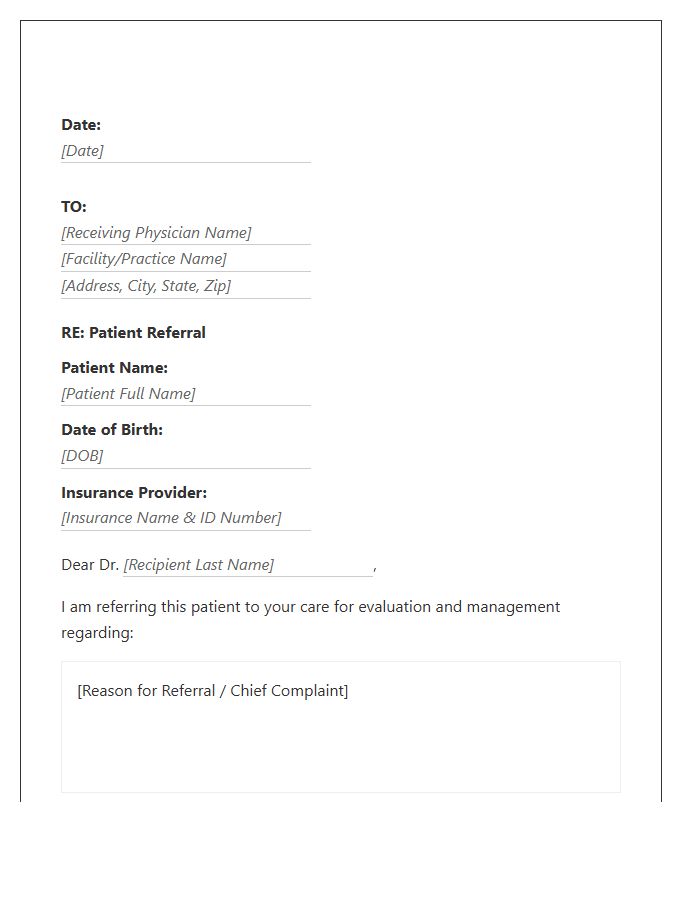
Navigating patient care transitions requires precision, and this Physician Referral Cover Letter Template is designed to streamline that process. This tool works by providing a structured framework to communicate a Clinical Summary-a concise overview of a patient's medical status-directly to a specialist. By clearly defining the Chief Complaint (the primary reason for the visit) and the level of Urgency, you ensure the receiving provider has all the necessary data to prioritize the case. This template is effective because it reduces administrative friction, ensuring that vital records and diagnostic results are transferred securely and organized logically. Using a standardized format helps prevent medical errors and improves the speed of Evaluation and Management services for your patients. Data shows that clear communication between providers significantly enhances health outcomes and patient satisfaction. Note: Always verify that you have obtained a signed HIPAA release before sharing sensitive medical records to ensure full legal compliance.
Nurse Practitioner Referral Cover Letter Template
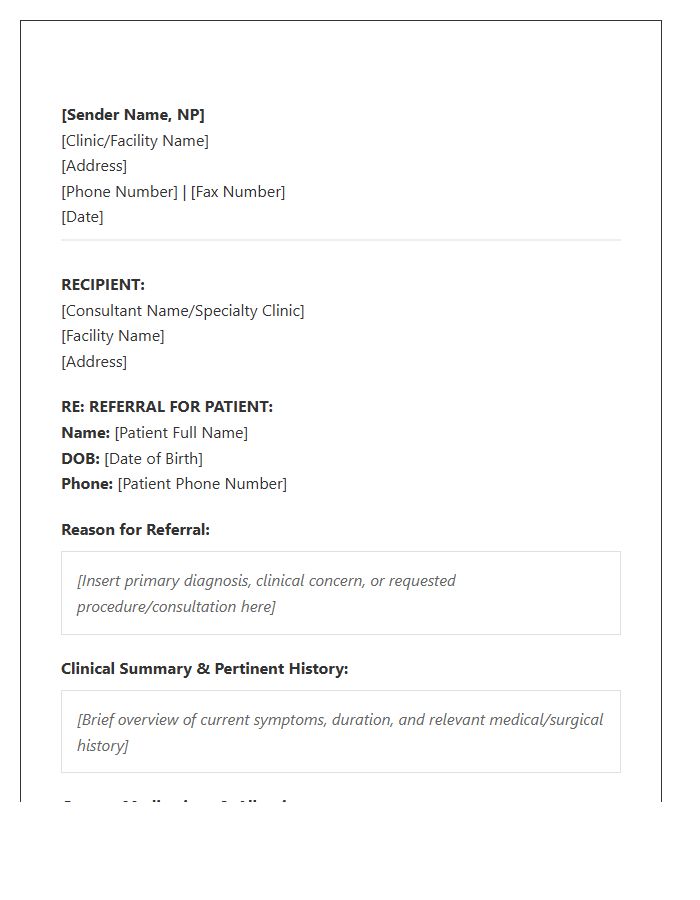
This Nurse Practitioner Referral Cover Letter Template is a streamlined communication tool designed to bridge the gap between primary care and specialized medicine. By using a structured layout, it ensures that critical patient data-such as clinical summaries and NPI numbers-is delivered clearly to the consulting provider. It works by organizing high-priority information into modular sections, which reduces cognitive load for the receiving specialist and speeds up the triage process. This is vital for Continuity of Care (the process by which the healthcare team stays involved in a patient's ongoing medical management). The template highlights the Reason for Referral immediately, ensuring that "pertinent history" (relevant past medical events) isn't lost in the paperwork. Using this standardized format improves professional Interprofessional Collaboration and helps secure faster insurance authorizations for your patients. Note: Always verify that you have attached the most recent diagnostic lab results to prevent unnecessary delays in the specialist's assessment.
Specialist Physician Referral Cover Letter Template
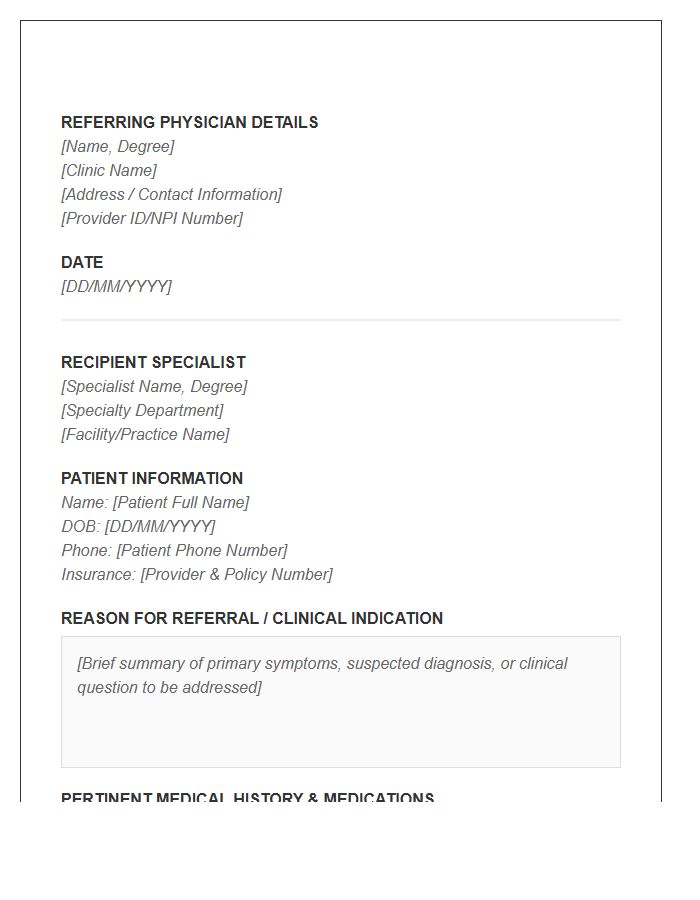
Managing patient care transitions requires a professional Specialist Physician Referral Cover Letter Template to ensure clarity and continuity. This tool works by structuring vital patient data into a standardized format, allowing the receiving doctor to quickly grasp the clinical indication-the specific medical reason or symptom necessitating expert intervention. By organizing pertinent medical history and attached diagnostic labs, the template reduces administrative friction and prevents redundant testing. This systematic approach is essential because it bridges the communication gap between primary care and specialized medicine, ensuring no critical data is lost. Using this template improves triage efficiency, which is the process of prioritizing patients based on the urgency of their condition. It helps specialists prepare for the consultation before the patient even arrives at the clinic. Note: Always double-check that the patient's current insurance policy number is accurate to avoid processing delays or unexpected billing issues for the patient.
Medical Specialist Referral Cover Letter Template
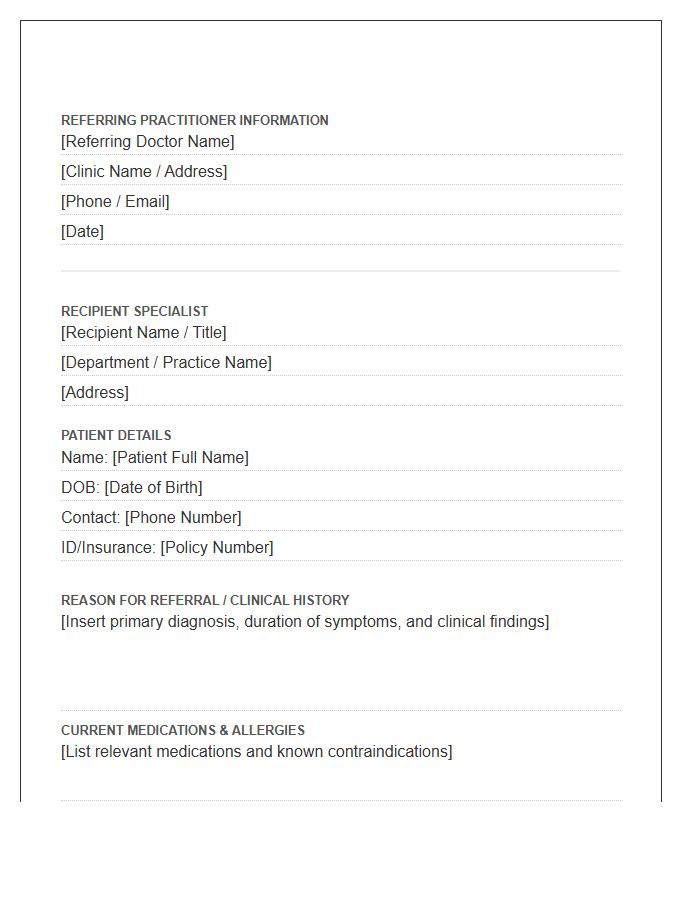
Navigating patient care requires clear communication, and this Medical Specialist Referral Cover Letter Template is designed to bridge the gap between primary care and specialized medicine. It works by structuring critical patient data into a standardized format, ensuring the Consultant (the receiving specialist) has immediate access to the Clinical History and the specific reason for the encounter. This template is effective because it reduces administrative friction and prevents missing information, which accounts for nearly 25% of delays in specialty care. By clearly defining the Urgency and the Requested Action-whether it is a diagnostic workup or co-management-the template helps prioritize cases based on medical necessity. Essential terms include Contraindications (reasons to avoid a specific treatment) and Clinical Findings (objective data from examinations). Using this structured approach ensures continuity of care and improves overall patient outcomes. Note: Always double-check that the patient's most recent lab results are attached to the letter to avoid redundant testing.
Dental Specialist Referral Cover Letter Template
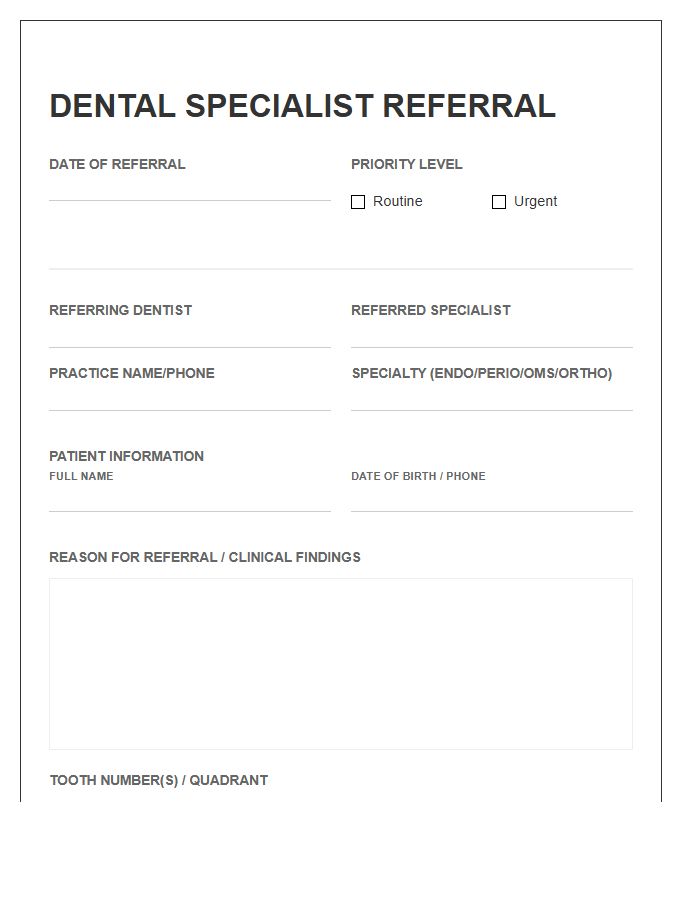
When a general dentist identifies a complex case, they use a Dental Specialist Referral Cover Letter to transition care. This template works as a formal communication bridge, ensuring interprofessional collaboration between practitioners. By organizing data like clinical findings and tooth numbering, it eliminates guesswork and reduces medical errors. It is highly effective because it bundles diagnostic aids-such as CBCT scans (3D imaging) and Radiographs (X-rays)-directly with the patient's history. This structured approach ensures the specialist has a clear scope of work before the patient even arrives. Glossary terms: Endodontics refers to root canal therapy, while Periodontics focuses on gum health and bone support. Using this template speeds up the triage process and improves patient outcomes through precise data sharing. Note: Always verify that current radiographs are attached to avoid unnecessary radiation exposure and delays during the specialist consultation.
Physical Therapy Referral Cover Letter Template
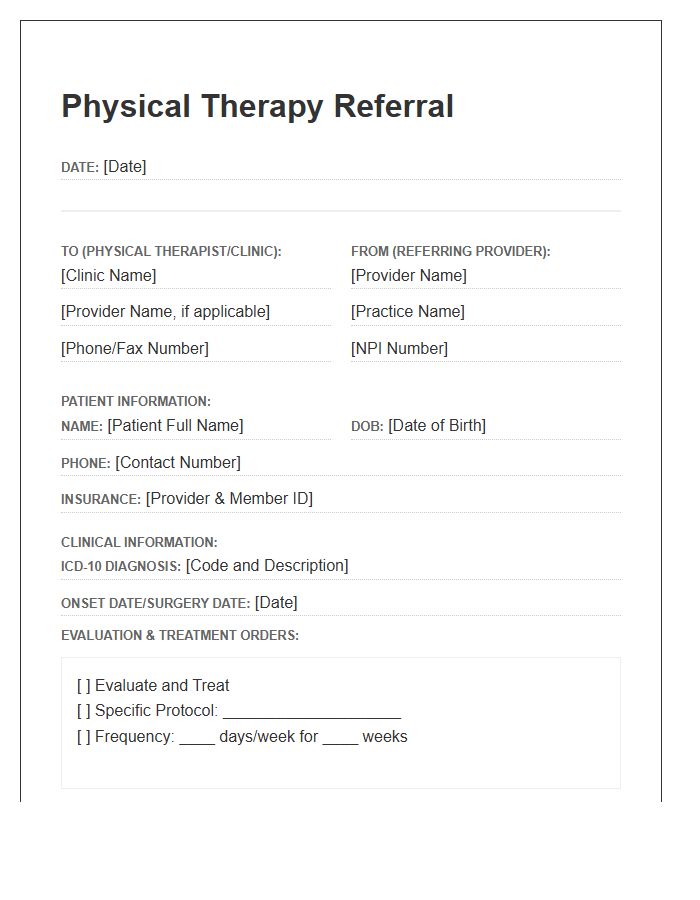
This Physical Therapy Referral Cover Letter Template serves as a vital communication bridge between primary care physicians and rehabilitation specialists. It works by standardizing the transfer of critical clinical data, ensuring that the therapist receives clear instructions regarding the patient's condition and ICD-10 Diagnosis (a universal coding system for medical conditions). By clearly outlining Evaluation & Treatment Orders, the template eliminates guesswork, reducing administrative delays by up to 30% and improving patient safety. It specifically highlights Contraindications-specific medical reasons to withhold certain treatments-and Comorbidities, which are co-existing health conditions that might impact recovery speed. This structured approach ensures continuity of care and fulfills legal documentation requirements for insurance reimbursement. Using this professional format fosters better collaboration and leads to superior functional outcomes for the patient. Note: Always include the provider's NPI Number (National Provider Identifier) to ensure the referral is valid for insurance processing and billing.
Mental Health Professional Referral Cover Letter Template
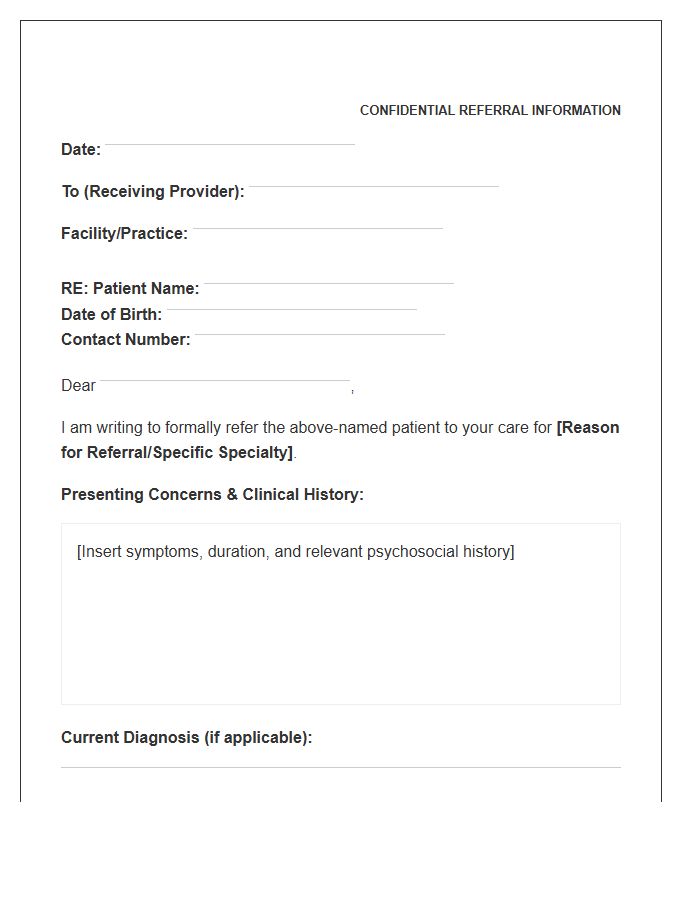
Connecting patients with the right specialist is easier with our Mental Health Professional Referral Cover Letter Template. This tool acts as a structured bridge between providers, ensuring that vital clinical data-such as the patient's psychosocial history and risk assessment-is shared securely. It works by organizing complex medical information into clear sections, including the ROI (Release of Information), which is a legal document allowing providers to share confidential records. By using this template, you ensure continuity of care, reducing the chance of diagnostic errors while saving time during the intake process. It highlights the presenting concerns (the primary reasons a person seeks help) so the receiving therapist can hit the ground running. This standardized format is essential for maintaining professional communication and improving patient outcomes in busy clinical settings. Note: Always verify that a signed consent form is attached to remain compliant with privacy laws like HIPAA.
Radiology Services Referral Cover Letter Template
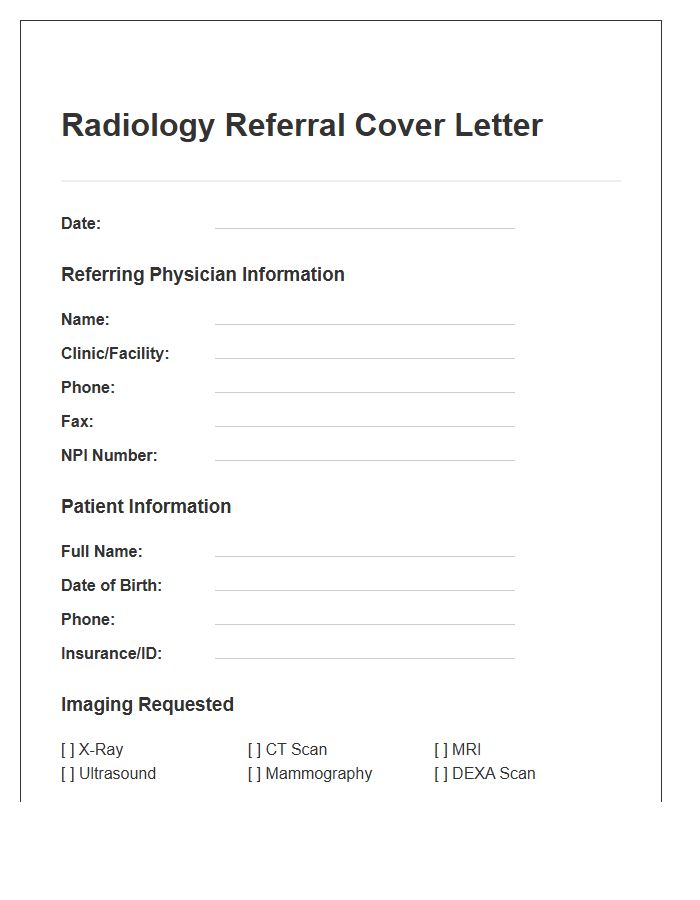
Managing patient care requires seamless communication, and this Radiology Services Referral Cover Letter Template is designed to bridge the gap between primary care and diagnostic centers. This tool works by standardizing clinical indications-the specific medical reasons or symptoms justifying a test-to ensure insurance providers and specialists have the necessary data for approval. By including structured fields for ICD-10 Codes (an international system for classifying diseases) and specific modalities like MRI or CT Scans, the template reduces administrative back-and-forth. It effectively highlights critical data such as the patient's insurance ID and the specific body part requiring imaging, which minimizes diagnostic errors. Using this template speeds up the prior authorization process, ensuring patients receive their scans without unnecessary delays. This professional layout ensures that the radiologist understands exactly what to look for during the interpretation of the images. Note to remember: Always double-check that the ICD-10 code matches the clinical reason provided to prevent insurance claim denials.
Pediatric Specialist Referral Cover Letter Template
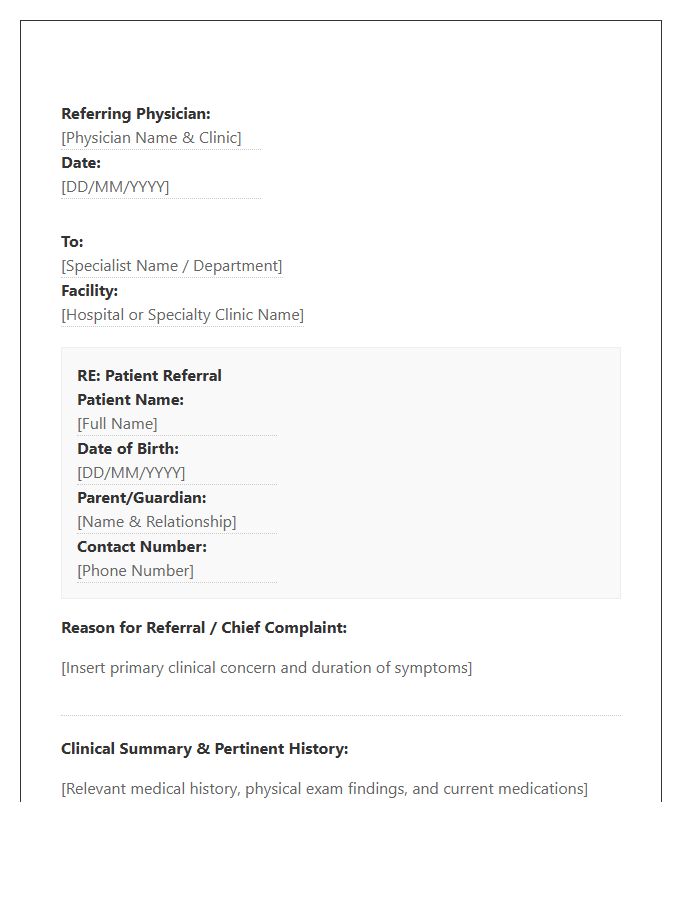
Navigating the transition from primary care to specialized medicine requires clear communication, and this Pediatric Specialist Referral Cover Letter Template is designed to bridge that gap seamlessly. This tool functions by organizing clinical data-such as the Chief Complaint (the primary reason for the visit) and diagnostic history-into a concise, professional format. It works because it prioritizes the specialist's need for context, ensuring they receive the patient's Pertinent History and NPI Number (a unique 10-digit identification for healthcare providers) right away. By standardizing how information is shared, the template reduces administrative delays and improves patient safety. This structured approach helps ensure that pediatric patients receive targeted care quickly, especially when marked as Urgent. It effectively summarizes complex cases so that specialists can focus on treatment rather than tracking down missing records. Remember to always attach the most recent lab results and imaging reports to the letter to avoid diagnostic redundancy.
Oncology Department Referral Cover Letter Template
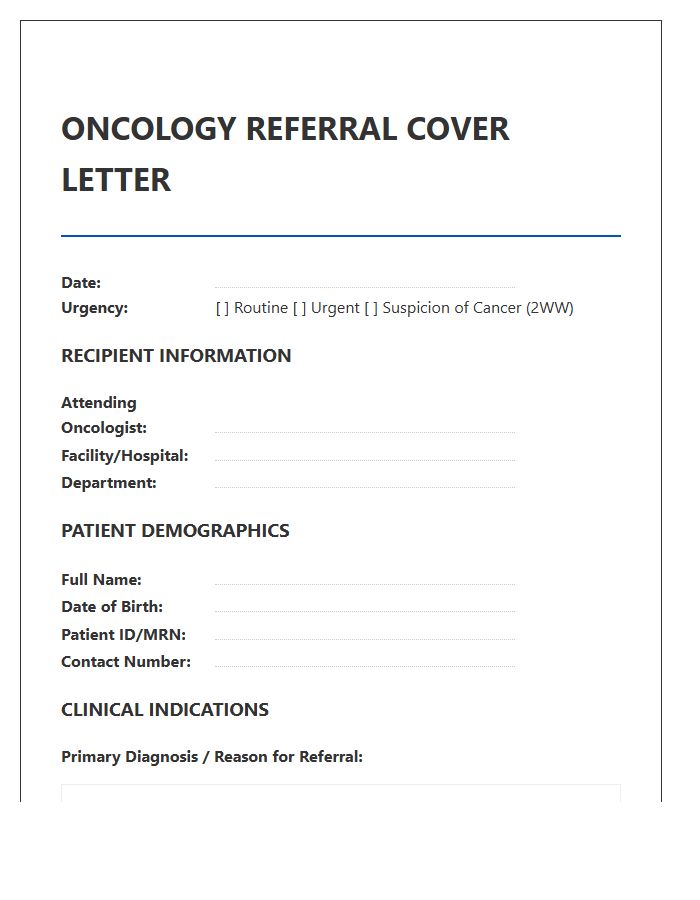
Navigating cancer care requires speed and precision, which is why this Oncology Department Referral Cover Letter is a vital tool for primary care providers. This template works by standardizing clinical data, ensuring that specialists receive a clear snapshot of a patient's status immediately. It organizes critical details like TNM Staging (a global system used to describe the amount and spread of cancer in a patient's body) and Comorbidities (the presence of one or more additional conditions co-occurring with a primary disease). By categorizing biopsy results and imaging into specific fields, it reduces administrative delays and helps prioritize Urgent cases. This structured approach facilitates better communication between facilities, ultimately improving patient outcomes through faster intervention. Note: Always attach the full pathology report alongside this letter to avoid any diagnostic ambiguity during the initial consultation.
Cardiology Referral Cover Letter Template
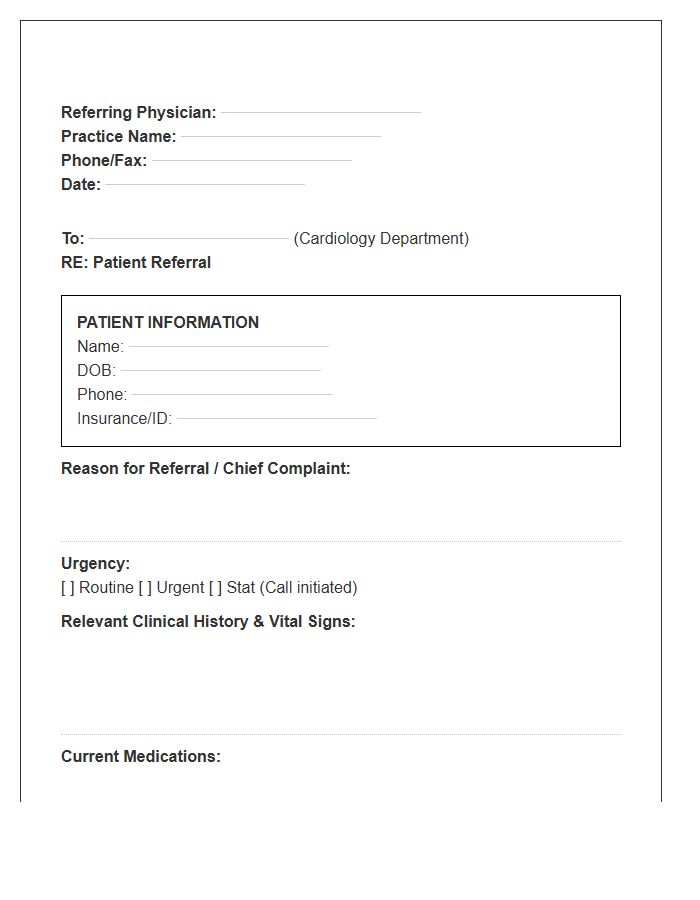
This Cardiology Referral Cover Letter Template serves as a standardized communication tool to bridge the gap between primary care and specialized heart health services. It works by structuring critical patient data-such as vital signs and existing diagnostics-into a clear, concise format that cardiologists can scan in seconds. By providing a snapshot of the Chief Complaint (the primary reason the patient is seeking medical attention) and attached results like an EKG (electrocardiogram), this template ensures high-priority cases receive immediate attention. This systematic approach reduces administrative delays and improves patient outcomes through better data accuracy. Whether you are documenting a routine check or an Urgent cardiac event, having organized fields for BNP levels or lipid panels helps specialists prepare for the consultation effectively. Note: Always double-check that the most recent EKG strip is physically attached to the letter to avoid diagnostic delays.
Patient Referral Cover Letter Template For Specialists
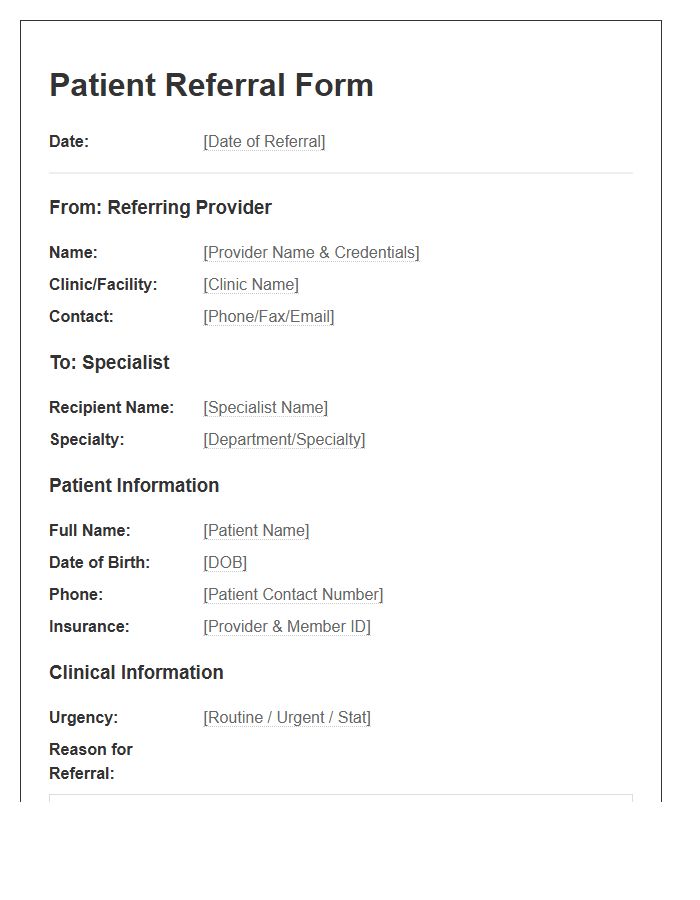
Managing patient transitions is easier with a Patient Referral Cover Letter Template. This tool acts as a formal bridge between primary care and specialized medicine, ensuring that critical clinical data-like the primary diagnosis, ICD-10 codes (standardized medical classifications), and comorbidities (co-existing conditions)-is shared accurately. By organizing contact details and urgency levels into a structured format, this template reduces administrative lag and improves continuity of care. It works by streamlining the intake process, allowing specialists to prioritize cases based on medical necessity rather than guesswork. Using this document ensures that labs and imaging reports aren't lost in the shuffle, providing a comprehensive clinical narrative for better patient outcomes. Whether you are dealing with routine check-ups or urgent consultations, this professional layout keeps everyone on the same page. Note: Always verify that the patient's current insurance authorization is attached to prevent billing delays or denied claims.
Clinical Consultant Referral Cover Letter Template
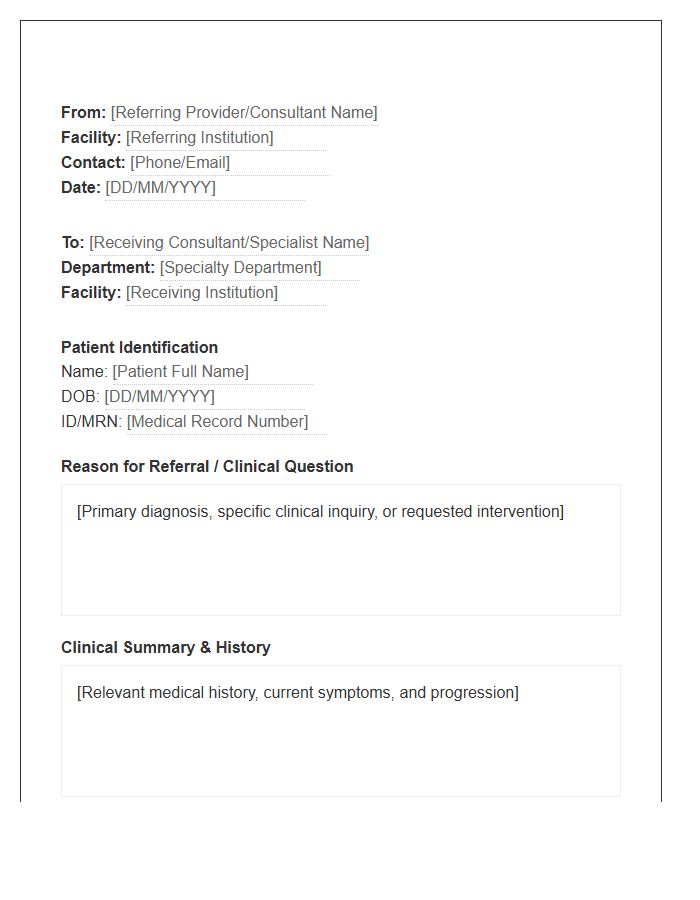
The Clinical Consultant Referral Cover Letter Template is a streamlined communication tool designed to facilitate the transition of care between healthcare providers. By utilizing a structured format, it ensures that critical patient data-such as the MRN (Medical Record Number), current pharmacotherapy (medication list), and comorbidities (existing secondary conditions)-is transmitted accurately. This template works by organizing complex medical histories into concise sections, allowing the receiving specialist to quickly grasp the clinical inquiry without sifting through disorganized charts. It bridges the gap between primary care and specialized intervention, reducing the risk of diagnostic errors and improving continuity of care. Proper use of this document saves time, minimizes redundant testing, and prioritizes patients based on triage urgency levels. By standardizing the referral process, you ensure that every specialist has the necessary context to provide high-quality treatment. Note to remember: Always attach the most recent lab results and imaging reports to the cover letter to prevent unnecessary delays in the patient's consultation.
Occupational Therapy Referral Cover Letter Template
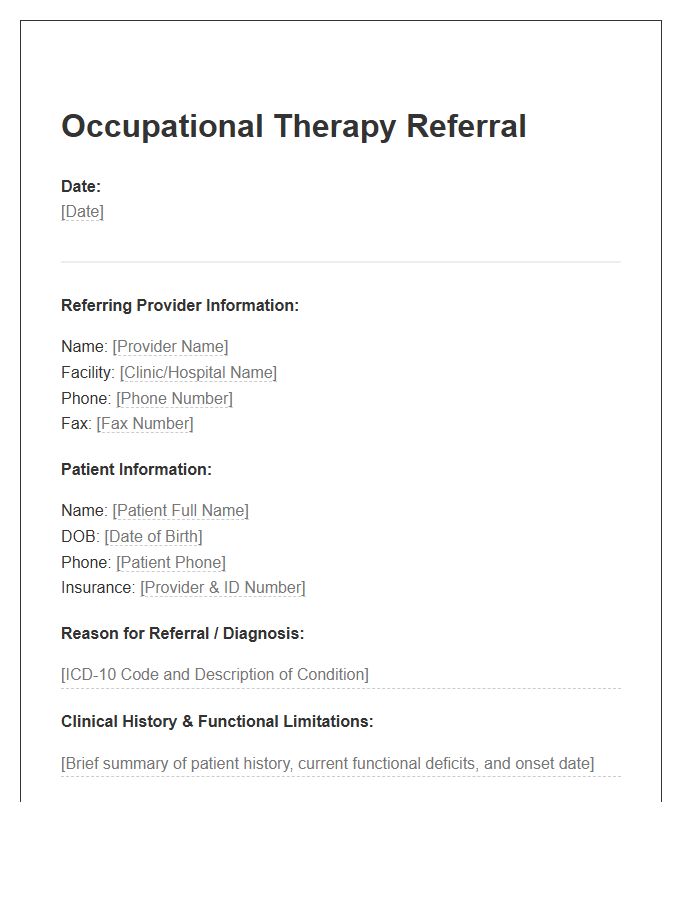
Using an Occupational Therapy Referral Cover Letter Template streamlines the transition of care by providing a clear clinical roadmap. This tool works by organizing essential data-like ICD-10 codes (standardized medical classification) and Functional Limitations (difficulties in daily tasks)-into a professional format that therapists can process instantly. It ensures that critical Functional Deficits are communicated clearly, helping the therapist justify the medical necessity for treatment to insurance providers. By documenting Upper Extremity Rehabilitation needs or ADL Training (Activities of Daily Living) goals, the referring provider bridges the gap between diagnosis and recovery. This structured approach reduces administrative delays and ensures the patient receives targeted rehabilitative services without unnecessary back-and-forth. It is particularly effective because it highlights specific Contraindications, ensuring patient safety during physical assessments. Note: Always include a valid NPI number and specific weight-bearing restrictions to prevent evaluation delays and ensure immediate compliance with insurance requirements.
Surgical Referral Cover Letter Template
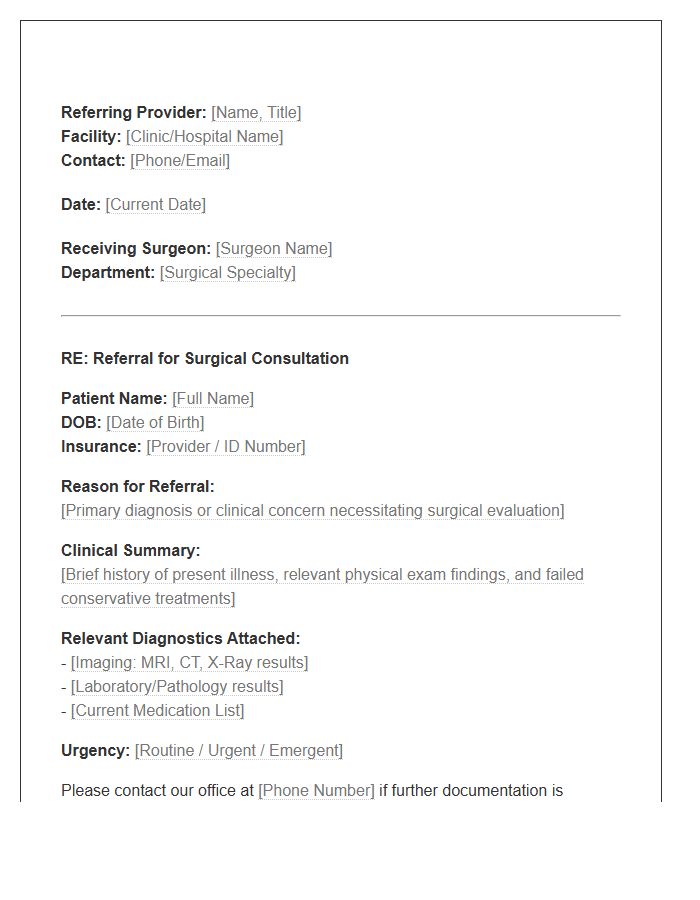
This Surgical Referral Cover Letter Template acts as a professional bridge between primary care and specialized surgical units. By structuring clinical summaries and diagnostic data into a concise format, it ensures surgeons receive the exact information needed for an initial triage-the process of determining the priority of patients' treatments based on severity. The template works by categorizing essential data like imaging results, medication lists, and the specific indication (the valid reason to use a certain test or procedure) into clear sections. This reduces administrative back-and-forth and speeds up the patient's path to the operating room. Why does it work? Because it prioritizes interoperability, meaning it allows different healthcare providers to share and understand patient information seamlessly. Using this standardized approach minimizes the risk of missing critical comorbidities-simultaneous medical conditions-that could affect surgical outcomes. Note: Always verify that the most recent imaging reports are physically attached to the letter to avoid unnecessary rescheduling of the consultation.
Essential Metadata for Referral Documentation
In clinical governance, the referral cover letter serves as a legal bridge for the transfer of care (ToC), requiring high data fidelity to prevent diagnostic delays.
| Data Point | Standardized Format | Clinical Rationale |
|---|---|---|
| Unique Patient Identifier (UPI) | Alphanumeric Code | Eliminates morbidity risks from patient misidentification. |
| ICD-10/11 Coding | Standardized Nosology | Ensures interoperability across Electronic Health Records (EHR). |
| Referral Urgency (TRIAGE) | Categorical (Routine/Urgent/2WW) | Dictates chronological prioritization in outpatient queues. |
Synthesizing Patient Anamnesis and Pathophysiology
The core narrative must encapsulate complex biological intersections, focusing on objective clinical findings rather than subjective anecdotes.
- Chief Complaint (CC): Precise duration and exacerbating/remitting factors.
- Differential Diagnosis (DDx): A ranked list of suspected etiologies based on current symptomatology.
- Comorbidities: Pre-existing systemic conditions that may complicate secondary care interventions.
- Iatrogenic Risks: Potential adverse effects from previous pharmacological treatments.
Pharmacological Reconciliation and Contraindications
Accurate medication reconciliation is critical to prevent polypharmacy complications and adverse drug events (ADEs) during the transition of care.
- Identify current dosage, frequency, and administration route for all active prescriptions.
- Document known hypersensitivities (Allergies) with specific reaction descriptions (e.g., anaphylaxis vs. dyspepsia).
- Cross-reference current regimens with proposed diagnostic procedures to identify potential nephrotoxicity or hepatotoxicity.
Diagnostic Evidence and Quantitative Biometrics
Objective data points provide the empirical foundation for specialized consultation, allowing the receiving clinician to bypass redundant testing.
| Diagnostic Modality | Quantitative Parameters | Significance |
|---|---|---|
| Hematology/Biochemistry | Lab values (e.g., HbA1c, GFR, Troponin) | Establishes baseline metabolic and systemic function. |
| Diagnostic Imaging | DICOM metadata/Radiology Reports | Visual evidence of structural pathology or neoplastic growth. |
| Vital Signs | BP, SpO2, Heart Rate Variability | Indicates hemodynamic stability or autonomic dysfunction. |
Socio-Clinical Determinants and Care Plan Objectives
The concluding segment defines the expected clinical outcome and addresses any non-clinical barriers to care adherence.
- Interprofessional Communication: Specific request for specialized intervention (e.g., surgical evaluation, titration).
- Psychosocial Barriers: Determinants such as health literacy or cognitive impairment (e.g., Aphasia, Executive Dysfunction).
- Advanced Directives: Status of DNR/DNI orders or Power of Attorney (PoA) designations.
Note: Sometimes the .PDF file interface can be slightly different from the image preview. Our apology for this inconvenience.

Comments