
Changing your focus within a university requires a clear strategy. An Academic Department Transfer Cover Letter is a formal document explaining why you wish to move from your current major to a new field of study. It acts as your personal pitch to the admissions committee, highlighting how your previous data-such as GPA and completed credits-aligns with your new goals. This process involves a "lateral move" (shifting between programs at the same level) to ensure your academic trajectory matches your evolving interests. By articulating your motivation, you prove you are prepared for the rigor of the new department. This article explores how to craft a compelling narrative to secure your spot. To help you begin, below are some ready to use templates.

Cover Letter Template and Sample List
Table of Content
- Internal Transfer Academic
- University Department Change
- Faculty Transfer Request
- Research Assistant Department Move
- Academic Staff Transfer
- Intra-University Program Transfer
- Professor Department Transfer
- Academic Advisor Department Swap
- Graduate Student Department Transfer
- College Department Relocation
- Higher Education Internal Transfer
- Academic Unit Transition
- Institutional Department Reassignment
- Cross-Department Academic Application
Internal Transfer Academic Cover Letter Template
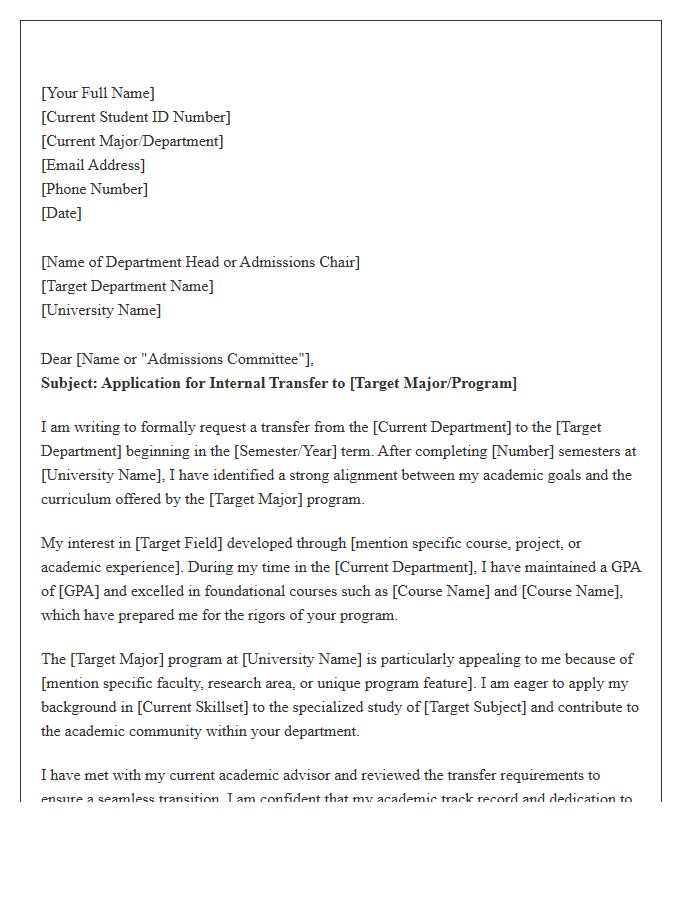
The Internal Transfer Academic Cover Letter Template is a strategic tool designed for students switching majors within the same university. It works by bridging your current academic achievements with your future goals, using a professional narrative to justify the change. Data shows that successful transfers often hinge on a clear Statement of Purpose (a formal essay explaining your motivations) and a solid GPA (Grade Point Average). This template helps you highlight specific prerequisites-required courses you have already completed-to prove you are ready for the new department's rigor. By focusing on alignment, or how well your skills fit the new program, you demonstrate academic maturity to the admissions committee. This structural approach minimizes friction and emphasizes your commitment to the institution. Note: Always mention a specific faculty member or research area in the new department to show you have done your homework.
University Department Change Cover Letter Template
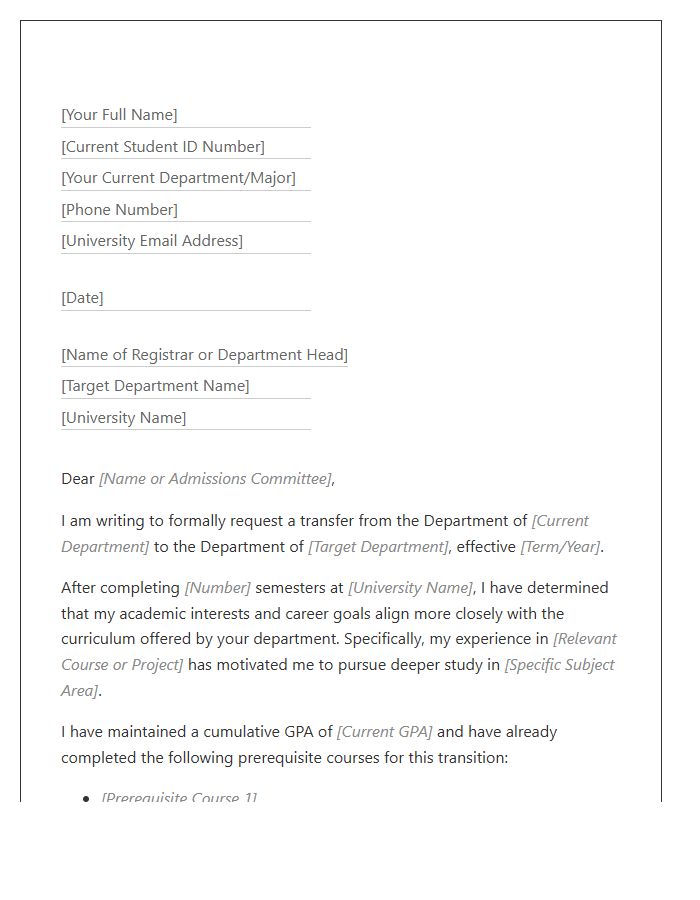
Switching your academic focus is a big step, and this University Department Change Cover Letter Template is designed to make that transition seamless. Essentially, it is a formal request that explains your internal transfer-the process of moving from one major or faculty to another within the same institution. This template works by structurally highlighting your academic performance, specifically your Cumulative GPA (the weighted average of all your grades) and completed prerequisites (required foundation courses). By clearly connecting your past successes to your future career goals, you provide the Registrar or department head with a data-driven reason to approve your request. It eliminates the guesswork by providing a professional layout that balances personal motivation with objective academic data. This ensures your application looks organized and purposeful rather than impulsive. Note: Always double-check your target department's specific credit transfer policies to ensure all your previous coursework counts toward your new degree requirements.
Faculty Transfer Request Cover Letter Template
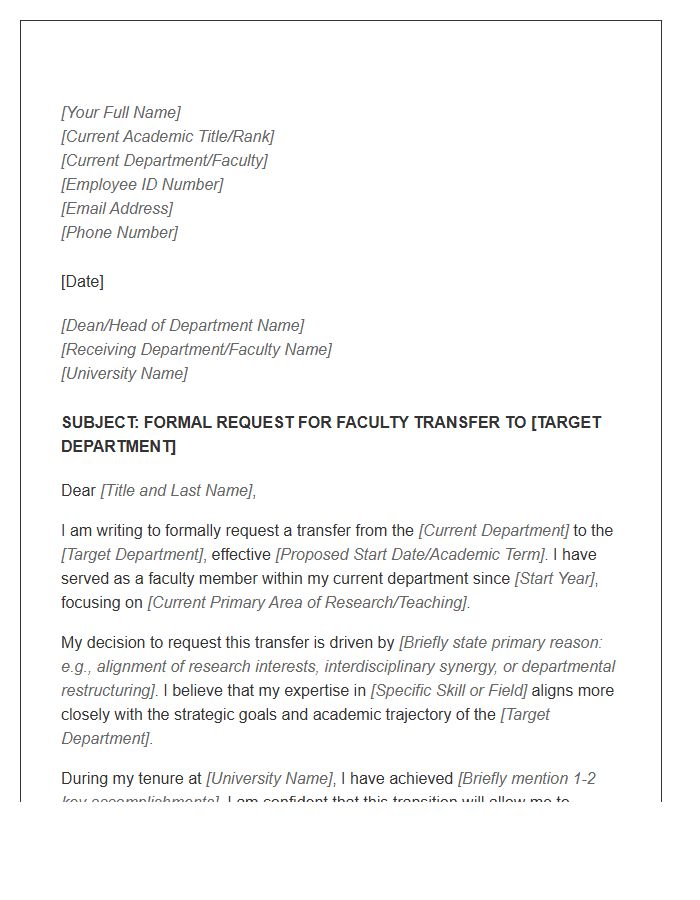
Finding the right academic fit is essential for career growth, and our Faculty Transfer Request Cover Letter Template is designed to make that transition seamless. This tool works by providing a professional structure that balances your past achievements with your future goals. It uses a persuasive narrative to explain why moving to a new department will foster better interdisciplinary synergy-which is the cooperative interaction between different academic disciplines to create a greater combined effect. By highlighting specific data, such as your years of service and key research milestones, the template justifies the move as a strategic benefit for the university rather than just a personal preference. It addresses the tenure (the permanent status of a teacher or professor) considerations and ensures your pedagogical (relating to teaching methods) strengths are front and center. Use this to clearly articulate how your expertise aligns with the target department's vision. Note: Always attach your updated CV to show the direct correlation between your recent work and the new department's curriculum.
Research Assistant Department Move Cover Letter Template
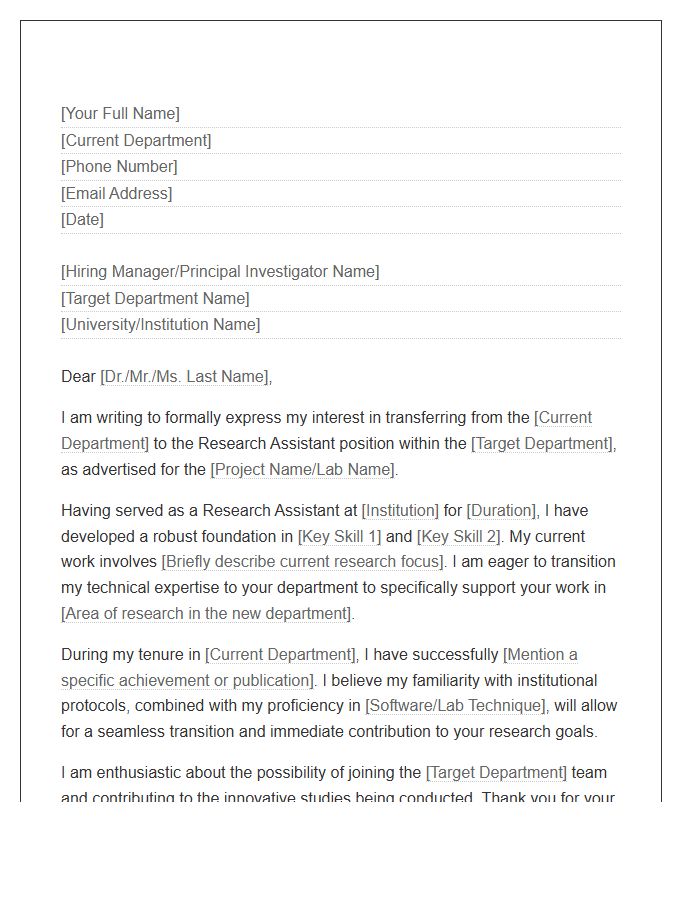
The Research Assistant Department Move Cover Letter Template is a specialized document designed for academic professionals seeking an internal transfer. This template works by emphasizing your existing institutional knowledge, which significantly reduces onboarding (the process of integrating a new employee) time and costs. By highlighting specific data-such as your tenure duration and technical milestones-it frames your relocation as a strategic gain for the new lab rather than just a department change. It focuses on institutional protocols, meaning you already understand the specific safety, ethics, and administrative rules of the university. This conversational yet professional layout helps you articulate how your current methodologies (specific research systems) will directly benefit the target Principal Investigator (the lead researcher or PI). Using this structured approach ensures your transferable skills are the focal point of the application. Remember to explicitly mention your current PI's support to ensure a smooth administrative transition between departments.
Academic Staff Transfer Cover Letter Template
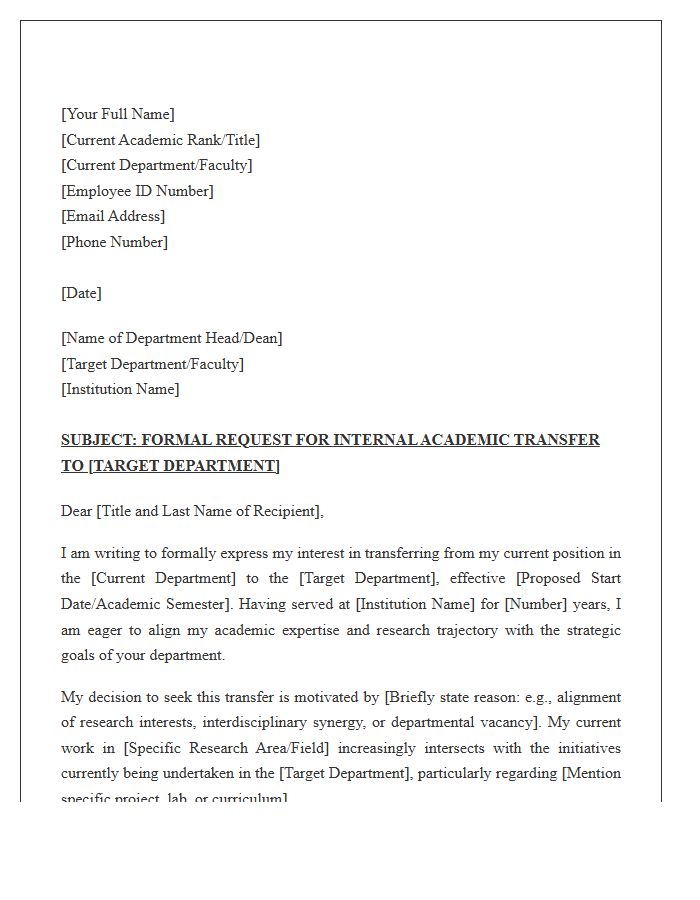
Moving between university departments requires a professional approach, and this Academic Staff Transfer Cover Letter is designed to facilitate that shift. This template works by focusing on interdisciplinary synergy-the seamless integration of your current expertise into a new academic environment. It structures your request by highlighting key performance data, such as grant success or publication history, to prove your value to the target dean. By using a formal yet conversational tone, it bridges the gap between your current role and your research trajectory (the long-term path of your scholarly work). This framework ensures you address the logistical needs of the administration while showcasing how your tenure (permanent academic appointment) or current rank benefits the new faculty. It is effective because it treats an internal move as a strategic upgrade for the institution rather than just a personal change. Note: Always secure a "no-objection" verbal agreement from your current department head before submitting this formal written request.
Intra-University Program Transfer Cover Letter Template
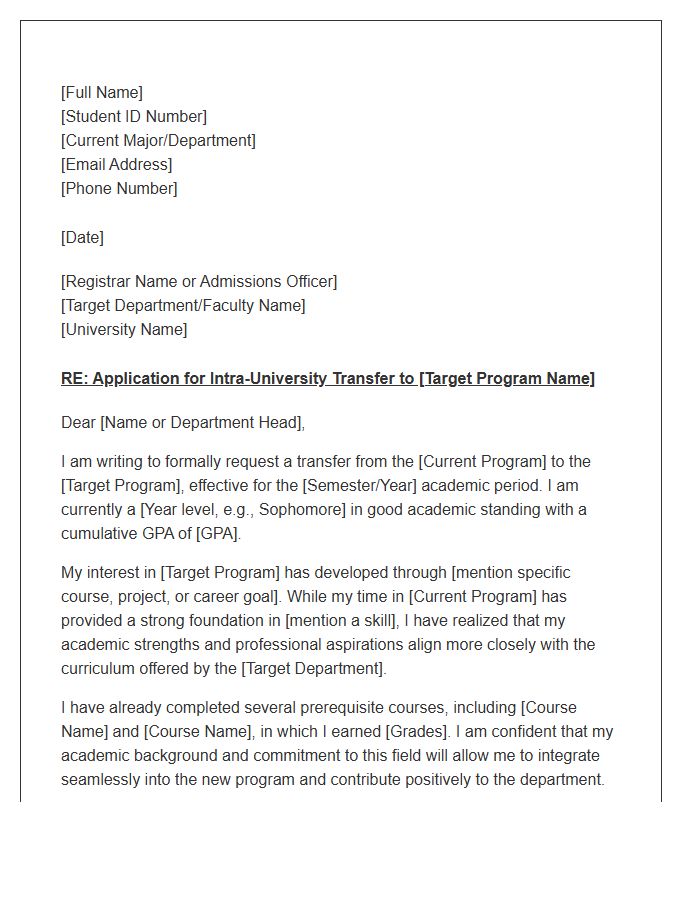
Switching majors doesn't have to be stressful. This Intra-University Program Transfer Cover Letter is a professional bridge designed to help you move from your current department to a new field of study within the same institution. It works by clearly articulating your academic alignment-the connection between your current skills and your future goals. By highlighting data like your cumulative GPA and completed prerequisites (foundational courses required before entering a major), you provide the admissions committee with concrete proof of your readiness. This template is effective because it shifts the focus from why you are leaving a program to why you are a perfect fit for the new one. In academic terms, this is known as a lateral transfer, which minimizes credit loss. Remember to double-check your university's specific transfer deadline to ensure your application is processed for the upcoming semester.
Professor Department Transfer Cover Letter Template
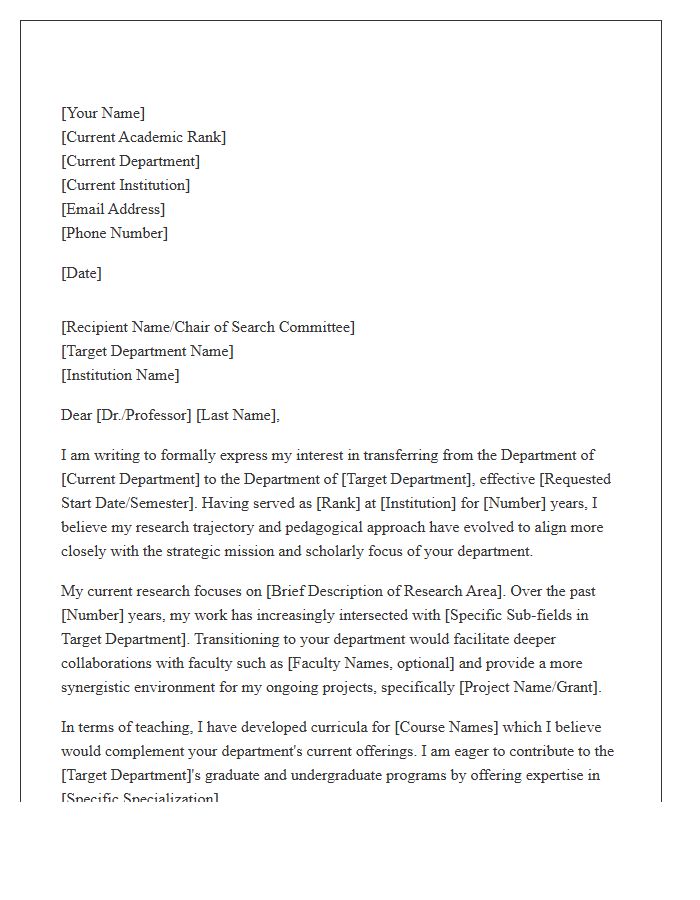
Moving between academic units requires a strategic Professor Department Transfer Cover Letter. This template functions as a formal bridge, helping you articulate why your current academic trajectory (the path of your research and career growth) now aligns better with a different department. It works by highlighting synergy-the increased effectiveness achieved through collaboration-between your existing pedagogical (teaching method) expertise and the target department's specific mission. By focusing on interdisciplinary overlap, you demonstrate that your move isn't just a change of scenery, but a data-driven decision to boost research output and student engagement. This structural approach ensures your Curriculum Vitae (academic resume) is viewed through the lens of your new goals. It reduces friction during the administrative review by clearly defining how your specialization fills a gap in the new faculty roster. Note: Always emphasize how the transfer benefits the university's collective goals rather than focusing solely on personal convenience.
Academic Advisor Department Swap Cover Letter Template
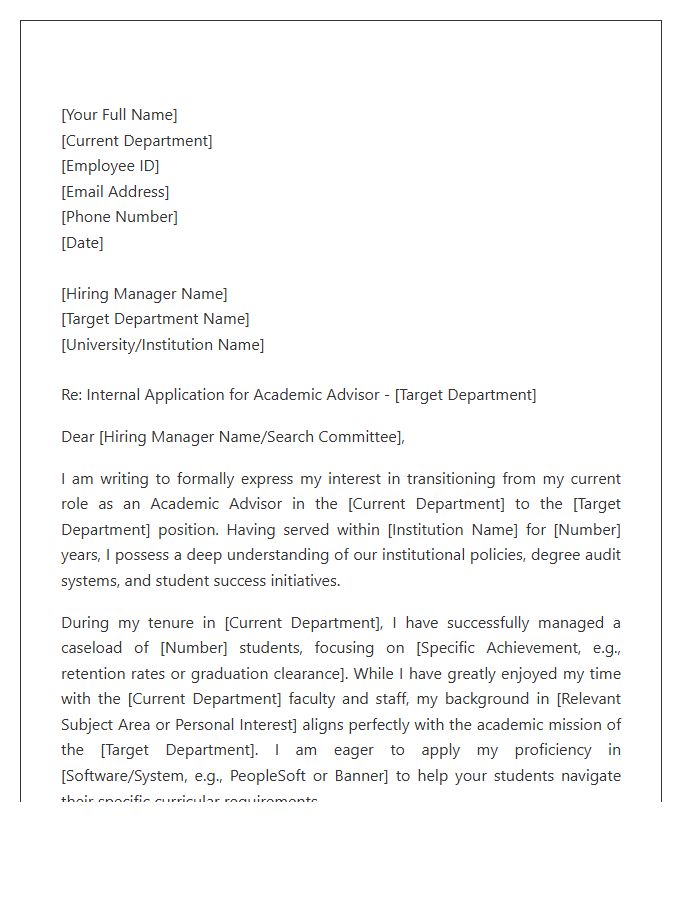
The Academic Advisor Department Swap Cover Letter Template is a strategic tool designed for internal mobility within higher education. It works by emphasizing your institutional knowledge, which significantly reduces the training time typically required for new hires. By using this template, you effectively communicate how your expertise in specific systems, such as a Degree Audit System (a digital tool used to track progress toward graduation), translates across different faculties. Data shows that internal transfers often increase retention rates because the advisor already understands the university's unique culture and administrative hurdles. This template focuses on your ability to manage a specific student caseload-the total number of students assigned to an advisor-while highlighting your desire to align with a new subject area. It bridges the gap between your current success and your future potential in a new department. Note: Always mention a specific Strategic Initiative of the target department to prove you have done your homework on their unique goals.
Graduate Student Department Transfer Cover Letter Template
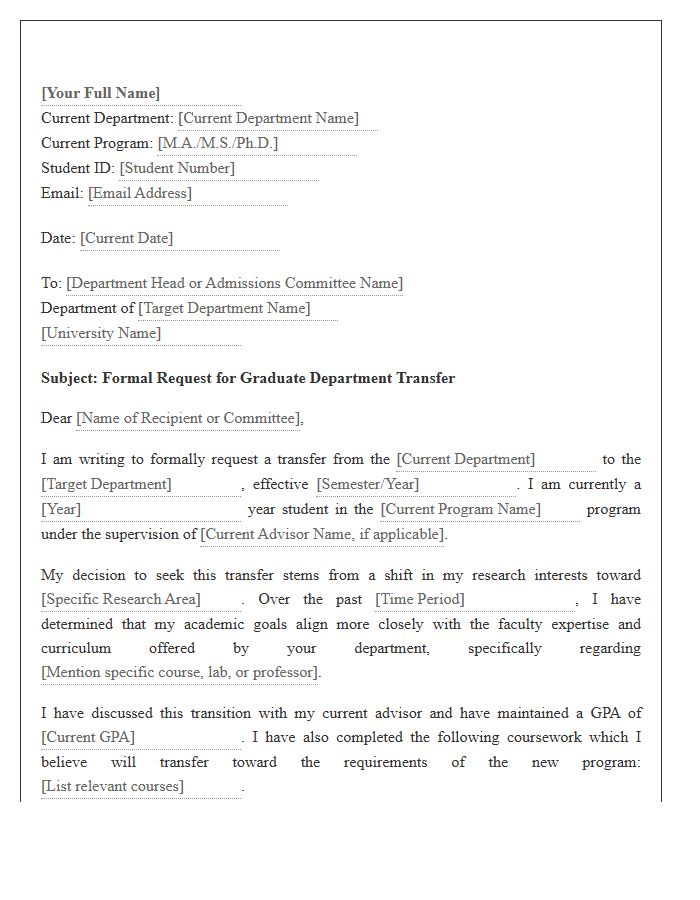
This Graduate Student Department Transfer Cover Letter Template is designed to help you navigate the administrative transition between academic units. It works by structuring your request around three pillars: research alignment, academic performance, and professional transparency. By using this layout, you provide the admissions committee with essential data, such as your GPA and completed coursework, which justifies your readiness for a new disciplinary focus. This template is effective because it uses a conversational yet formal tone to explain your "pivot"-a glossary term referring to a strategic shift in one's research direction. It ensures you mention your current advisor, signaling that the move is collaborative rather than disruptive. Whether you are moving from Biology to Chemistry or Sociology to Education, this document bridges your past achievements with your future goals. Note to remember: Always check your university's specific internal transfer deadlines before submitting this letter to ensure your request is processed for the upcoming semester.
College Department Relocation Cover Letter Template
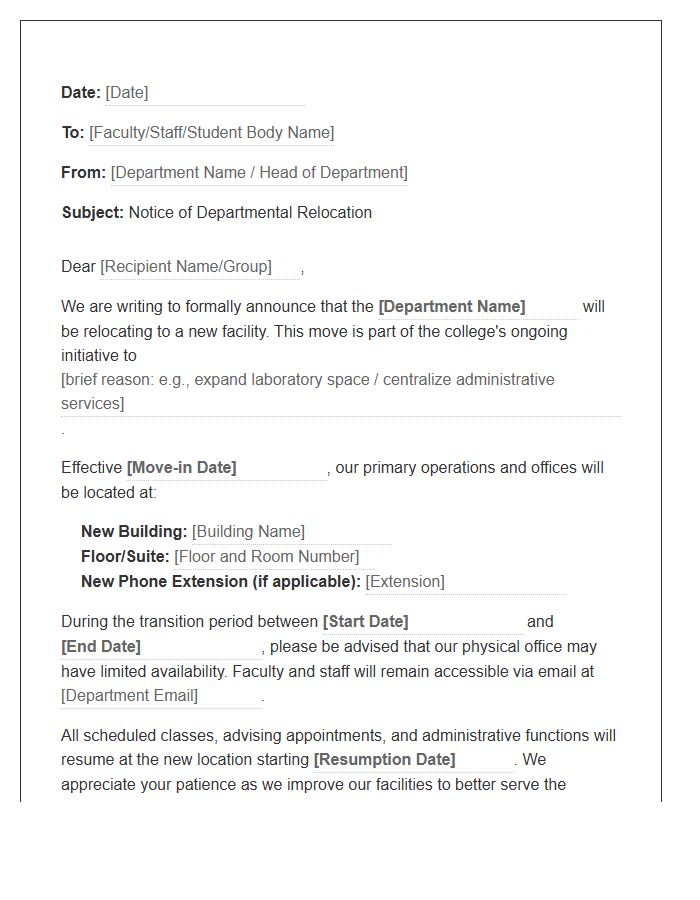
This College Department Relocation Cover Letter Template is a professional communication tool designed to manage campus logistics during a move. It works by providing a structured Notification Protocol, ensuring that students and faculty receive critical data like the "Move-in Date" and "New Building" location in a clear format. By using this template, departments minimize confusion during a Transition Period-the timeframe when services might be limited due to packing and setup. It functions as a single source of truth to maintain academic continuity. For clarity, Administrative Functions refer to the non-teaching tasks like payroll or registration that keep the department running. This template is essential because it bridges the gap between old and new facilities while highlighting contact Accessibility via email. Note: Always include a floor plan or a digital map link to help stakeholders navigate the new layout effortlessly.
Higher Education Internal Transfer Cover Letter Template
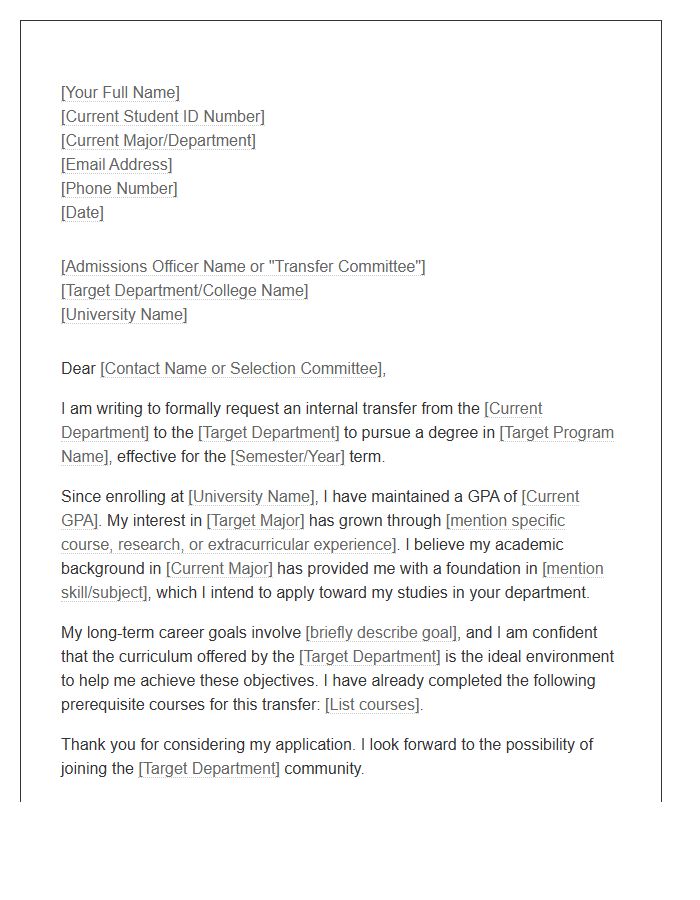
This Higher Education Internal Transfer Cover Letter Template is a strategic tool designed for students looking to switch majors or departments within the same university. It works by bridging your current academic standing with your future career trajectory. By highlighting hard data like your GPA and specific completed prerequisites (essential courses required before entering a program), you demonstrate academic readiness. This template is effective because it moves beyond "interest" and focuses on your institutional fit, showing the committee that your transfer is a logical progression based on your research and performance. Key glossary terms to note include interdisciplinary skills-the ability to apply knowledge from one field to another-and matriculation, which is the formal process of entering the new program. This structured approach helps decision-makers see you as a low-risk, high-reward candidate. Note: Always verify if your target department requires a specific Statement of Purpose instead of a standard cover letter before submitting.
Academic Unit Transition Cover Letter Template
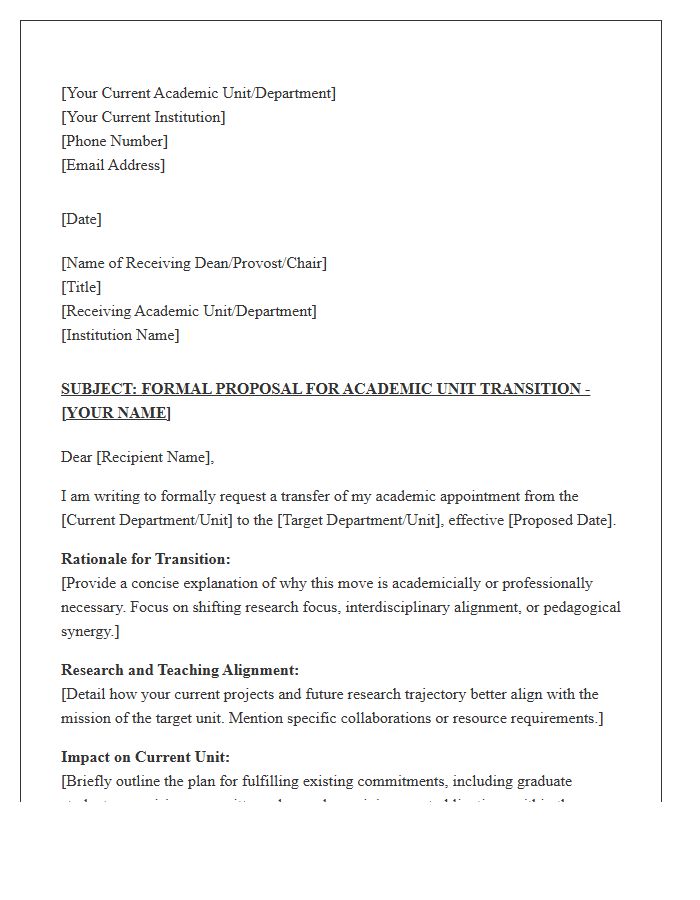
Moving between departments in a university requires more than just a conversation; it needs a structured Academic Unit Transition Cover Letter. This template functions as a formal bridge, helping faculty members articulate a logical pedagogical synergy-which refers to the combined benefit of teaching and research across different disciplines-and clear administrative shifts. It works by addressing the three pillars of academia: research alignment, teaching responsibilities, and resource allocation, the process of distributing financial or physical assets like lab space. By clearly outlining how your work fits better in a new department, you reduce friction between deans and chairs. Data shows that well-documented requests expedite the tenure-track migration process by providing a clear paper trail for the Provost. Use this guide to turn a complex bureaucratic move into a strategic career advancement. Note: Always verify your institution's specific bylaws regarding faculty transfers before submitting your final proposal.
Institutional Department Reassignment Cover Letter Template
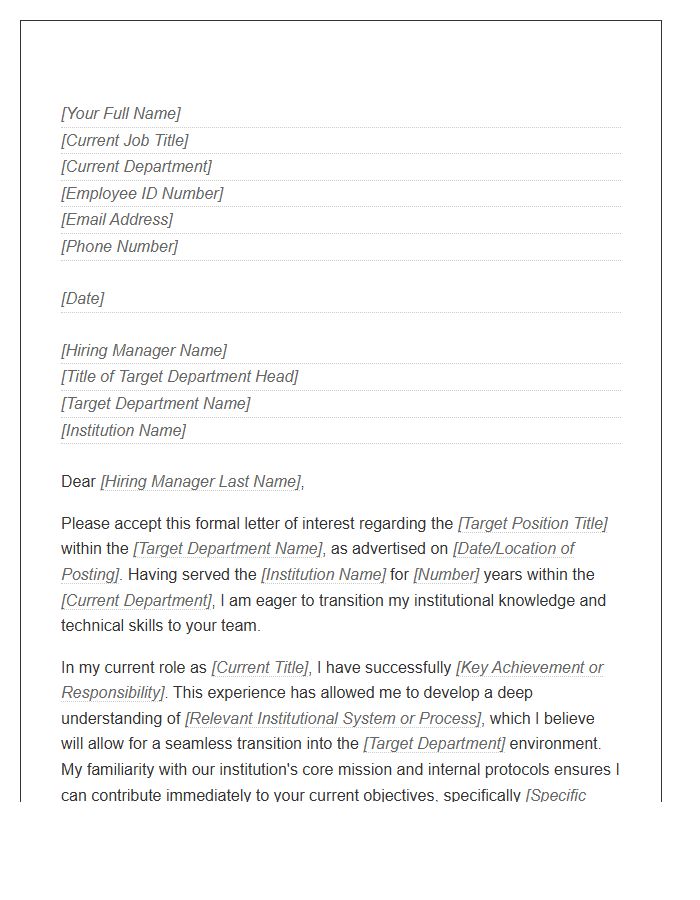
Are you looking to pivot your career within your current organization? The Institutional Department Reassignment Cover Letter Template is a strategic tool designed to help employees transition smoothly between internal sectors. This template works by emphasizing your institutional knowledge-the specialized understanding of an organization's unique culture, systems, and "unwritten rules"-to prove you are a lower-risk hire than an external candidate. By highlighting specific data, such as your years of service and internal achievements, you demonstrate a "seamless transition" (a lateral move without the typical learning curve). This structured approach effectively bridges the gap between your current functional role and the specific objectives of the target department. It is highly effective because it treats the reassignment as a strategic internal recruitment opportunity rather than just a simple job change. Note: Always customize the "Reason for Interest" section to show how your move benefits the company's bottom line, not just your personal preferences.
Cross-Department Academic Application Cover Letter Template
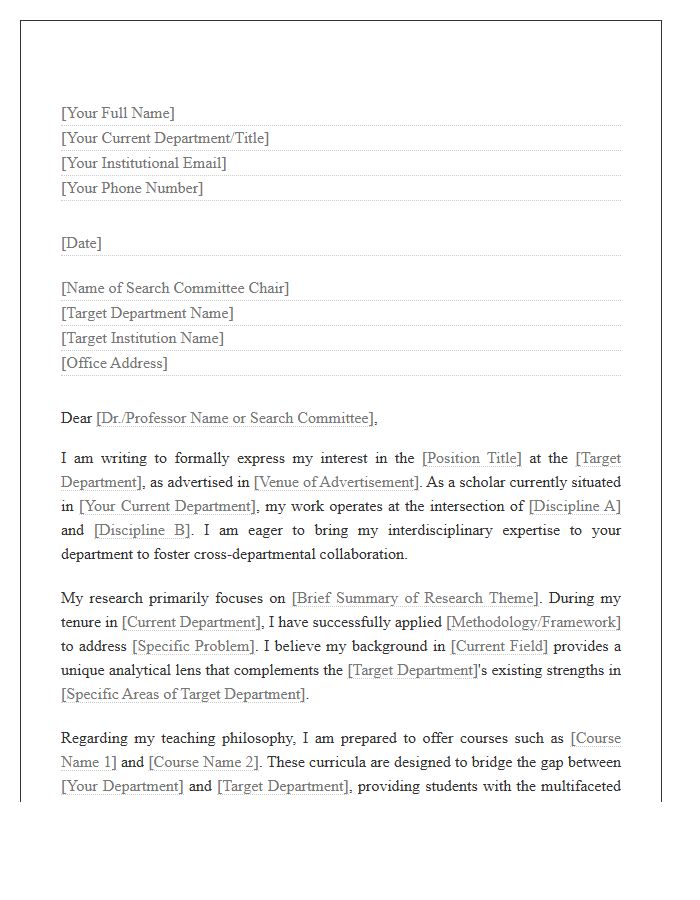
Navigating a career move between academic disciplines requires a strategic Cross-Department Academic Application Cover Letter. This template is designed to bridge the gap between your current expertise and a target department by emphasizing transferable skills. It works by utilizing a structural interdisciplinary approach, which refers to the integration of knowledge from different fields to solve complex problems. By focusing on your unique methodology-the specific system of methods used in your study-the template helps you articulate how your "outsider" perspective adds value rather than confusion. Data shows that candidates who explicitly link their past research to the new department's goals are significantly more likely to secure an interview. Use this layout to showcase your teaching philosophy and demonstrate how your multifaceted toolkit serves the institutional mission. Note: Always customize the analytical lens section to prove you understand the specific technical language of the department you are joining.
Academic Context and Intent-to-Transfer Rationalization
A formal request for departmental migration necessitates a rigorous justification based on interdisciplinary synergy and pedagogical alignment. The candidate must articulate how their current scholastic trajectory necessitates a pivot toward a specialized curriculum.
- Quantitative Aptitude: Evidence of prerequisite mastery in foundational methodologies.
- Curricular Congruence: Mapping current credit distribution to target department requirements.
- Research Convergence: Identifying intersections between existing projects and new faculty expertise.
Comparative Analysis of Credit Equivalency
To facilitate administrative reconciliation, the cover letter should include a granular breakdown of transferable unit competencies. This ensures that the Office of the Registrar can validate academic standing without stipulated remediation.
| Course Code | Cognate Discipline | GPA Impact (Weighted) | Status |
|---|---|---|---|
| MATH-401 | Stochastic Processes | 3.92 | Validated |
| PHIL-202 | Epistemological Logic | 4.00 | Pending Review |
Methodological Framework and Research Interests
High-level academic transfers are often predicated on the ontological shift of the student's research focus. The letter must define the specific theoretical paradigms that the applicant intends to explore under the new department's jurisdictional oversight.
- Definition of the primary heuristic framework for upcoming thesis work.
- Identification of specific longitudinal datasets requiring departmental laboratory access.
- Proposed timeline for comprehensive examination readiness post-transfer.
Faculty Sponsorship and Mentorship Dynamics
Securing departmental endorsement requires a demonstration of existing intellectual rapport with faculty members. This section details the collaborative potential and the symbiotic integration of the student into the new academic ecosystem.
- Principal Investigator (PI) Alignment: Specific labs or clusters of inquiry.
- Grants and Fellowships: Portability of existing extramural funding.
- Instructional Support: Capacity to serve as a Graduate Student Instructor (GSI) within the new discipline.
Synthesized Professional Objective Statement
The conclusion must consolidate the teleological purpose of the transfer, emphasizing the long-term vocational viability and academic rigor. It acts as a final affirmative declaration of the student's commitment to the new department's strategic mission.
| Term | Academic Definition |
| Interdisciplinary Fluency | The capacity to synthesize divergent methodological approaches. |
| Institutional Continuity | The seamless transition of administrative records and funding cycles. |
Note: Sometimes the .PDF file interface can be slightly different from the image preview. Our apology for this inconvenience.

Comments