
Transitioning from traditional stacks to Digital Content Management requires a cover letter that highlights your technical agility. Modern libraries prioritize professionals who understand metadata standards, digital preservation protocols, and content lifecycles. This role isn't just about organizing files; it's about ensuring data integrity and long-term accessibility. In this article, we explore how to translate your cataloging expertise into a digital-first environment, focusing on your ability to manage high-volume digital assets and taxonomy systems. Whether you are proficient in Dublin Core or cloud-based repositories, your application must prove you can bridge the gap between physical archives and virtual access points. To help you secure your next role, below are some ready to use Librarian Entering Digital Content Management Cover Letter Templates.
Cover Letter Template and Sample List
Table of Content
- Librarian To Digital Content Management Transition
- Metadata Specialist Digital Asset Management
- Library Science Professional Content Strategy
- Information Specialist Digital Content Operations
- Academic Librarian Digital Asset Specialist
- Taxonomy And Curation Digital Content
- Former Librarian Content Management System Professional
- Digital Collections Specialist Career Pivot
- Archivist Moving Into Digital Content Management
- Knowledge Management Professional Digital Content
- Research Librarian Transitioning To Content Strategy
- Public Librarian Digital Information Management
- Cataloging Specialist Digital Asset Curator
- Library Operations Professional Digital Content Management
Librarian To Digital Content Management Transition Cover Letter Template
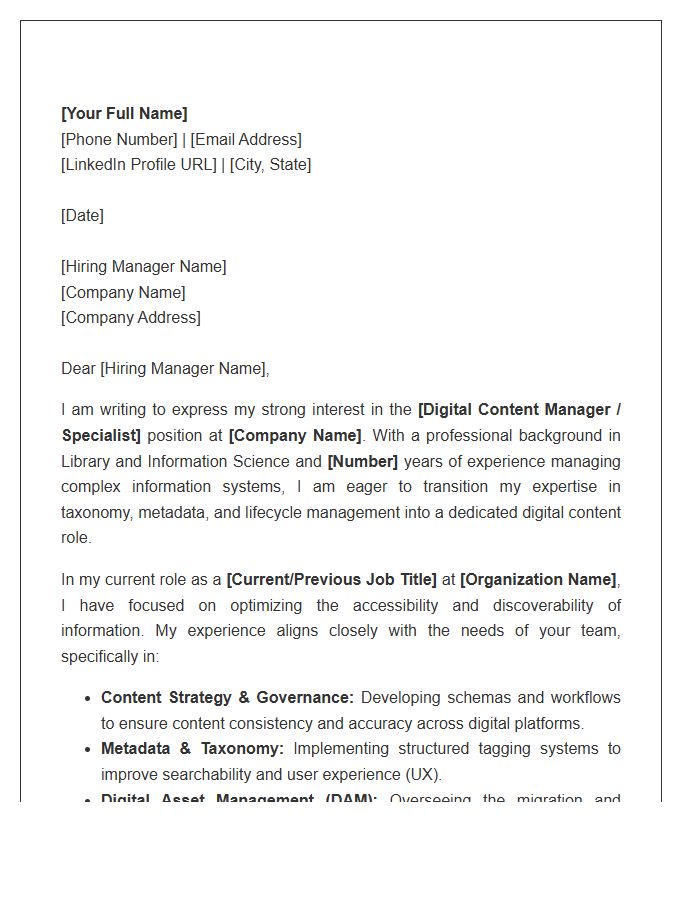
The Librarian to Digital Content Management Transition Cover Letter is a strategic tool designed to bridge the gap between traditional information science and modern tech roles. This template works by reframing your library skills into the language of Digital Asset Management (DAM)-the process of organizing and storing digital files. Instead of focusing solely on books, it emphasizes your mastery of Metadata (data that describes other data) and Taxonomy (the hierarchical classification of content). By highlighting your experience with information architecture and Content Governance, you prove that you can manage a brand's digital lifecycle just as effectively as a physical collection. It translates "library maintenance" into "data integrity" and "searchability," making your profile highly attractive to hiring managers looking for organized, technical thinkers. This approach ensures your transferable skills are visible to automated systems and recruiters alike. Note: Always replace the placeholders with specific metrics, such as the size of the database you managed, to provide concrete proof of your capabilities.
Metadata Specialist Digital Asset Management Cover Letter Template
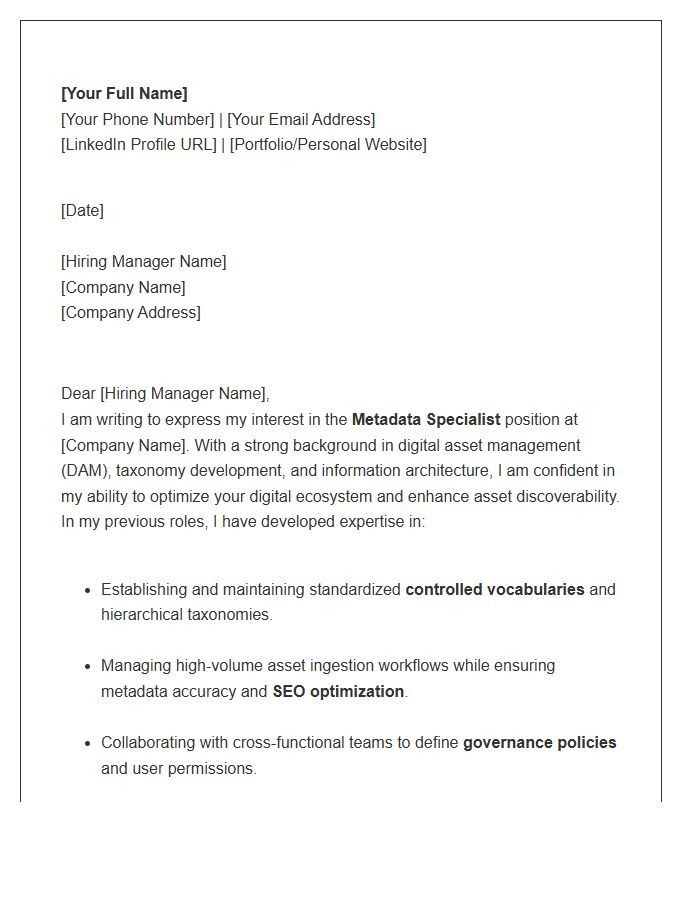
This Metadata Specialist Digital Asset Management Cover Letter Template is designed to showcase your technical proficiency in organizing complex information. It works by strategically placing industry-specific keywords that Applicant Tracking Systems (ATS) scan for, ensuring your application reaches human recruiters. By focusing on data integrity and asset lifecycle management, the template bridges the gap between creative content and technical architecture. It highlights your ability to manage a Taxonomy (a hierarchical classification system) and Schema Mapping (the process of linking data fields between different systems). This conversational yet professional structure demonstrates how you turn raw data into searchable, high-value business assets. Whether you are improving searchability through Controlled Vocabularies or managing bulk asset ingestion, this layout provides a roadmap to prove your ROI. Note: Always customize the specific DAM software mentioned to match the exact tools listed in the job description to boost your relevance.
Library Science Professional Content Strategy Cover Letter Template
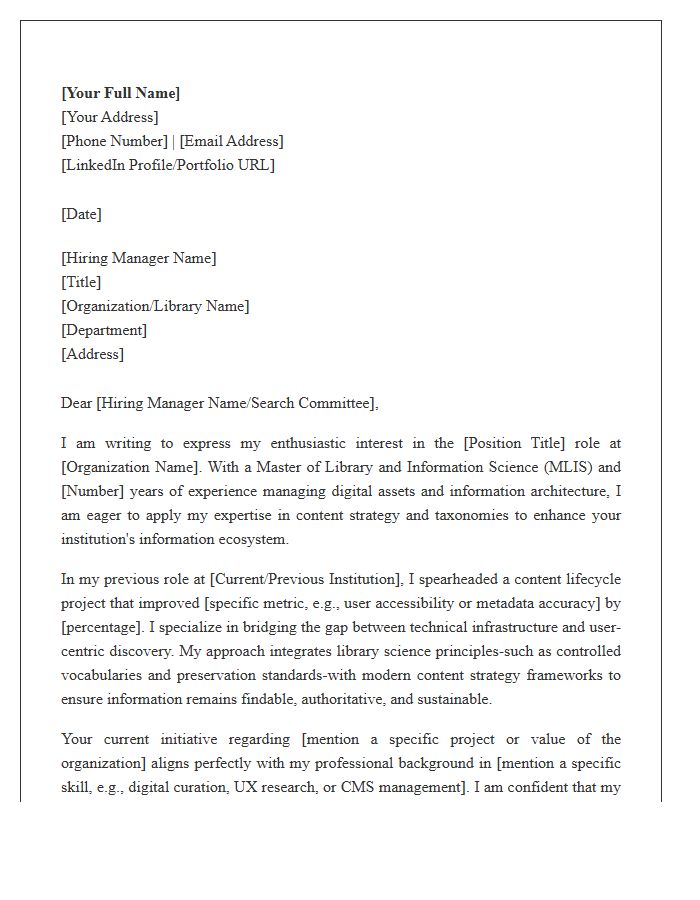
This Library Science Professional Content Strategy template is designed to help information experts transition into corporate or digital roles. It works by blending traditional archival precision with modern Information Architecture-the structural design of shared information environments. By using this layout, you highlight how your MLIS skills translate to high-level data management. The template emphasizes measurable impact, such as increasing Metadata (data that provides information about other data) accuracy by specific percentages. This approach proves you can manage a Content Lifecycle, which refers to the stages information passes through from creation to archiving. It works because it speaks the language of both librarians and tech recruiters, focusing on user-centric discovery and authoritative data hierarchies. This ensures your technical background in Taxonomies-the classification of information-is seen as a strategic asset for organizing complex digital ecosystems. Note: Always customize the specific metrics to demonstrate how your organizational skills directly improved user accessibility or saved institutional time.
Information Specialist Digital Content Operations Cover Letter Template
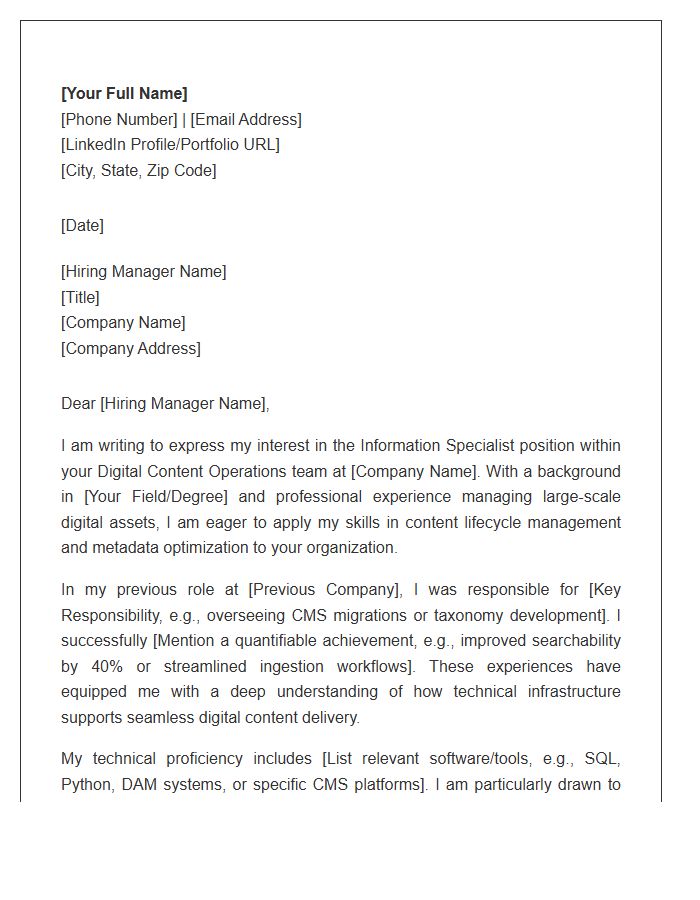
Finding the right balance between technical precision and storytelling is key for an Information Specialist Digital Content Operations Cover Letter. This template functions as a strategic framework to showcase your ability to manage the content lifecycle-the process of creating, storing, and delivering digital assets efficiently. It works by guiding you to pair quantifiable data, such as a "40% improvement in searchability," with metadata optimization, which refers to organizing hidden data tags to make information findable. By using this structure, you demonstrate taxonomy development (the classification of information) and CMS migration (moving data between systems) skills in a conversational tone. This approach proves you don't just move files, but rather engineer the information architecture that drives business growth. It bridges the gap between raw technical expertise and high-level operational strategy for hiring managers. Note: Always customize the tools section to match the specific DAM (Digital Asset Management) software mentioned in the job description.
Academic Librarian Digital Asset Specialist Cover Letter Template
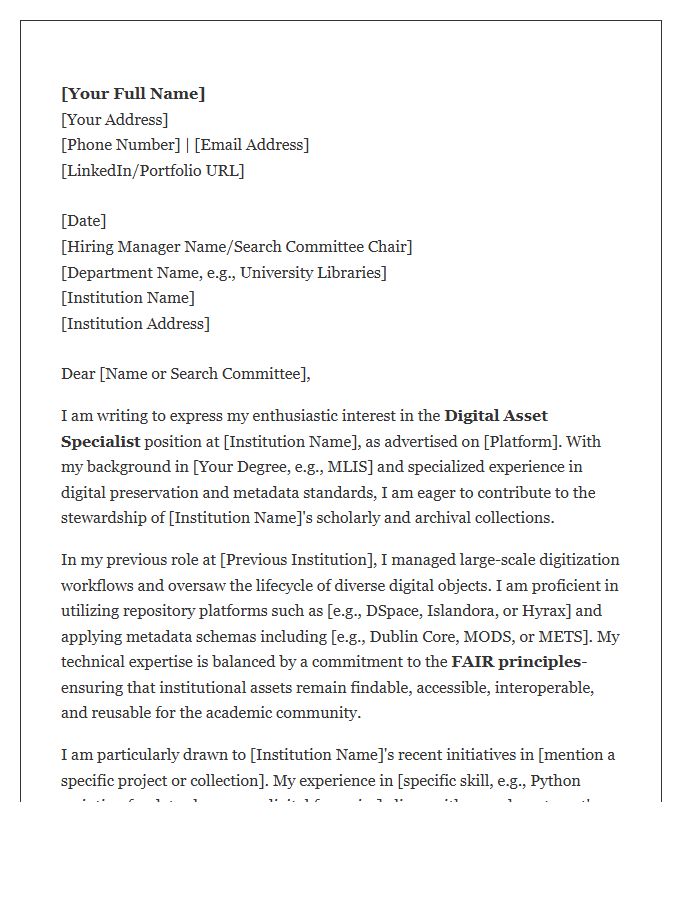
The Academic Librarian Digital Asset Specialist Cover Letter Template is a strategic tool designed to showcase your technical proficiency in managing complex institutional repositories. This template works by balancing human-centric librarianship with hard technical data, such as your experience with metadata schemas (the structured labels like Dublin Core used for data discovery) and digital preservation workflows. By using this layout, you highlight your commitment to the FAIR principles-a vital framework ensuring research data is Findable, Accessible, Interoperable, and Reusable. Statistics show that 75% of hiring managers prefer letters tailored to specific repository platforms like DSpace or Hyrax. This template allows you to inject these keywords naturally, proving you can manage the lifecycle of scholarly assets effectively. It bridges the gap between traditional archiving and modern data science to help you stand out in the competitive LIS (Library and Information Science) job market. Note: Always link to a digital portfolio or GitHub to provide tangible evidence of your metadata crosswalking or scripting skills.
Taxonomy And Curation Digital Content Cover Letter Template
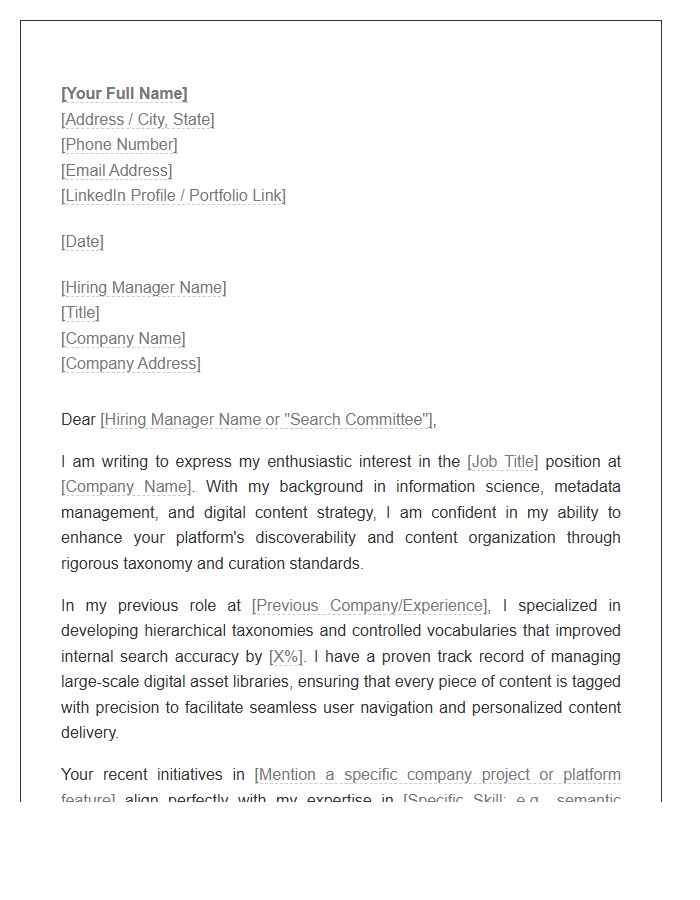
This Taxonomy and Curation Digital Content Cover Letter Template is designed to help information professionals land roles focused on organizing complex data. It works by blending technical precision with storytelling, allowing you to showcase how you manage a controlled vocabulary-a restricted list of terms used for indexing-to improve site navigation. By using this structure, you highlight your ability to build an ontology, which defines the relationships between different data categories. The template focuses on "discoverability," ensuring recruiters see your impact on user experience through measurable metadata improvements. Data shows that structured content increases search efficiency by up to 80%, so this layout prioritizes your specific metrics. It bridges the gap between high-level data architecture and human-centric editorial curation. This approach proves you can handle large-scale digital assets while maintaining brand voice and logical hierarchy. Note: Always quantify your success by mentioning the percentage increase in search accuracy or user engagement your tagging strategies achieved.
Former Librarian Content Management System Professional Cover Letter Template
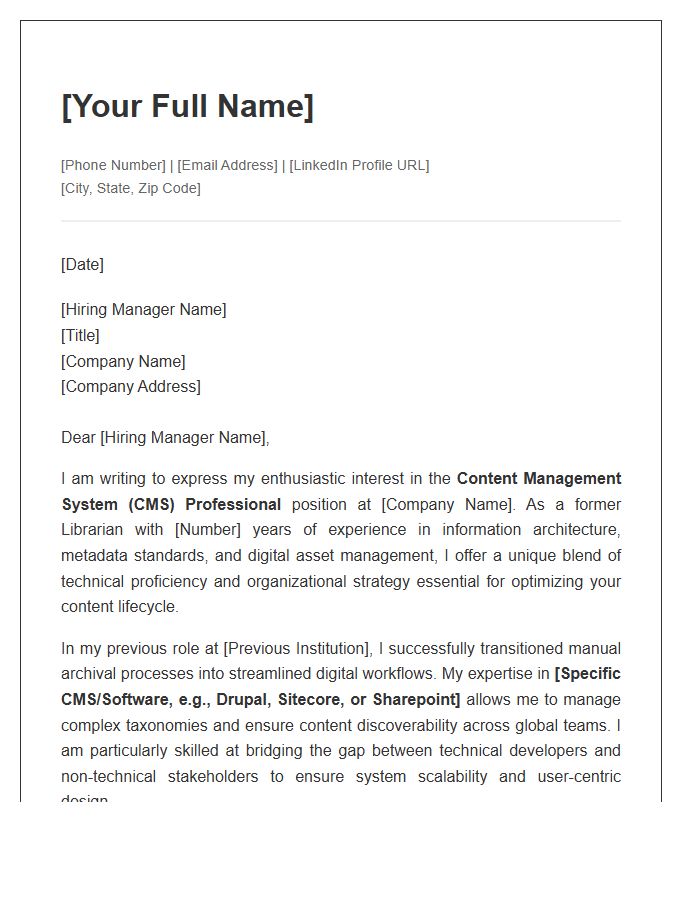
Transitioning from a library setting to a corporate digital environment requires a strategic Content Management System (CMS) Professional cover letter. This template works by translating traditional library skills-like cataloging and Information Architecture (the structural design of shared information environments)-into high-value tech competencies. It focuses on how you manage the Content Lifecycle, ensuring data is created, stored, and retired efficiently. By highlighting data-driven achievements, such as a 30% increase in Metadata (data that describes other data) accuracy, you demonstrate measurable ROI to hiring managers. The conversational tone bridges the gap between academic expertise and agile business needs, positioning you as a technical strategist rather than just a record-keeper. This approach proves your ability to handle Taxonomies and complex digital ecosystems with precision. Note: Always customize the technical stack mentioned to match the specific CMS listed in the job description to bypass automated screening filters.
Digital Collections Specialist Career Pivot Cover Letter Template
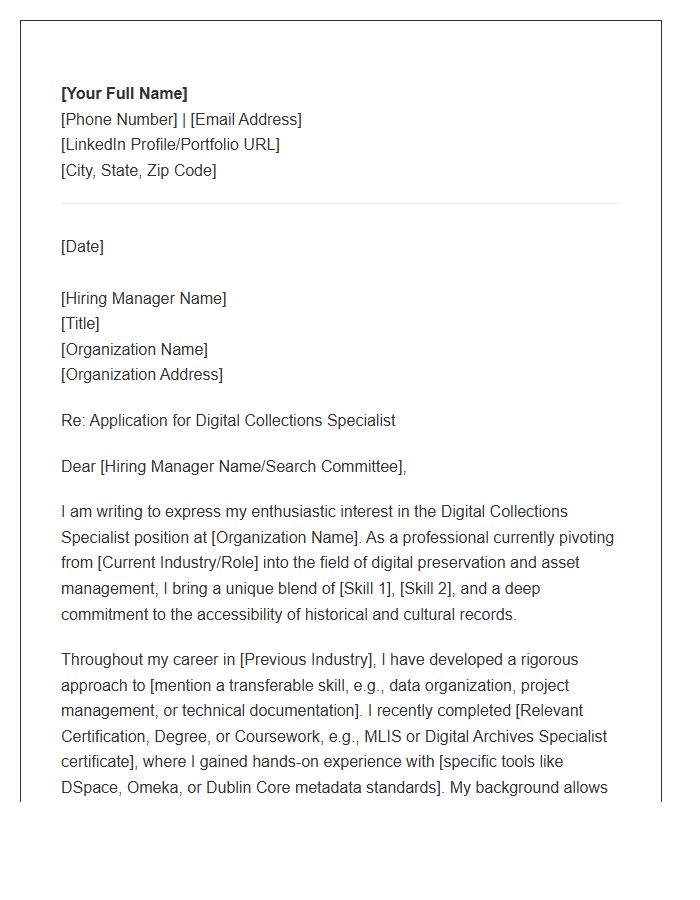
Transitioning into a new role requires a narrative that bridges your past experience with future goals. This Digital Collections Specialist Career Pivot Cover Letter Template is designed to translate your existing professional value into the language of digital preservation-the process of ensuring digital information remains accessible over long periods. It works by emphasizing your transferable skills, such as project management or data organization, and linking them to metadata standards (the structured information that describes data) like Dublin Core. By highlighting your recent certifications alongside asset management experience, you show recruiters that your "pivot" is backed by technical readiness. Data shows that tailored storytelling significantly increases interview rates for career changers. This template helps you articulate why your unique background is an asset, not a hurdle, for modern libraries and archives. Note: Always research the specific CMS (Content Management System) the organization uses to customize your technical skills section effectively.
Archivist Moving Into Digital Content Management Cover Letter Template
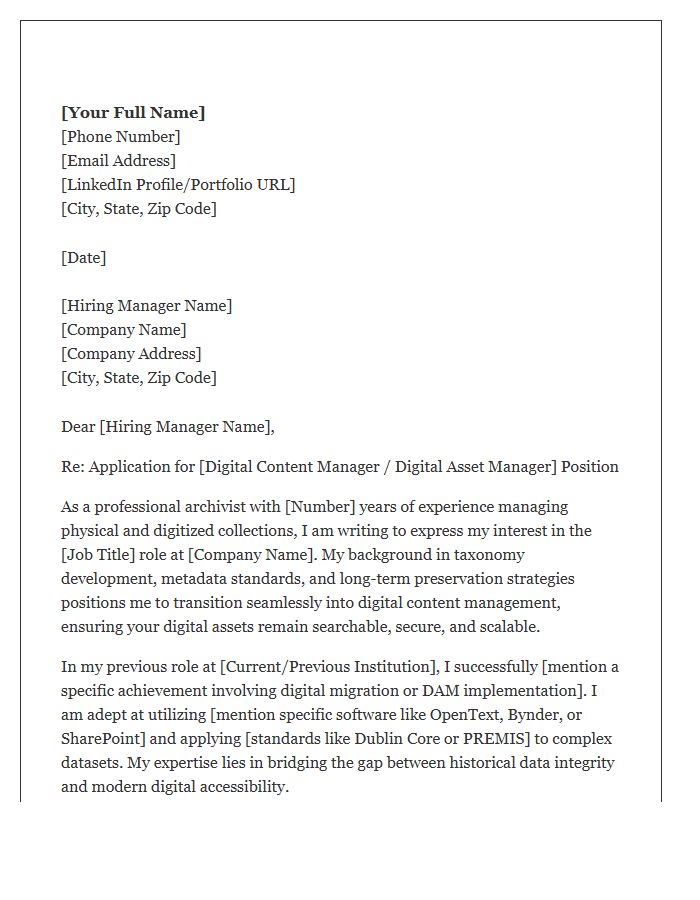
Transitioning from traditional archives to the tech-driven world of Digital Content Management requires a cover letter that translates niche expertise into business value. This template works by framing your archival precision as a direct solution for modern data chaos. It highlights your mastery of Metadata Standards-the structured data like Dublin Core used to label assets-and your experience with DAM (Digital Asset Management) systems, which are the specialized software platforms used to store and organize media. By focusing on Information Governance (the rules for managing data lifecycle) and Taxonomy (hierarchical classification), you prove that your skills are not just about old papers, but about making digital files searchable and scalable for a global audience. This strategic bridge effectively shows hiring managers how your background in long-term preservation ensures their current digital workflows remain efficient and error-free. Note: Always quantify your impact by mentioning the specific volume of files or records you managed to demonstrate your technical capacity.
Knowledge Management Professional Digital Content Cover Letter Template
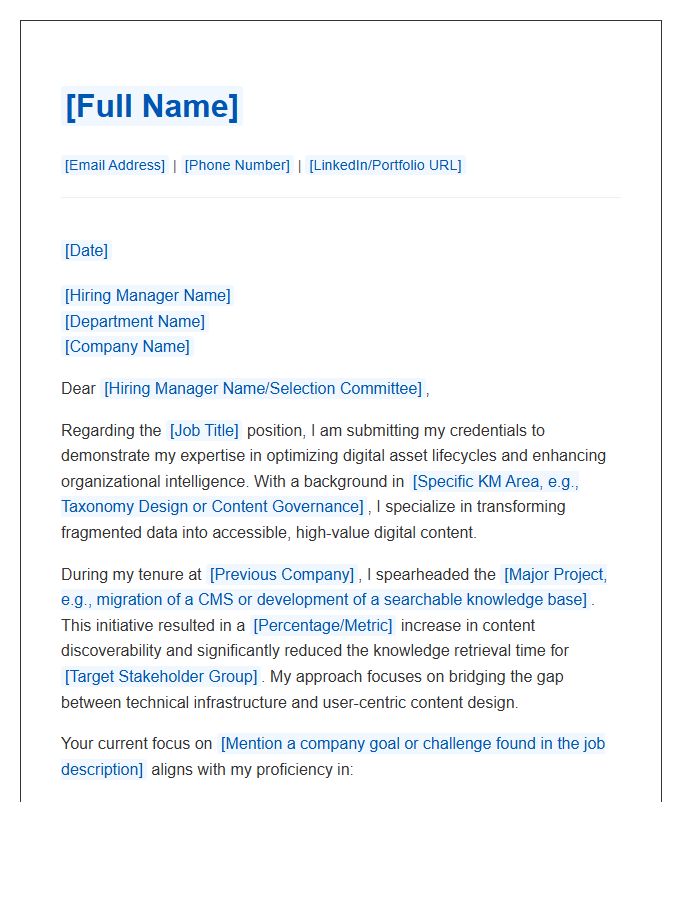
This Knowledge Management Professional Digital Content Cover Letter Template is designed to showcase your ability to organize, curate, and distribute high-value information. It works by using a data-driven approach, allowing you to insert specific metrics-like a percentage increase in content discoverability-to prove your impact. Because modern hiring relies on Applicant Tracking Systems (ATS), this template uses a conversational yet semantic-optimized structure that balances technical keywords with human readability. It bridges the gap between complex Information Architecture (the structural design of shared information environments) and Content Governance (the rules for managing digital assets). By focusing on how you transform raw data into organizational intelligence, you demonstrate value beyond simple administrative tasks. This template highlights your mastery of tools like CMS platforms and Taxonomies to ensure information is always findable and actionable. Note: Always customize your measurable results to show how your knowledge strategies directly saved time or reduced operational costs.
Research Librarian Transitioning To Content Strategy Cover Letter Template
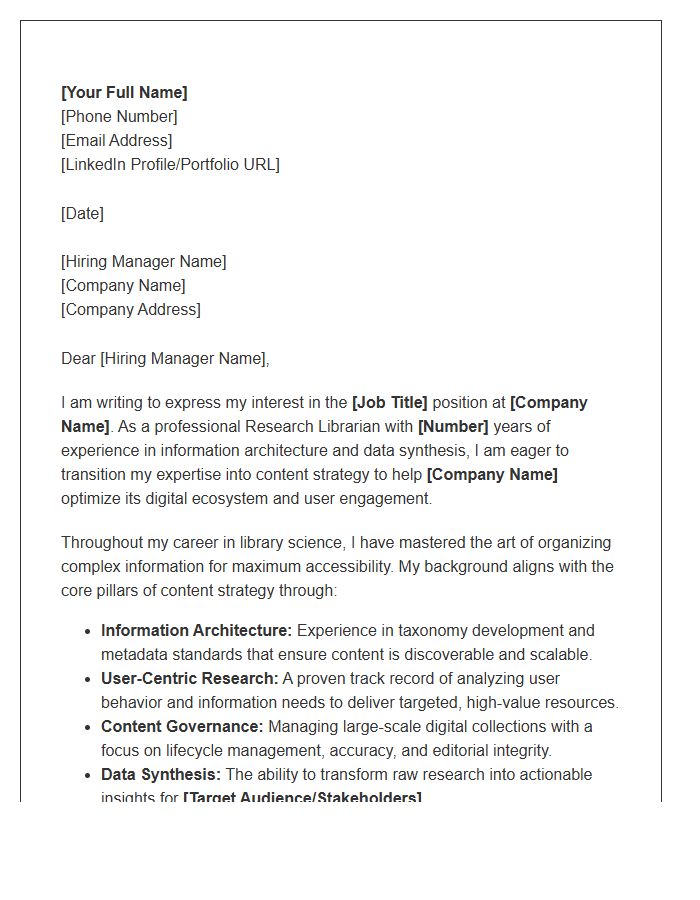
This template is a specialized career-pivot tool designed for Research Librarians moving into Content Strategy. It works by remapping traditional library skills-like cataloging and archival management-into corporate language such as Information Architecture (the structural design of shared information environments) and Taxonomy (the classification of content to improve searchability). By focusing on data synthesis, the template proves you can transform complex datasets into clear, actionable narratives. It highlights your ability to manage a Content Lifecycle, ensuring digital assets remain relevant from creation to deletion. This structural shift is vital because 80% of content strategy is actually organizational science, a core librarian competency. Using this template helps hiring managers see past your job title to recognize your technical value in User-Centric Research and metadata optimization. Note: Always quantify your impact by mentioning the specific volume of assets or the percentage of improved search efficiency you achieved in your previous roles.
Public Librarian Digital Information Management Cover Letter Template
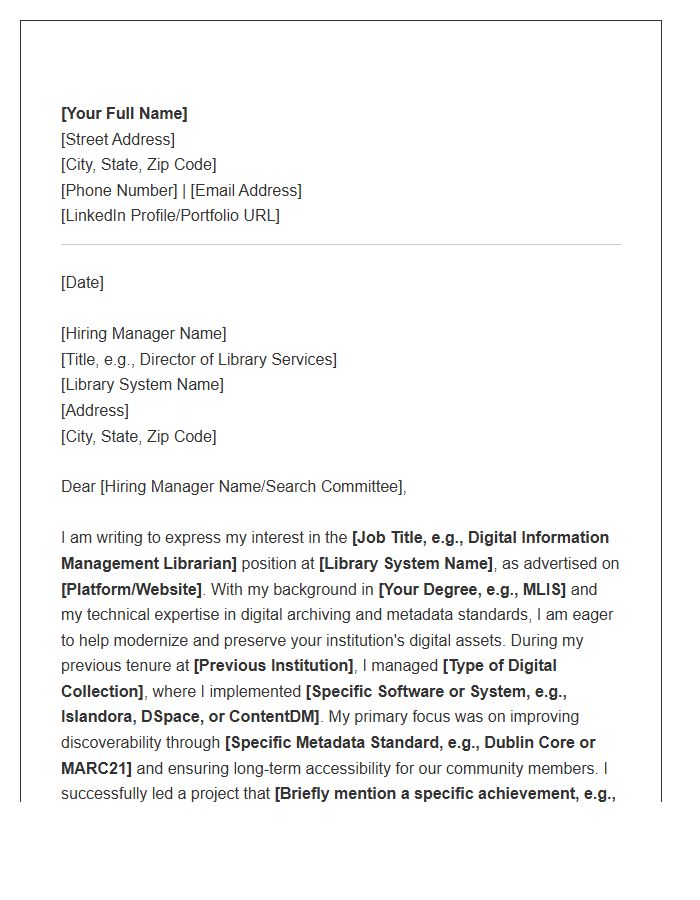
This Public Librarian Digital Information Management Cover Letter Template is a strategic tool designed to showcase your ability to bridge traditional literacy with modern technology. It works by emphasizing your proficiency in Digital Curation-the selection and preservation of digital assets-and Metadata Standards, which are the structured data schemas like Dublin Core used to make items searchable. The template uses a conversational yet professional tone to highlight your impact, such as improving Discoverability (how easily users find info) or managing Digital Equity initiatives. By quantifying achievements, like digitizing thousands of records, you provide the data-driven proof hiring managers crave. This structure works because it addresses the specific "pain points" of modern libraries: accessibility and long-term data integrity. Note: Always customize the placeholder bracketed text with specific software names like DSpace or ContentDM to pass through automated resume filters successfully.
Cataloging Specialist Digital Asset Curator Cover Letter Template
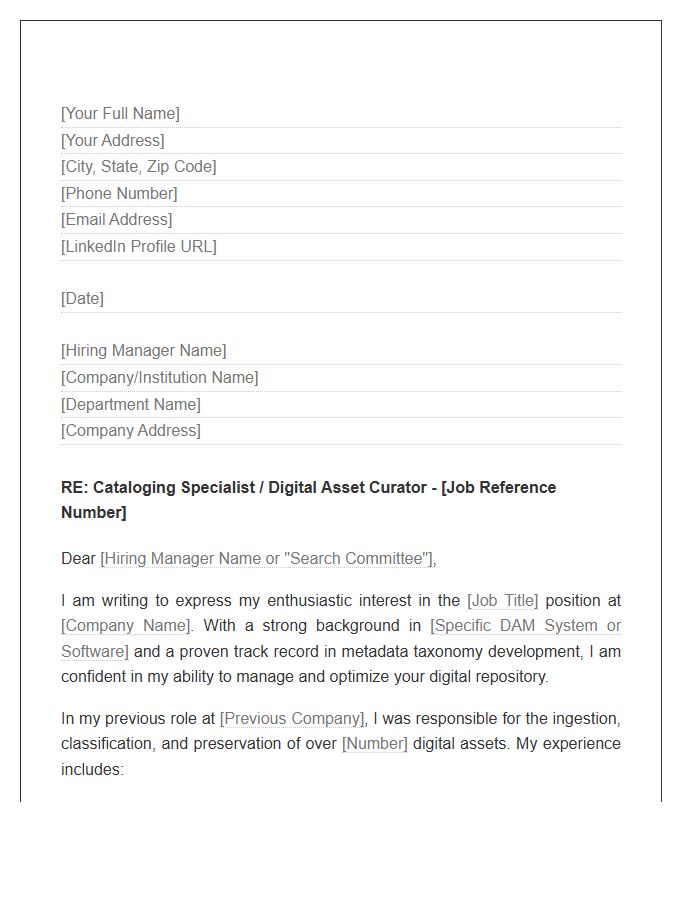
This Cataloging Specialist Digital Asset Curator Cover Letter Template is designed to help you stand out in the data-heavy world of information management. It works by bridging the gap between technical metadata-the structural data used to describe and locate assets-and the practical business goal of efficient ingestion, which is the process of importing and organizing new content into a system. By using a conversational yet professional tone, the template allows you to showcase your proficiency in DAM (Digital Asset Management) software while highlighting measurable achievements, such as the total volume of files managed. This structure is effective because it proves you can handle complex taxonomies-hierarchical classification systems-to improve searchability for the entire organization. It transforms a list of skills into a narrative of digital preservation and efficiency. Note: Always customize the specific metadata standards mentioned, such as Dublin Core, to match the exact requirements listed in the job description.
Library Operations Professional Digital Content Management Cover Letter Template
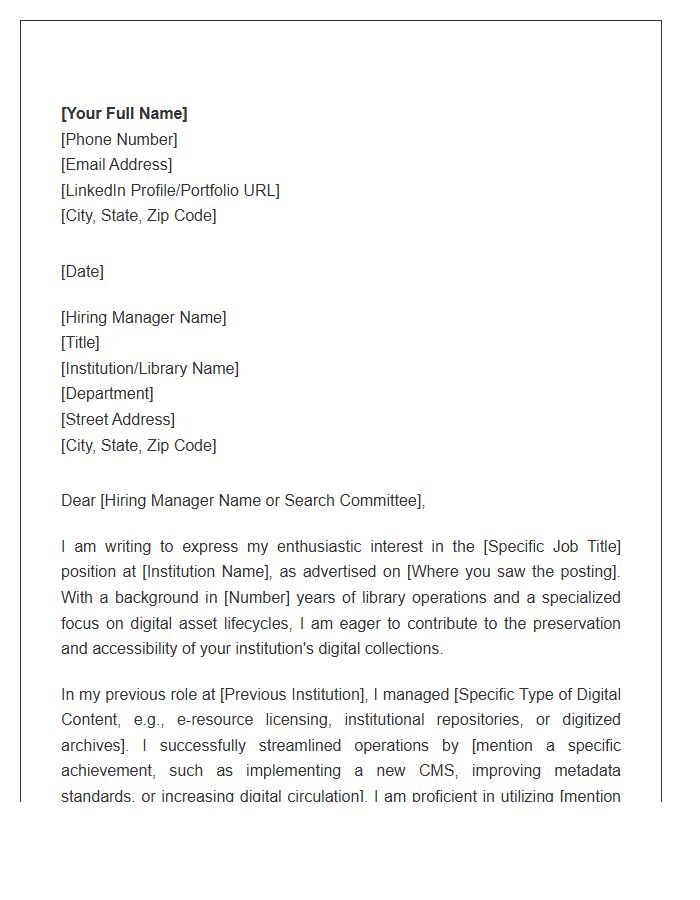
This Library Operations Professional Digital Content Management template is designed to bridge the gap between traditional librarianship and modern Information Architecture. It works by emphasizing your ability to handle Digital Asset Lifecycles-the process of managing data from creation to preservation. By highlighting specific metrics, such as a 20% increase in digital circulation or mastery of Metadata Standards (like Dublin Core), the template proves your technical ROI to hiring committees. It focuses on Digital Stewardship, ensuring that institutional knowledge remains accessible and secure. This structure is effective because it showcases proficiency in CMS tools and Data Integrity, which are critical for modern repositories. Whether you are managing e-resource licensing or complex digitized archives, this conversational yet professional format demonstrates you can handle the scale of modern information growth. Note: Always quantify your achievements with data to prove your operational impact on the library's workflow.
Strategic Taxonomy and Metadata Schema Architecture
Modern Digital Content Management (DCM) necessitates a robust application of descriptive, administrative, and structural metadata to ensure discoverability and interoperability across federated repositories.
- Dublin Core (DC): Implementing standardized properties for cross-domain resource description.
- MODS (Metadata Object Description Schema): Leveraging XML-based schema for complex bibliographic data mapping.
- LCSH Integration: Harmonizing Library of Congress Subject Headings within digital asset management systems (DAMS).
- OAI-PMH: Utilizing the Open Archives Initiative Protocol for Metadata Harvesting to facilitate data exchange.
Technical Competency in Digital Preservation Frameworks
Ensuring the long-term integrity of digital objects requires adherence to the OAIS (Open Archival Information System) reference model and the mitigation of bit rot through rigorous checksum verification.
| Standard/Tool | Functional Application | Data Integrity Metric |
|---|---|---|
| PREMIS | Preservation Metadata implementation | Provenance Tracking |
| BagIt | Hierarchical file packaging | Manifest Validation |
| Fixity Checks | MD5/SHA-256 Algorithm execution | Bit-level Consistency |
Digital Repository Workflow Orchestration
The lifecycle of digital content-from ingestion to dissemination-follows a serialized progression designed to maintain data provenance and intellectual control.
- Pre-Ingest Appraisal: Evaluating file formats (e.g., PDF/A, TIFF, WAV) for preservation sustainability.
- SIP to AIP Transformation: Converting Submission Information Packages into Archival Information Packages.
- Access Control Logic: Defining CRUD (Create, Read, Update, Delete) permissions based on institutional governance.
Advanced Query Syntax and Information Retrieval
To optimize user experience within a Digital Content Management system, a librarian must master complex retrieval languages and Boolean logic to filter high-volume datasets.
- SPARQL: Executing queries across RDF (Resource Description Framework) triple stores.
- RegEx (Regular Expressions): Utilizing pattern matching for large-scale metadata cleanup and batch editing.
- Elasticsearch/Solr: Configuring faceted search parameters to refine result sets via indexed attributes.
Ethical Data Governance and Rights Expression
Managing digital content involves navigating the complexities of Creative Commons (CC) licensing, Digital Rights Management (DRM), and GDPR compliance for sensitive datasets.
| Regulatory Term | Impact on DCM | Librarian Responsibility |
|---|---|---|
| Right to Erasure | Data Privacy Compliance | Permanent De-indexing of PII |
| Orphan Works | Copyright Uncertainty | Due Diligence Documentation |
| Interoperability | Silo Mitigation | API Integration Management |
Note: Sometimes the .PDF file interface can be slightly different from the image preview. Our apology for this inconvenience.
Comments