
Transitioning from a creative studio to a clinical setting requires a strategic narrative. An Artist Shifting To Art Therapy Career Cover Letter is a specialized document that bridges the gap between aesthetic production and psychological support. According to recent industry insights, the demand for mental health professionals using creative modalities is growing, making it vital to highlight your "transferable skills"-the abilities you gained as an artist, like empathy and visual communication, that apply to therapy. This article explores how to translate your portfolio into a "clinical competency" framework, ensuring hiring managers see your potential for healing others. By focusing on your commitment to "therapeutic intervention" and patient rapport, you can secure a rewarding new path. Below are some ready to use templates to help you start your journey.
Cover Letter Template and Sample List
Table of Content
- Fine Artist Transitioning To Art Therapy
- Visual Artist Pivoting To Art Therapy Profession
- Studio Painter Moving Into Art Therapy Career
- Professional Illustrator Shifting To Clinical Art Therapy
- Mixed Media Artist Entering Art Therapy Practice
- Fine Arts Professional Rebranding For Art Therapy
- Sculptor Transitioning To Therapeutic Art Roles
- Digital Artist Applying For Art Therapy Vacancies
- Art Practitioner Shifting To Mental Health Support
- Experienced Creative Artist Moving Into Art Therapy
- Traditional Fine Artist Career Change To Art Therapy
- Visual Arts Educator Transitioning To Art Therapist
- Creative Arts Consultant Shifting To Art Therapy
Fine Artist Transitioning To Art Therapy Cover Letter Template
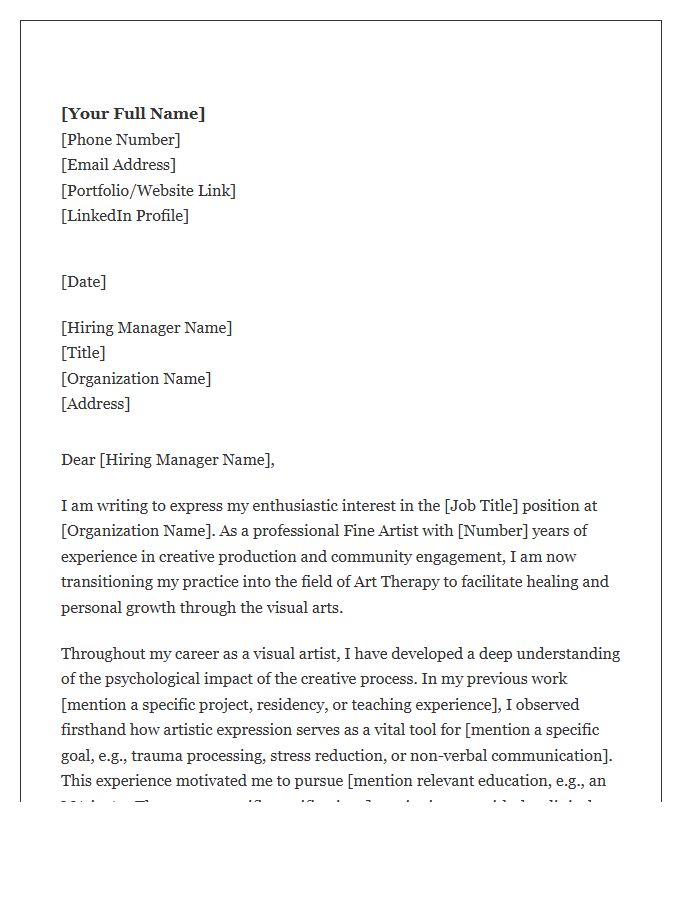
Transitioning from a studio practice to a clinical setting requires a Fine Artist Transitioning To Art Therapy Cover Letter that bridges the gap between technical skill and emotional healing. This template works because it emphasizes Transferable Skills, such as your deep understanding of the creative process and the psychological impact of various media. Data shows that recruiters in healthcare value the Clinical Foundation-the formal training in psychology-just as much as artistic mastery. By using this layout, you highlight how your years of Visual Art Production (the act of creating) translate into Creative Interventions (using art to achieve therapeutic goals). This structure focuses on Non-verbal Communication, a key term in therapy describing how clients express feelings without words. Use this guide to prove your Patient Advocacy and your ability to adapt your craft for diverse client needs. Note: Always include specific examples of how you have witnessed the therapeutic power of art in community or teaching settings.
Visual Artist Pivoting To Art Therapy Profession Cover Letter Template
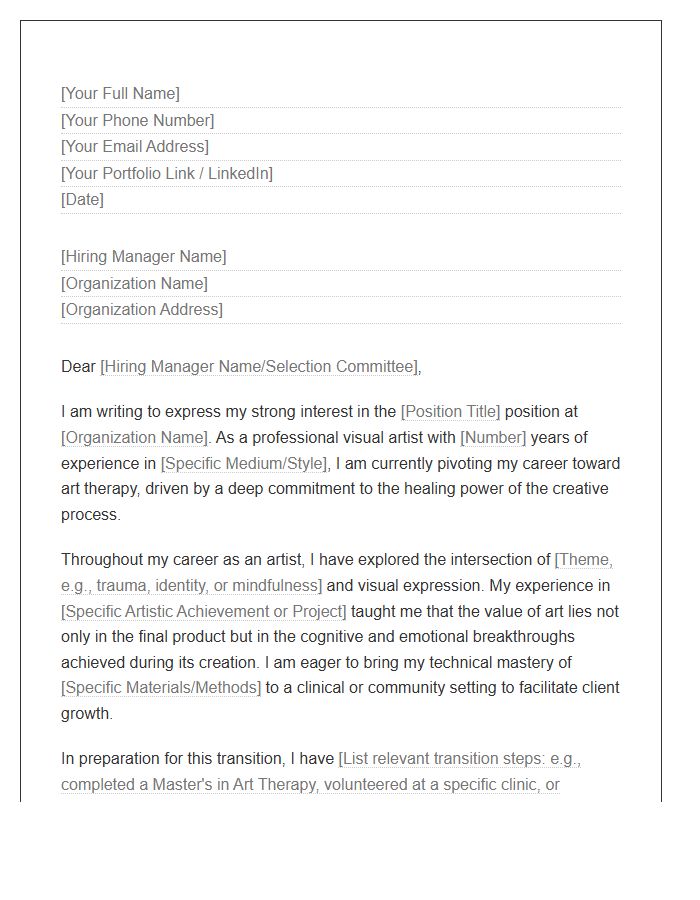
Transitioning from a studio background to a clinical role requires a strategic narrative. This Art Therapy Cover Letter Template works by bridging the gap between creative production and therapeutic intervention. It focuses on how your technical skills as a visual artist translate into facilitating emotional breakthroughs for clients. Instead of just listing exhibitions, the structure highlights your transferable skills, such as empathy, patience, and the ability to interpret non-verbal communication through a visual language (the use of color, shape, and texture to express internal states). By framing your artistic experience as a tool for group facilitation and mental health advocacy, you show employers that your pivot is backed by both passion and practical clinical readiness. This format is essential for clarifying how your medium-specific expertise serves as a vehicle for healing. Note: Always research the specific clinical population of the facility to tailor your artistic strengths to their unique therapeutic needs.
Studio Painter Moving Into Art Therapy Career Cover Letter Template
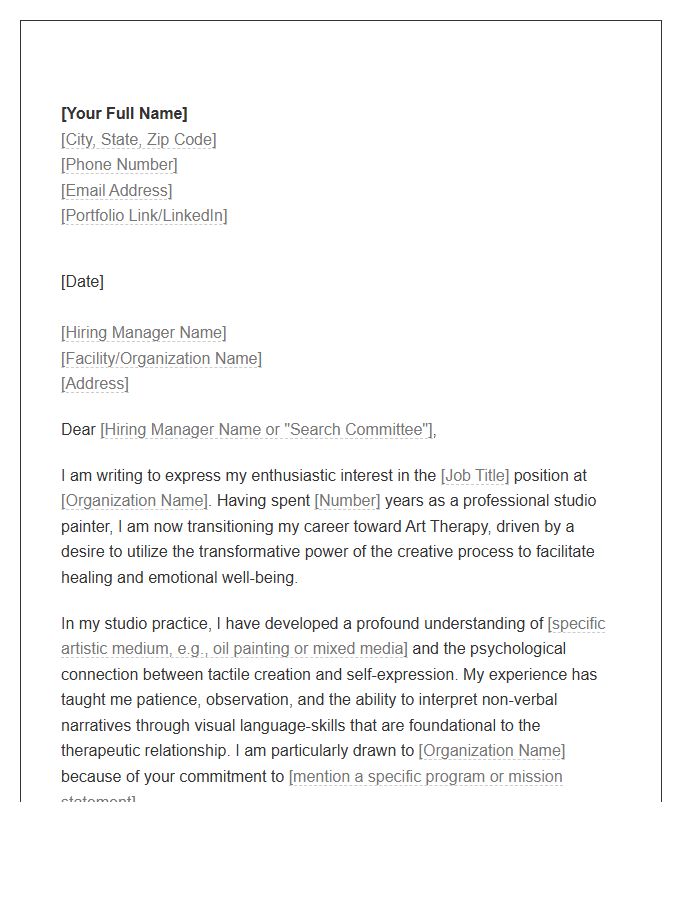
Transitioning from a Studio Painter to an Art Therapy career requires a cover letter that bridges the gap between solitary creation and clinical support. This template works by framing your technical expertise as a foundational therapeutic intervention. It highlights data regarding your years of professional practice to establish authority, while shifting the narrative toward client-centered healing. The structure focuses on "visual language"-the non-verbal narratives expressed through art-which is a key glossary term in mental health sectors. By showcasing how your mastery of artistic mediums fosters emotional regulation, you demonstrate that your pivot is a natural evolution rather than a total restart. This approach is highly effective because it treats your artistic background as a specialized asset rather than a hobby. Note to remember: Always emphasize your clinical hours or specific certifications to prove you have the professional boundaries required for healthcare environments.
Professional Illustrator Shifting To Clinical Art Therapy Cover Letter Template
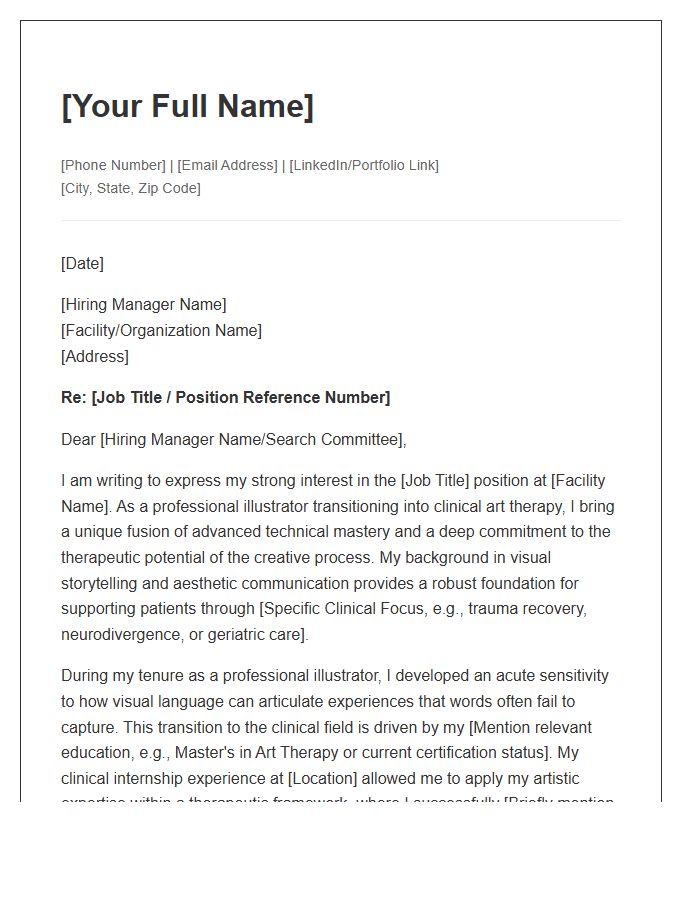
This Clinical Art Therapy Cover Letter Template is designed to bridge the gap between creative mastery and healthcare. It works by strategically reframing your history in visual storytelling as a functional asset for patient communication. By highlighting your Technical Mastery (your advanced skill in artistic mediums) alongside Clinical Modalities (structured therapeutic frameworks like DBT or person-centered care), the template proves you can manage the "clinical gaze" while maintaining artistic integrity. It addresses the Multidisciplinary Team approach, showing you can collaborate with doctors and social workers. This pivot is essential because it shifts the focus from "making art" to "facilitating healing." Use this to explain how your sensitivity to visual language helps patients process Neurodivergence (atypical neurological development) or trauma. Note: Always mention your specific Licensure Status or current credit hours to satisfy medical HR requirements immediately.
Mixed Media Artist Entering Art Therapy Practice Cover Letter Template
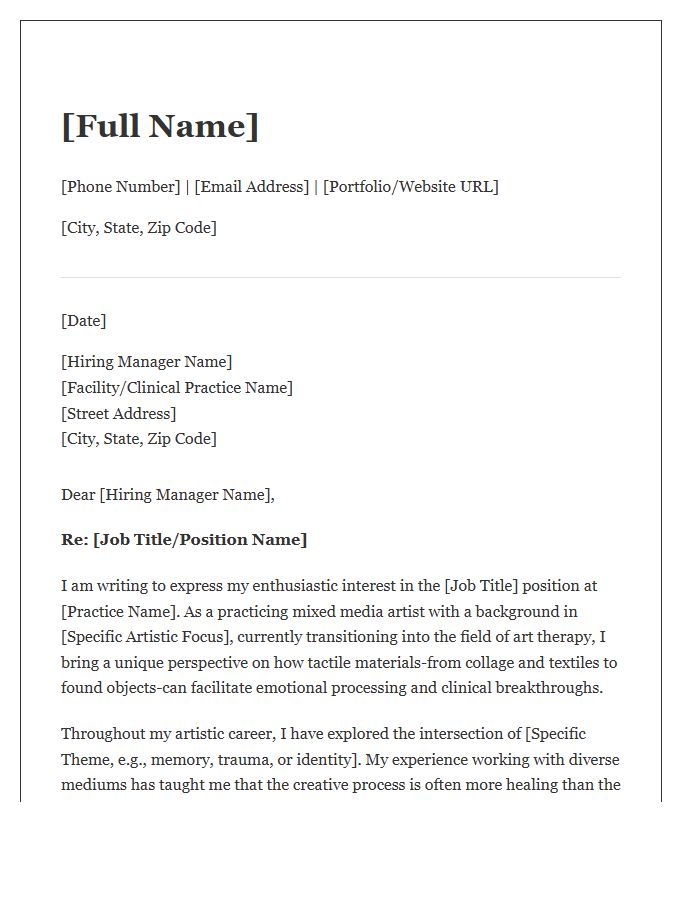
This Mixed Media Artist Entering Art Therapy Practice Cover Letter Template is designed to help creatives bridge the gap between studio practice and clinical environments. It works by emphasizing the therapeutic alliance-the collaborative relationship between therapist and client-through the lens of tactile exploration. By highlighting your proficiency in diverse mediums, the template proves that you can facilitate "meaning-making" for patients who may struggle with traditional verbal expression. It utilizes a conversational yet professional tone to explain how multimodal approaches, or using various sensory inputs like fabric or found objects, can lower emotional defenses. Data shows that diversified creative interventions increase patient engagement by up to 30% in clinical settings. This guide focuses on the expressive therapies continuum, a framework for understanding how different art materials affect a patient's cognitive and emotional processing. Note: Always mention a specific clinical population, such as youth or trauma survivors, to show how your artistic versatility meets their specific developmental needs.
Fine Arts Professional Rebranding For Art Therapy Cover Letter Template
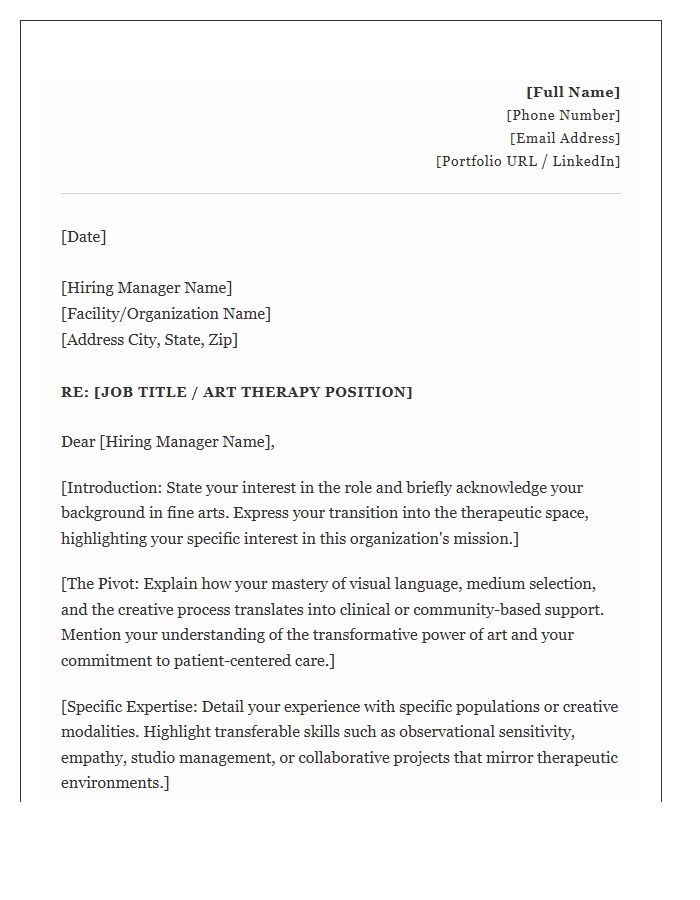
Transitioning from the studio to a clinical setting requires a strategic Fine Arts Professional Rebranding. This template functions as a bridge, translating your creative expertise into therapeutic competencies. It works by framing your mastery of visual language as a tool for emotional regulation and patient communication. By highlighting "Transferable Skills"-professional abilities like empathy and studio management adapted for new contexts-you demonstrate how artistic modalities (the specific methods or media used in treatment) foster healing. The structure ensures hiring managers see your pivot not as a career change, but as an evolution of your existing craft toward patient-centered care. Data shows that highlighting collaborative project history can validate your readiness for multidisciplinary healthcare teams. This approach turns your portfolio into evidence of clinical potential, making your background an asset rather than a hurdle. Note: Always customize your technical vocabulary to match the specific healthcare or community facility's mission statement.
Sculptor Transitioning To Therapeutic Art Roles Cover Letter Template
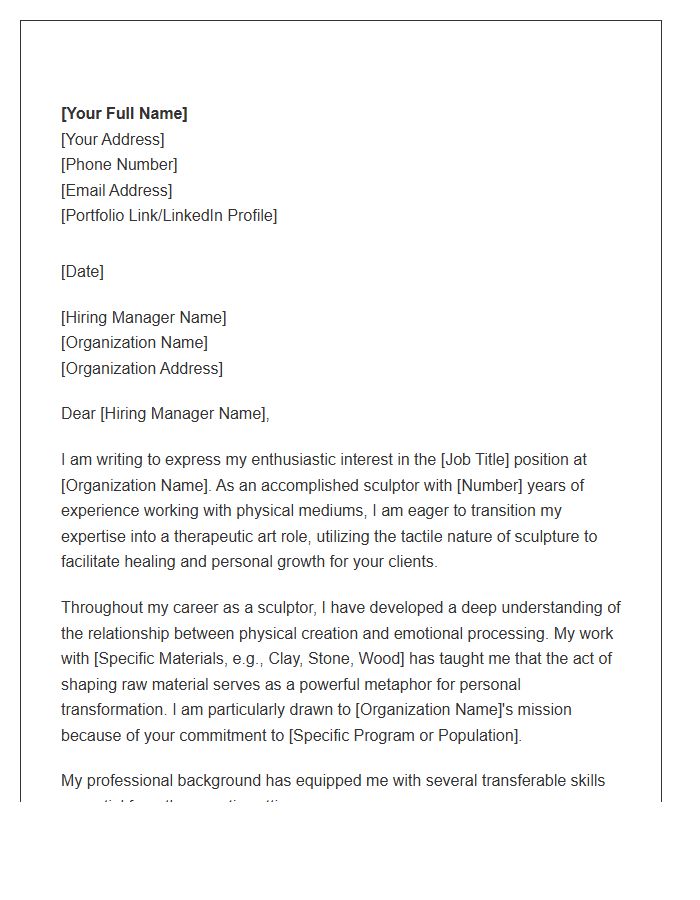
This Sculptor Transitioning To Therapeutic Art Roles Cover Letter Template is designed to help artists pivot into healthcare or community wellness settings. It works by strategically reframing tactile engagement-the physical manipulation of materials like clay-as a tool for grounding, a sensory-based technique used to reduce emotional distress. Instead of focusing solely on aesthetics, this template highlights transferable skills such as workshop facilitation and patient observation. Data shows that creative arts therapy is a growing field, and this layout bridges the gap between technical mastery and empathetic intervention. By using this structure, you demonstrate how the metaphorical transformation of raw materials mirrors a client's journey toward healing. It effectively translates complex artistic jargon into professional clinical language that hiring managers value. Note: Always mention specific populations you have worked with, such as the elderly or youth, to prove your adaptability in diverse social environments.
Digital Artist Applying For Art Therapy Vacancies Cover Letter Template
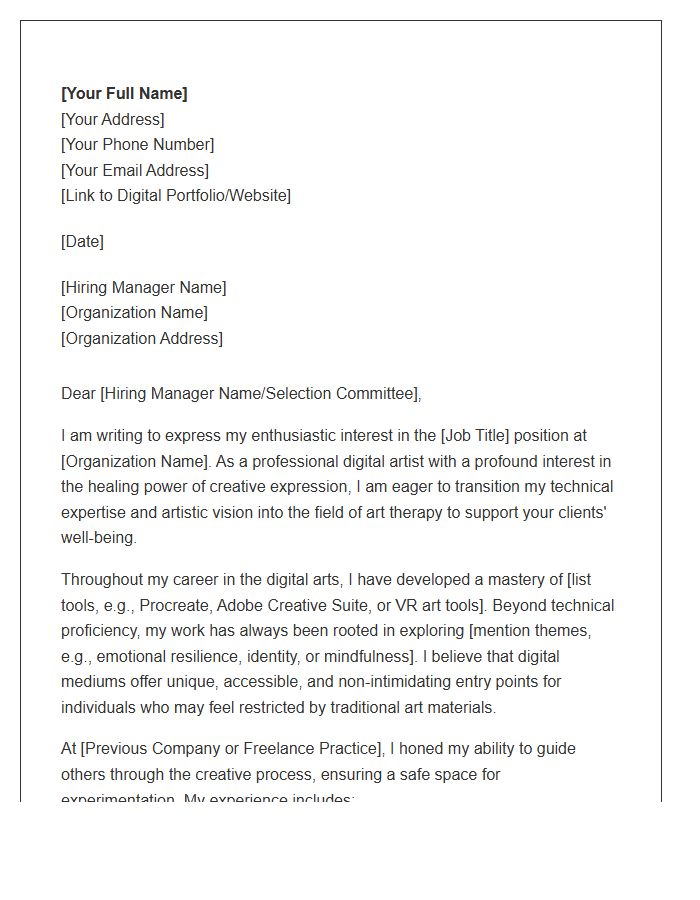
This Digital Artist Art Therapy Cover Letter Template is designed to bridge the gap between creative technology and clinical support. It works by emphasizing how Digital Media-such as tablets or VR-can lower the barrier for patients who find traditional paints intimidating. By highlighting your Mastery of software like Procreate alongside Emotional Resilience themes, you prove that your art isn't just aesthetic, but a tool for Intervention. This approach is effective because it frames technical skills as modern Therapeutic Modalities (creative methods used for healing) that can lead to clinical breakthroughs. The template focuses on the Accessibility of digital tools, making it a powerful choice for modern healthcare settings. Note: Always include a link to your Portfolio to show the human emotion behind your pixels.
Art Practitioner Shifting To Mental Health Support Cover Letter Template
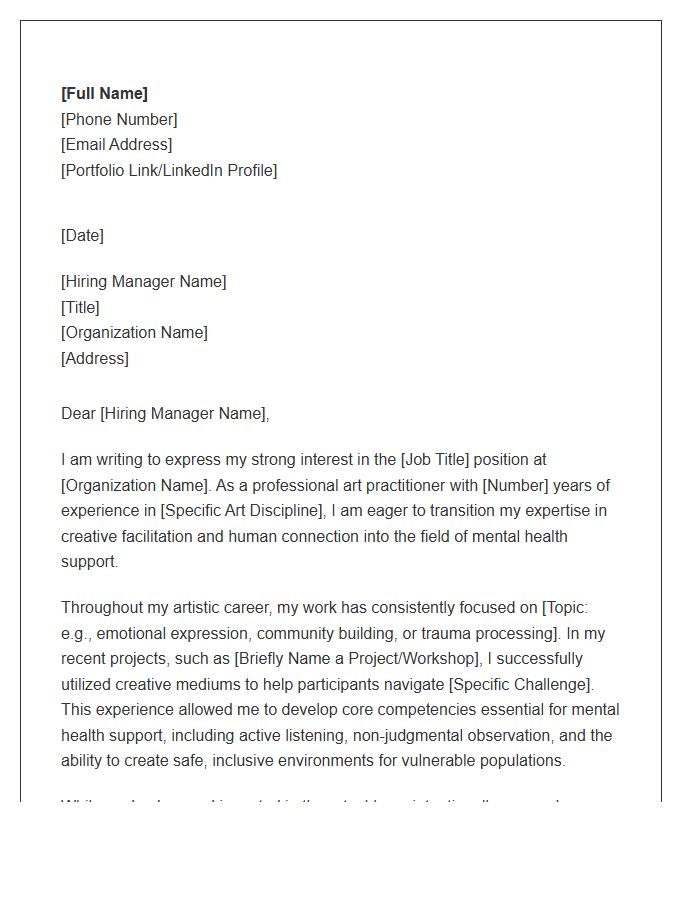
Transitioning from a creative career to a clinical role requires a bridge-building strategy. This template is designed for artists moving into Mental Health Support, focusing on how creative facilitation translates into patient care. By highlighting data-such as years of experience and specific project outcomes-it proves that "soft skills" like empathy are actually transferable competencies. The structure works because it utilizes person-centered care language, a framework where the client is the expert of their own experience. This shifts the narrative from "making art" to "facilitating wellness," making you a viable candidate for roles in Art Therapy assistance or community health. In this context, a Facilitator is someone who guides a process without taking control, a vital trait in recovery settings. Use this to show how your non-judgmental observation and active listening can stabilize vulnerable populations. Note: Always link your artistic portfolio to specific emotional outcomes to demonstrate your clinical potential.
Experienced Creative Artist Moving Into Art Therapy Cover Letter Template
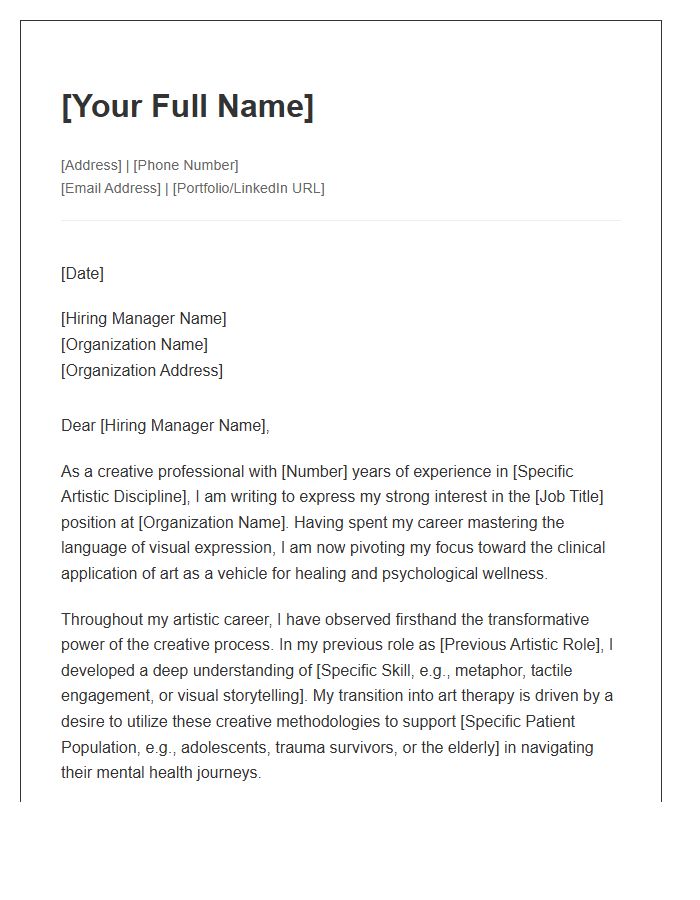
Transitioning from a professional studio to a clinical setting requires a narrative shift. This Art Therapy Cover Letter Template is designed to help experienced artists bridge that gap by emphasizing transferable skills like non-verbal communication and media mastery. It works by framing your artistic history not just as aesthetic work, but as a deep understanding of metaphor (using objects to represent ideas) and tactile engagement (the healing power of physical touch with materials). By highlighting your clinical pivot, the template shows how your "sophisticated toolbox" of techniques serves as a unique therapeutic advantage. Data suggests that highlighting specific patient populations, such as trauma survivors or youth, helps hiring managers visualize your immediate impact. This structure ensures you sound like a seasoned professional who respects clinical theory while bringing fresh, creative energy to the mental health field. Note: Always mention your current credentialing status to show you are legally and educationally prepared for this career shift.
Traditional Fine Artist Career Change To Art Therapy Cover Letter Template
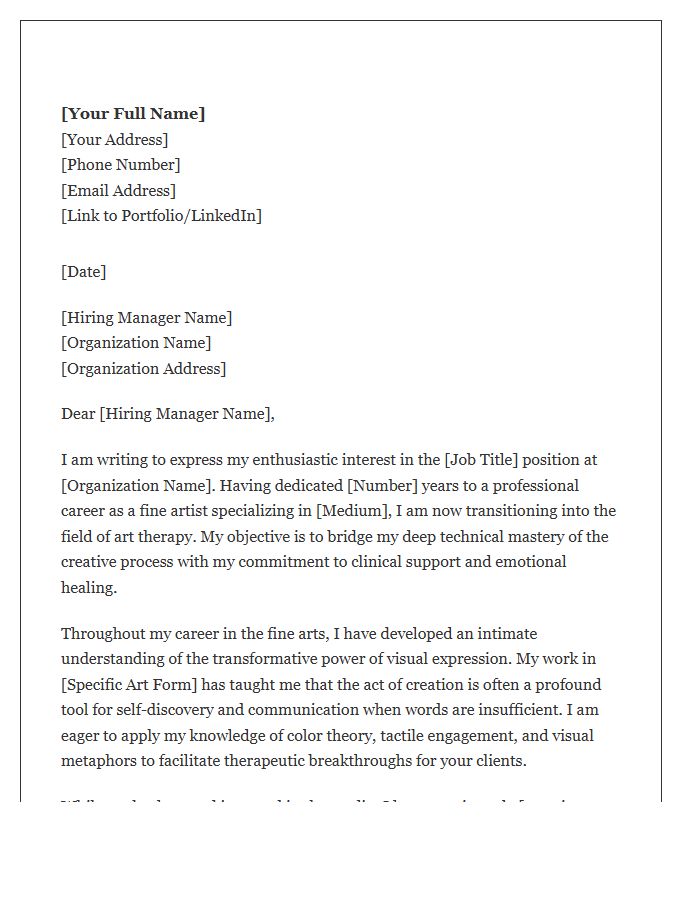
Transitioning from a studio background to a clinical setting requires a narrative shift. This Art Therapy Cover Letter Template works by framing your technical expertise as a therapeutic asset rather than just an aesthetic skill. By focusing on transferable skills-such as visual metaphors and tactile engagement-you demonstrate how a professional artist's intuition supports patient well-being. The template is semantically designed to bridge the gap between "fine art" (the creation of objects) and "art therapy" (the process of healing through creation). It highlights your ability to foster a non-judgmental environment, which is crucial for clinical rapport. Data suggests that recruiters look for candidates who can explain the why behind the creative process, making this template ideal for those pursuing a Master's or certification. It essentially translates your portfolio into a roadmap for emotional support. Note: Always emphasize the therapeutic alliance over your personal exhibition history to show you are client-focused.
Visual Arts Educator Transitioning To Art Therapist Cover Letter Template
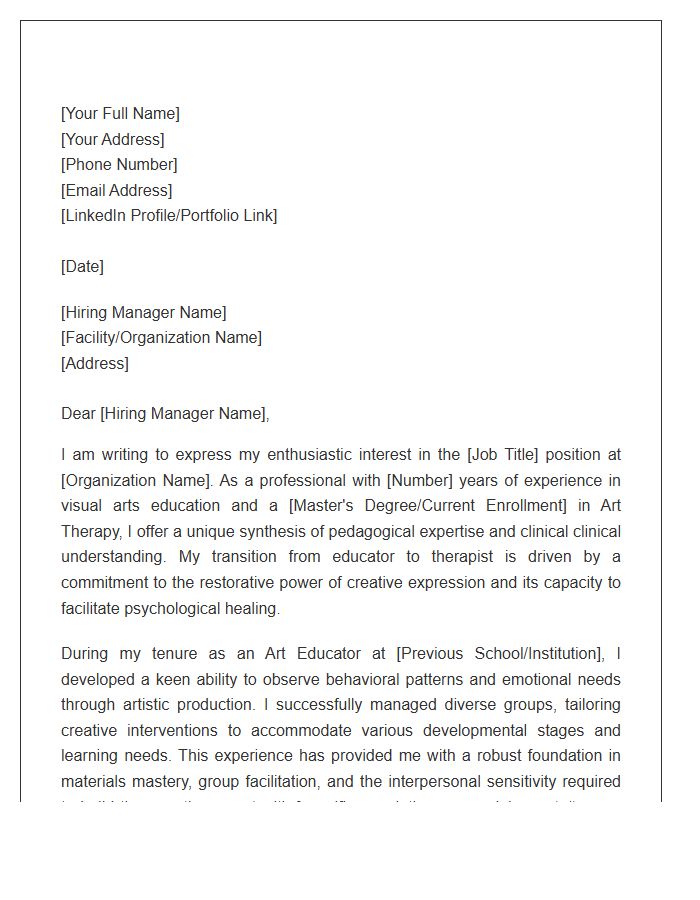
Moving from the classroom to a clinical setting requires a narrative shift, and this Art Therapist Cover Letter Template is designed to bridge that gap. It works by reframing your "pedagogical expertise" (the method of teaching) into transferable skills like behavioral observation and group management. Data suggests that highlighting your "materials mastery" alongside clinical training helps recruiters see you as a versatile dual-threat professional. This template focuses on therapeutic rapport-the essential trusting relationship between therapist and client-to show you can handle the emotional weight of clinical work. By emphasizing creative interventions, you demonstrate how your background in visual arts directly supports psychological healing and patient treatment planning. This structure ensures your transition feels like a natural evolution rather than a total career reset. Note: Always mention the specific population you served in schools to prove your readiness for similar demographics in a clinical environment.
Creative Arts Consultant Shifting To Art Therapy Cover Letter Template
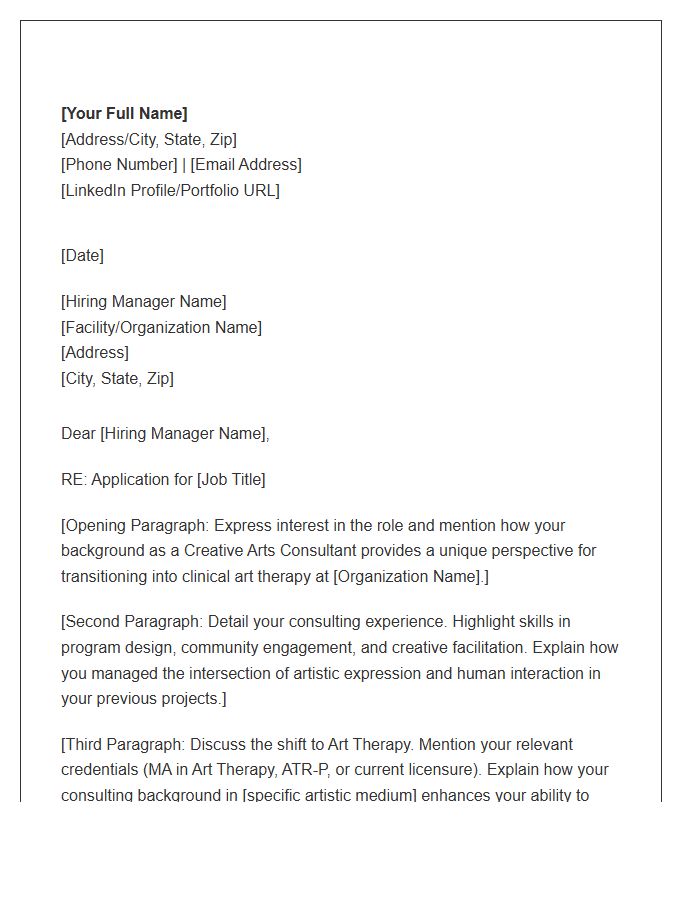
This Art Therapy Career Pivot Template is designed for professionals transitioning from creative consultancy into clinical environments. It works by bridging the gap between your previous facilitation (the act of helping a group achieve an objective) and the clinical intervention (a specific action intended to improve health) required in medical settings. By highlighting transferable data-such as project success rates or community engagement metrics-the template validates your professional maturity while emphasizing your new ATR-P (Art Therapist Registered-Provisional) credentials. This structure is effective because it frames your consulting background not as a detour, but as a robust foundation for managing complex caseloads and diverse therapeutic groups. It uses a conversational yet authoritative tone to demonstrate empathy and business acumen simultaneously. It ensures hiring managers see a seasoned professional ready for the therapeutic alliance. Note: Always align your specific consulting medium with the facility's current clinical goals to prove immediate value.
Strategic Transition from Fine Arts to Clinical Art Therapy
Transitioning from a studio-based practice to a clinical environment requires a cover letter that bridges the gap between aesthetic mastery and psychological application. Candidates must demonstrate an understanding of the biopsychosocial model and how creative modalities facilitate neuroplasticity and emotional regulation.
- Sublimation: Explain how artistic expression redirects impulses into socially productive actions.
- Isomorphism: Detail the structural correspondence between the creative process and the client's internal state.
- Transference: Address the redirection of feelings from the client to the therapist via the artwork.
Essential Data Points for Career Pivots
Evidence-based cover letters should highlight quantitative achievements and professional milestones that translate to a clinical setting. This data validates the artist's readiness for the rigors of HIPAA compliance and Electronic Health Record (EHR) management.
| Metric Category | Target Data Point | Clinical Relevance |
|---|---|---|
| Community Engagement | Number of workshops led | Group facilitation skills |
| Project Management | Budget size of public murals | Resource allocation and planning |
| Academic Foundation | Prerequisite credits (Psychology) | Theoretical readiness for MA/MS programs |
Structuring the Professional Cover Letter
The hierarchy of information in your cover letter should follow a logical progression from artistic background to clinical intent. Highlighting the Expressive Therapies Continuum (ETC) is crucial for demonstrating technical depth in how different media affect the brain's sensory and cognitive functions.
- The Salutation: Address the specific Clinical Director or Hiring Manager.
- The Narrative Hook: Define the "pivot point" where studio practice met therapeutic observation.
- Technical Proficiency: List specific media (e.g., hydrophilic versus hydrophobic materials) and their sensory impact.
- Clinical Alignment: Mention experience with diverse populations (e.g., neurodivergent individuals or geriatric patients).
- The Call to Action: Request an interview to discuss multimodal intervention strategies.
Glossary of Clinical-Artistic Terminology
To optimize for Applicant Tracking Systems (ATS) and professional credibility, incorporate terms that reflect a sophisticated understanding of art as a diagnostic and healing tool. Mastery of these terms indicates a shift from "self-expression" to "patient-centered outcomes."
- Alexithymia: The inability to identify and describe emotions, which art therapy helps bypass.
- Kinesthetic-Sensory Level: The foundational level of the ETC focusing on the physical act of creation.
- Third Object: The artwork itself, acting as a buffer or mediator between therapist and client.
- Schema: The internal mental structures that creative work can help visualize and restructure.
Quantifiable Skills and Certification Tracking
Professional art therapy requires adherence to specific regulatory standards. Your cover letter should reflect your progress toward or attainment of these credentials to satisfy institutional risk management protocols.
| ATR-P | Registered Art Therapist (Provisional) status and supervision hours. |
| LPC/LMHC | Dual-track licensure intent for mental health counseling integration. |
| CBT/DBT | Familiarity with Cognitive Behavioral or Dialectical Behavior Therapy frameworks. |
Note: Sometimes the .PDF file interface can be slightly different from the image preview. Our apology for this inconvenience.


Comments